If your podcast is supposed to support a business, downloads matter.
But downloads are not ROI.
Neither is CPM.
Those numbers can tell you useful things about reach, distribution, and advertising inventory. What they cannot tell you by themselves is whether the podcast helped the right person understand your business, join your email list, make an inquiry, evaluate an offer, become a customer, stay a customer, or take another useful action.
That is the bigger podcast ROI question:
What useful value is the podcast creating relative to what it costs you to operate?
And to answer that responsibly, you need more than one number.
You need a measurement system.
What Does Podcast ROI Actually Mean?
Podcast ROI is the value created by your podcast compared with the money, time, and resources required to produce and operate it.
Revenue may be part of that value.
But depending on the job of the show, value may also include:
- qualified inquiries;
- email subscribers;
- product evaluation;
- customer education;
- assisted sales;
- useful business relationships;
- referrals;
- reusable content;
- authority;
- direct sales.
The important part is not pretending every one of those things is revenue.
It is identifying what the podcast was supposed to accomplish and measuring evidence that actually relates to that job.
CPM Isn’t Wrong. It Just Answers a Different Question.
CPM means cost per thousand impressions.
If your podcast business is primarily based on selling advertising inventory, CPM can be an important number.
It helps answer an advertising question.
But many podcasts are not primarily advertising businesses.
A local business may use a podcast to educate prospective customers.
A creator may use one to grow an owned audience.
An educator may use one to build authority and drive registrations.
A company may use one to educate customers or support a longer buying decision.
A nonprofit may use one to strengthen relationships around its mission.
In those cases, the podcast may still generate impressions. Those impressions just aren’t the complete job of the show.
That is the distinction.
Don’t throw away CPM because somebody told you it is a vanity metric. Use it when it answers the question you are actually asking.
If you want a deeper explanation of CPM, CPA, CPL, and other advertising terminology, see Decoding Podcast Monetization Terms.
Podcast ROI Starts With the Job of the Show
Before you choose metrics, answer this:
What useful job is this podcast supposed to perform?
That decision should come first.
Otherwise, almost any number can become the success metric of the week.
Downloads went up. Great.
A clip got views. Great.
Someone left a comment. Also great.
But did any of those things help the podcast perform the job you built it to perform?
A business-minded podcast might exist primarily to:
- generate qualified awareness;
- build authority around a subject;
- grow an email audience;
- educate prospective customers;
- support product evaluation;
- generate inquiries;
- strengthen customer relationships;
- create reusable content;
- develop valuable relationships;
- influence sales.
You do not need all of them.
In fact, trying to make the podcast do twelve jobs at the same time usually makes measurement harder.
Start with the primary job.
Then decide what evidence would indicate that the podcast is actually doing it.
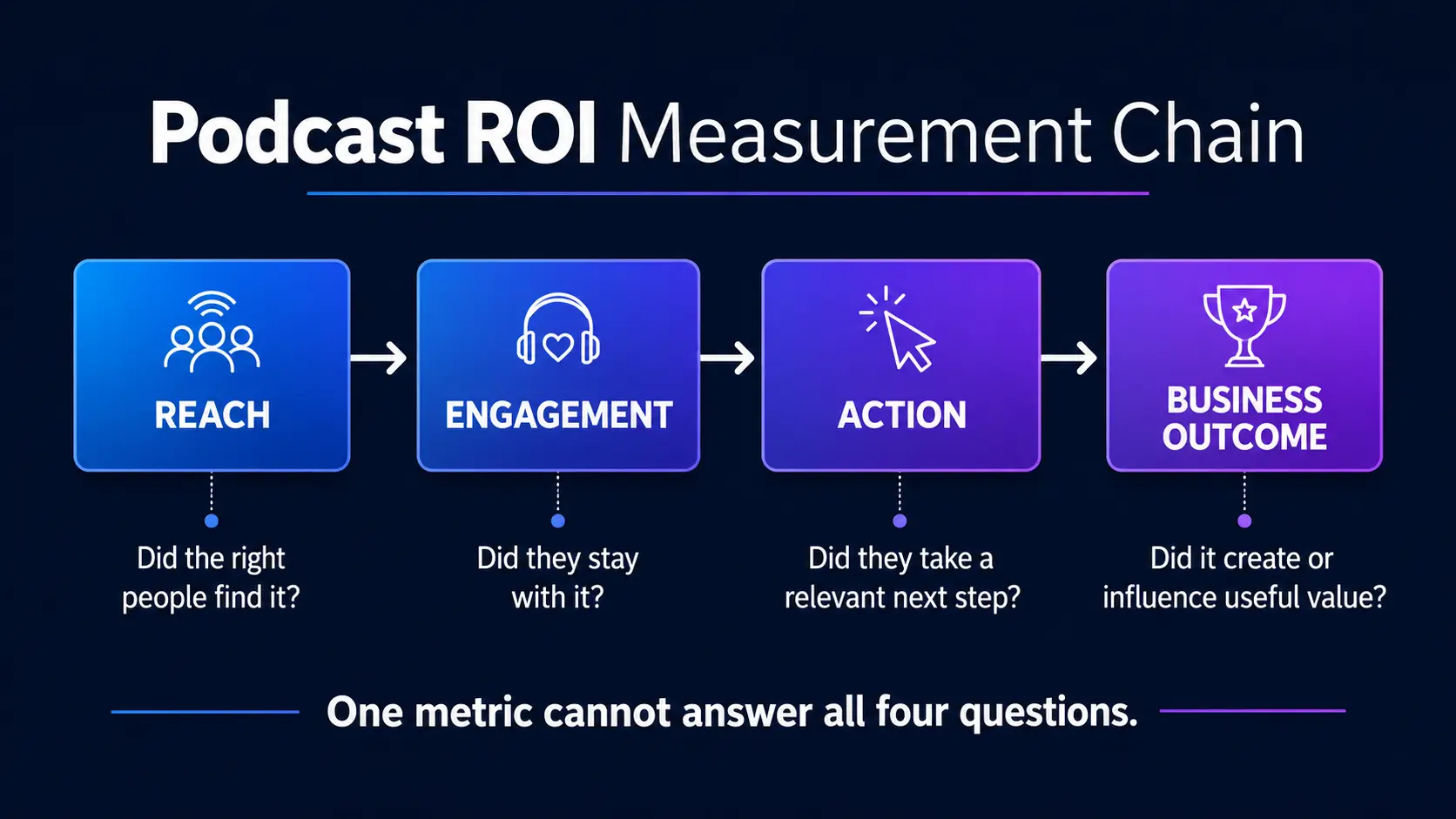
Use the Podcast Measurement Chain
A simple way to think about podcast performance is:
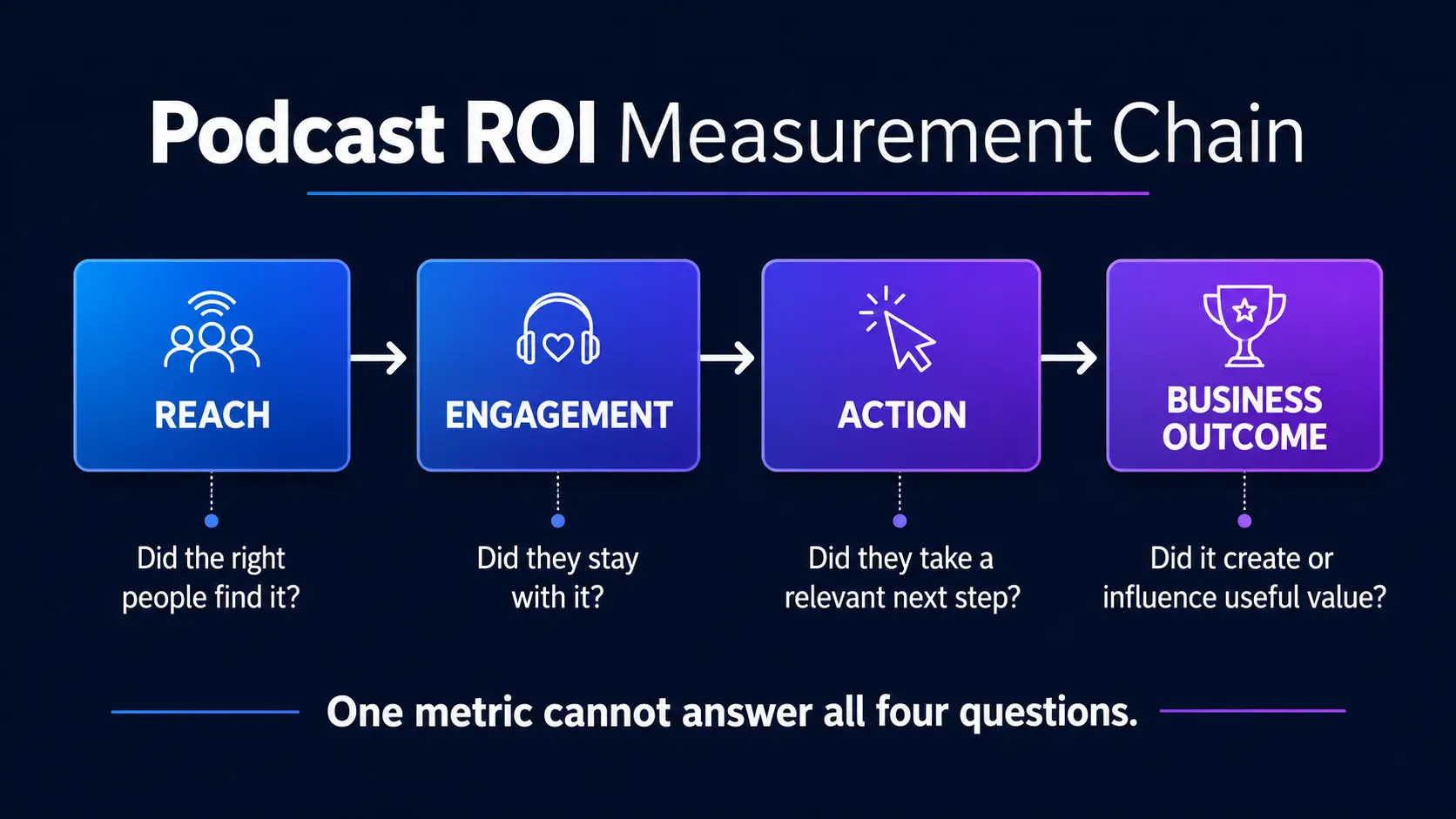
REACH → ENGAGEMENT → ACTION → BUSINESS OUTCOME
Each stage answers a different question.
Reach: Did the Right People Find It?
Reach includes things such as:
- downloads;
- video views;
- impressions;
- subscribers;
- search visibility;
- website visits from podcast content.
These numbers matter.
They tell you whether the content is being distributed and discovered.
What they do not automatically tell you is whether the podcast created a useful business result.
That is why downloads belong on the dashboard without becoming the entire dashboard.
If you want the deeper version of that distinction, read Why Podcast Downloads Don’t Prove Business Impact.
Engagement: Did They Stay With It?
Now ask whether people actually spent meaningful time with the content.
Depending on where you publish, you may look at signals such as:
- listening or viewing time;
- audience retention;
- episode completion patterns;
- repeat consumption;
- movement into related content;
- meaningful replies or comments.
Engagement gives you another layer of evidence.
But it still doesn’t prove a sale.
Someone can watch twenty minutes of an episode, think it was useful, and never take another action.
That does not make engagement meaningless.
It means engagement answers a different question.
Action: Did They Do Something Next?
This is where the podcast starts connecting more visibly to the rest of the business.
A useful action might be:
- downloading a resource;
- joining an email list;
- visiting an offer page;
- registering for an event or class;
- replying to an email;
- booking a conversation;
- sending an inquiry;
- requesting more information;
- purchasing a product.
The relevant action depends on the episode and the listener’s readiness.
That is also why one clear call to action is usually more useful than dumping six links into the outro and hoping the listener picks one.
If your episodes do not have a clear next step, this podcast CTA strategy explains how to connect the lesson to one relevant action.
Business Outcome: Did It Create or Influence Useful Value?
Now we get to the part most people mean when they ask about podcast ROI.
Did anything useful happen?
Maybe a listener became a customer.
Maybe the podcast influenced a customer who originally discovered you somewhere else.
Maybe an episode generated qualified inquiries.
Maybe the show became a useful customer-education resource.
Maybe one recording produced several assets your business continued using for months.
Those are different forms of value.
And they should not all be shoved into one giant number called “podcast revenue.”
Separate Three Types of Podcast Value
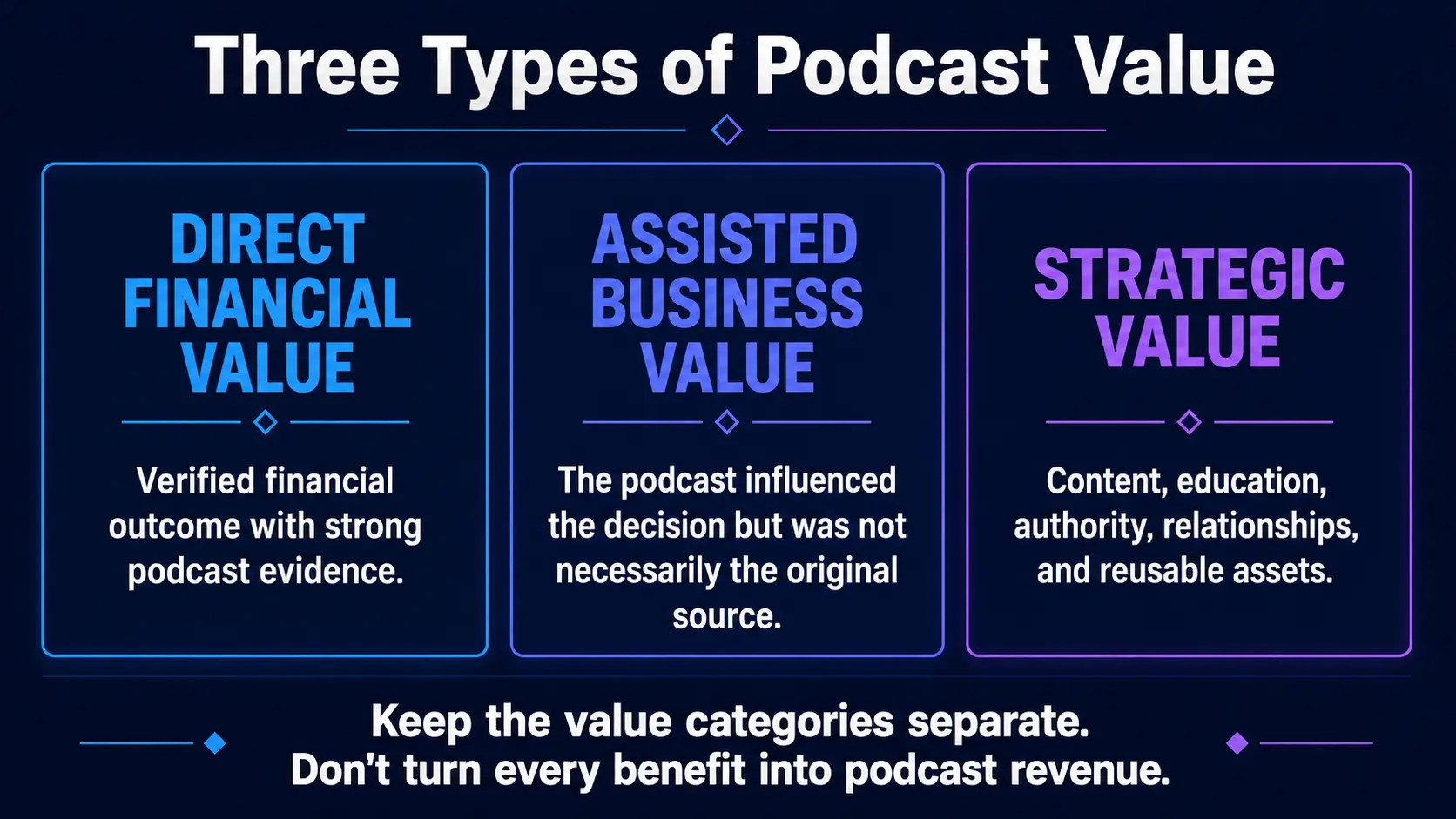
One of the easiest ways to make podcast ROI look better than reality is to assign financial value to everything.
I prefer separating the evidence.
1. Direct Financial Value
Direct financial value is the cleanest category.
You have a financial outcome and enough evidence to connect that result directly to the podcast with reasonable confidence.
That evidence might include a podcast-specific link, a form response, checkout data, a customer statement, CRM information, or another documented connection.
The standard should be simple:
If you are going to call it direct podcast revenue, you should be able to explain why.
2. Assisted Business Value
This is where attribution becomes more realistic.
Imagine somebody originally discovers your company through Google.
Later, they listen to four podcast episodes.
They join your email list.
Three weeks later, they contact you and specifically say the podcast helped them understand your approach.
Was the podcast the original source?
No.
Did it influence the decision?
Very possibly.
That belongs in your measurement system.
It just should not be reported the same way as a clean direct conversion.
3. Strategic Value
Some podcast value is useful without being direct revenue at all.
For example:
- one recording creates several reusable content assets;
- an episode becomes a resource your team can send to customers;
- the host builds authority around an important subject;
- a guest conversation develops into a useful relationship;
- an episode answers a recurring customer question;
- your archive becomes a searchable library of useful ideas.
Those things can matter.
Document them.
Just resist the temptation to invent a dollar value because the spreadsheet looks more impressive that way.
ROI and Attribution Are Not the Same Thing
This distinction matters.
ROI asks whether the return justifies the investment.
Attribution asks how confidently you can connect an outcome to the podcast.
You need both.
Suppose someone becomes a customer after listening to the podcast.
That alone does not tell you:
- where the person originally discovered you;
- whether the podcast influenced the decision;
- which episode mattered;
- whether another channel played a larger role;
- how confident you should be in the connection.
A useful attribution system keeps the original source separate from podcast influence.
You might ask:
How did you first hear about us?
Then separately:
Did the podcast or a specific episode influence your decision to sign up, purchase, or contact us?
Those two questions tell you very different things.
And that difference protects you from two common mistakes:
Claiming too much podcast revenue.
Or assuming the podcast created no value because another channel received the original-source credit.
Give Your Attribution Evidence a Confidence Level
Not every podcast outcome will have equally strong evidence.
That is normal.
Instead of pretending the data is perfect, classify the confidence.
For example:
VERIFIED
You have strong documented evidence connecting the podcast and the outcome.
SUPPORTED
Several pieces of evidence indicate meaningful podcast influence.
DIRECTIONAL
There are useful signals, but the connection is incomplete.
UNKNOWN
You do not have enough evidence to make the claim.
This is much more useful than forcing every lead or sale into either “podcast” or “not podcast.”
Real customer journeys are usually messier than that.
Your measurement system should be able to admit it.
What Should You Track?
You do not need a forty-column analytics dashboard to begin.
Start with information that helps you answer the actual business question.
Useful fields can include:
- episode or topic;
- primary episode CTA;
- destination;
- tracked link or campaign;
- original acquisition source;
- podcast influence;
- specific episode mentioned;
- resulting action;
- business outcome;
- attribution classification;
- evidence confidence;
- direct production costs;
- internal labor hours.
You can add sophistication later.
The important part is collecting the same useful evidence consistently.
What Each Podcast Metric Actually Tells You
| Metric or signal | What it can help show | What it does not prove by itself |
|---|---|---|
| Downloads / reach | Distribution and audience activity | Engagement, leads, sales, or ROI |
| Retention / watch time | Whether people stayed with the content | Business impact |
| Resource download | Response to a specific CTA | A sale |
| Email signup | Movement into an owned audience | Revenue |
| Inquiry or booking | Stronger business intent | That the podcast caused it |
| Customer statement | Direct evidence of source or influence | Every other customer’s journey |
| Verified sale | Financial outcome | Podcast attribution unless the connection is documented |
The point is not to find the one perfect metric.
The point is to understand what each piece of evidence can and cannot tell you.
What Counts as the Investment?
ROI has another side people sometimes forget.
The investment.
Track what the podcast actually costs.
That may include:
- production services;
- editing;
- hosting;
- software;
- equipment allocated to the podcast;
- freelance or agency costs;
- paid distribution;
- internal labor.
For internal labor, track the actual hours first.
Do not invent a convenient hourly rate just to finish the calculation.
If your organization has an established method for assigning labor cost, use it consistently.
And make sure your return and your investment cover the same period and scope.
Comparing a year of revenue influence with one month of podcast expense does not give you a useful ROI number.
When Can You Calculate Direct Financial Podcast ROI?
Once you have:
- a verified financial return;
- a reasonably complete cost;
- a matching measurement period;
- enough attribution evidence;
you can calculate direct financial ROI.
The basic formula is:
Direct Financial ROI = (Verified Direct Financial Return − Podcast Investment) ÷ Podcast Investment
The important word is verified.
Assisted value and strategic value should still be documented.
They simply should not be quietly added to the direct-return number.
That separation gives you a more honest picture of what the podcast is doing.
Content Yield Belongs in the Value Conversation
A podcast is rarely just one media file anymore.
A well-planned recording can become:
- the complete audio episode;
- a YouTube video;
- context-complete clips;
- an article;
- an email;
- LinkedIn content;
- graphics;
- customer-education material;
- future episode ideas.
That is strategic value.
But there is an important catch.
Recording forty-five minutes of conversation and telling an editor to “find ten clips” does not automatically create a content engine.
Useful repurposing starts upstream.
The episode needs useful ideas.
Those ideas need enough context to stand on their own.
The production workflow needs to know what assets it is trying to create.
And the publishing system needs somewhere useful to send the audience afterward.
That is why podcast ROI is connected to production.
One decision at the beginning of the workflow can affect the value you are able to create all the way at the end.
If your production process is still being rebuilt every week, start with a repeatable podcast workflow.
A Simple Podcast ROI Example
Imagine a hypothetical local professional who publishes an educational podcast.
The show’s primary job is to build trust with prospective customers and generate qualified inquiries.
During the review period, the host sees:
- consistent reach among the intended audience;
- listeners downloading a related resource;
- new email subscribers who mention the podcast;
- several inquiries tied to specific episode topics;
- a customer who says the podcast influenced the decision;
- a useful library of videos, articles, emails, and clips created from the recordings.
Now the measurement conversation becomes useful.
Which outcomes have enough evidence to count as direct?
Which were assisted?
Which belong in the strategic-value ledger?
What did the show actually cost?
Where is the evidence strong?
Where is it still directional?
And what should change in the next production cycle?
That tells you far more than:
“We averaged 742 downloads.”
The download number can still stay on the report.
It just no longer has to carry the entire business case by itself.
Downloads Still Matter
None of this means downloads are useless.
Downloads can help you understand:
- reach;
- distribution activity;
- audience patterns;
- episode-to-episode changes;
- whether the show is growing or shrinking in consumption.
They are evidence.
They are simply evidence of a particular part of the system.
Think of downloads as one instrument on the dashboard.
You would not drive a car by staring only at the speedometer.
Your podcast should not be operated that way either.
The Real Podcast ROI Question
The useful question is not:
What number makes my podcast look successful?
It is:
What job is this show supposed to perform, what evidence would show that it is performing that job, and what value is being created relative to the investment?
That leads you into better questions:
Did the right people find it?
Did they stay?
Did they act?
Did anything useful happen?
Did the podcast cause or influence that outcome?
How strong is the evidence?
What did it cost?
What should we change next?
That is a podcast ROI system.
And it is much harder to build after fifty episodes than it is to design before you start measuring.
Build Measurement Into the Podcast System
Podcast ROI is not really a reporting problem.
It is usually an upstream design problem.
If the show has no defined business job, no clear listener, random episode topics, disconnected calls to action, no attribution questions, and no consistent measurement process, the spreadsheet at the end of the quarter cannot magically reconstruct all of that.
The measurement system has to connect to the podcast system.
That means the show’s strategy, audience, content, production, conversion path, ROI model, and attribution method need to work together.
That connected approach is what the Podcast Business System + Podcast Production OS is built to establish.
The Podcast Business System helps define what the show should do and how its business layers fit together.
The Podcast Production OS helps carry those decisions into the episodes and content you actually produce.
You do not need a bigger pile of podcast metrics.
You need the right evidence for the job your podcast is supposed to perform.
Frequently Asked Questions About Podcast ROI
What is podcast ROI?
Podcast ROI compares the useful value created by a podcast with the money, time, and resources invested in producing and operating it. For a business podcast, that value may include verified revenue as well as separately tracked assisted and strategic value.
Are podcast downloads a measure of ROI?
Downloads are primarily a reach and consumption indicator. They can be useful context for ROI analysis, but downloads alone do not prove engagement, listener action, sales, or business impact.
Is CPM a bad way to measure a podcast?
No. CPM is useful when you are evaluating or selling advertising inventory. It becomes incomplete when you use it as the universal measure of a podcast whose primary job is education, conversion, authority, customer support, relationships, or another business outcome.
Can a podcast create value without directly generating a sale?
Yes. A podcast can influence an eventual purchase, educate customers, create reusable content, build authority, generate inquiries, or strengthen relationships. Those outcomes should be documented according to what the evidence actually supports rather than automatically counted as direct podcast revenue.
How do you know whether a podcast influenced a customer?
Use several forms of evidence when possible, including tracked links, forms, checkout information, CRM notes, source questions, podcast-influence questions, and direct customer statements. Keep the person’s original acquisition source separate from later podcast influence.
If your podcast has never been built around a clear business job, listener pathway, ROI model, and attribution process, that is an upstream system problem—not a reporting problem. The Podcast Business System + Podcast Production OS is designed to connect those decisions before you try to measure them at the end.