Some podcasters treat their episode format like an FCC regulation.
Every episode has to be an interview. Every interview has to run 45 minutes. And every Tuesday, whether the guest is ready or not, another interview has to magically appear.
It doesn’t.
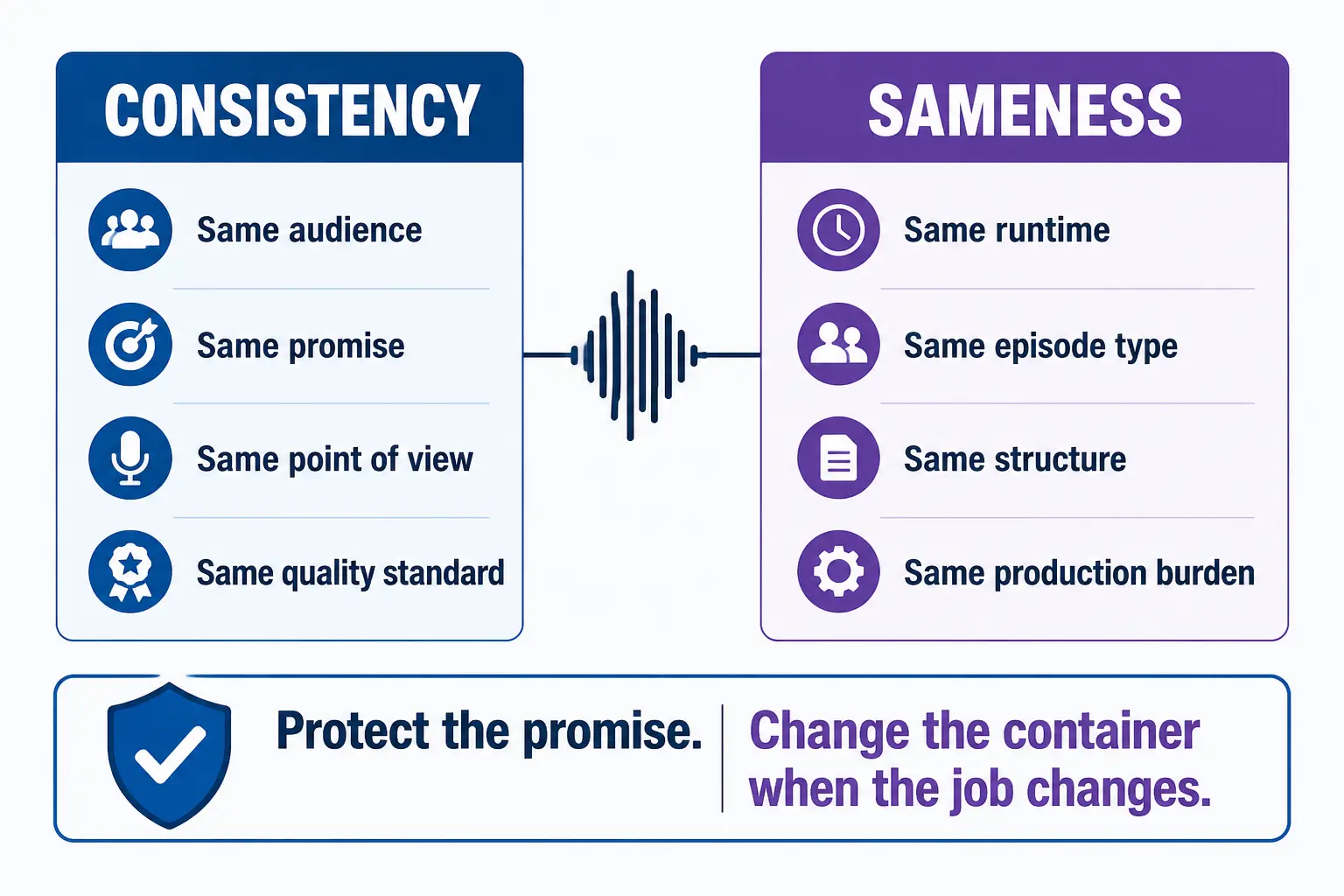
A consistent podcast needs a recognizable audience, promise, point of view, and quality standard. It does not require every episode to have the same length, structure, or production burden.
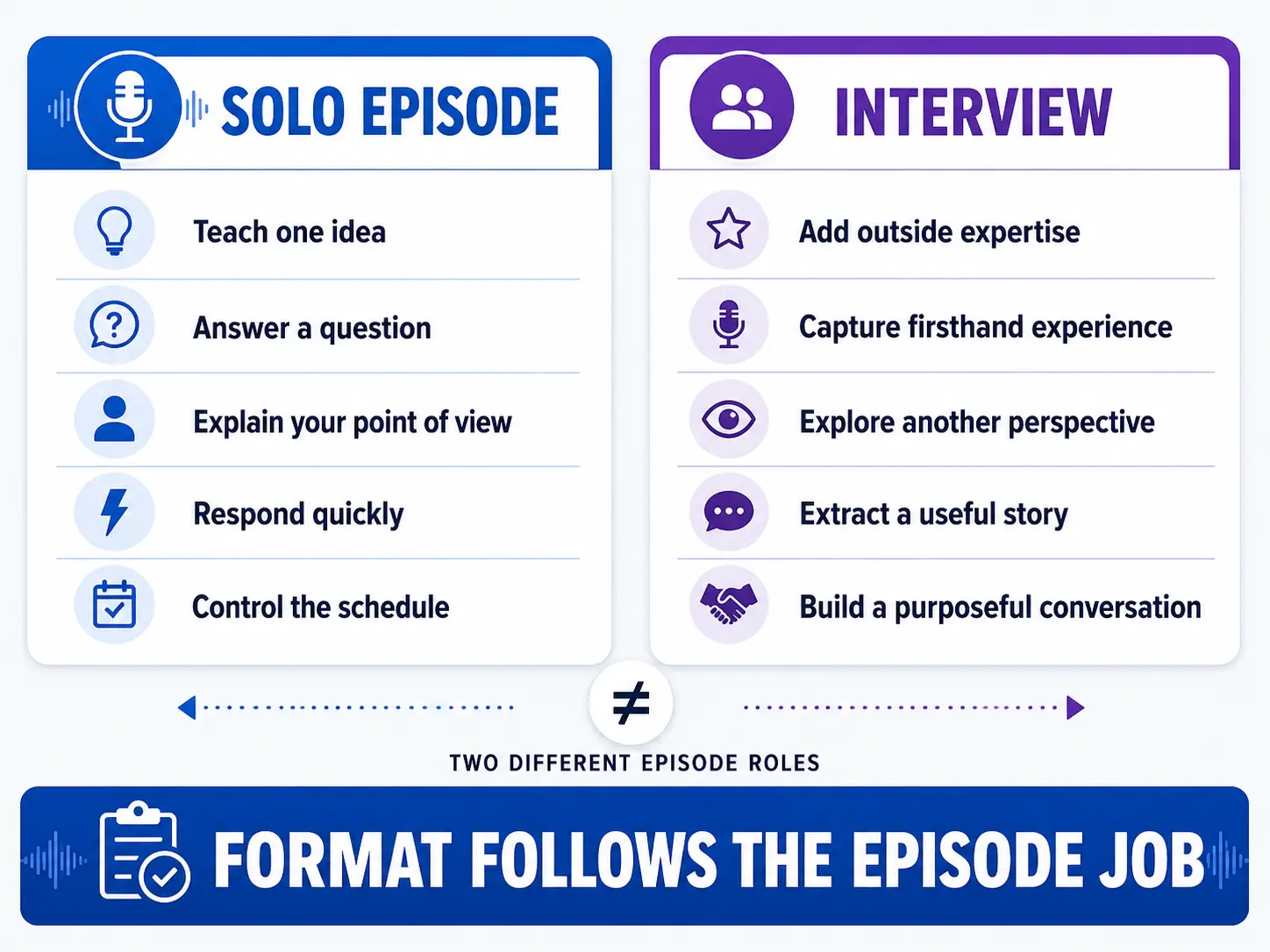
A focused solo episode can perform one job. A guest interview can perform another. A case study or commentary episode might perform a third.
The important decision is not, “Which format is best?”
It is:
What does this episode need to accomplish, and which format gives it the best chance of doing that without creating unnecessary production work?
Consistency Does Not Mean Every Episode Has to Be Identical
Your listeners should recognize the show even when the episode format changes.
That consistency usually comes from the things underneath the format:
- Who the show is for
- What kinds of problems it helps solve
- The host’s point of view
- The quality standard
- The tone and personality
- The kind of useful result the listener expects
The format is simply how you deliver that value.
Imagine a podcast for independent fitness professionals.
One episode might be a 12-minute solo lesson explaining how to price a new service.
The next could be a 35-minute conversation with a studio owner who has already navigated that decision.
Those episodes feel different. They may even have different production requirements.
But they can still belong to the same show because they serve the same listener and support the same larger promise.
That is consistency.
Making every episode 42 minutes because Episode 1 happened to be 42 minutes is sameness.
Those are not the same thing.
Give Every Podcast Format a Job
The easiest way to choose between a solo episode and an interview is to stop choosing by habit.
Start with the job of the episode.
Ask:
What does the listener need from this particular idea?
If you can explain the idea directly, a solo episode may be the cleanest choice.
If the value depends on someone else’s firsthand experience, specialized knowledge, opposing perspective, or story, an interview may be stronger.
That distinction also prevents one of the most common format problems I see as a producer: booking a guest first and trying to figure out the episode afterward.
A guest is not an episode strategy.
They are one possible way to deliver the episode.
When a Solo Podcast Episode Makes Sense
A solo episode works especially well when the host already possesses the explanation, framework, story, opinion, or experience needed to deliver the value.
Solo episodes are useful for:
- Teaching one focused idea
- Answering a recurring audience question
- Correcting a common mistake
- Explaining your point of view
- Walking through a process
- Responding to a timely issue
- Handling a guest cancellation without disrupting the feed
- Making your own expertise more visible
They also remove one major production dependency: another person’s calendar.
That does not automatically make a solo episode easier. You still need a clear idea, useful structure, and natural delivery. A 12-minute ramble is still a ramble. It just ends sooner.
If you are developing that skill, my guide on why new hosts benefit from solo episodes first goes deeper into using solo recordings to build your hosting confidence and studio rhythm.
Want to Get Better at Recording Solo?
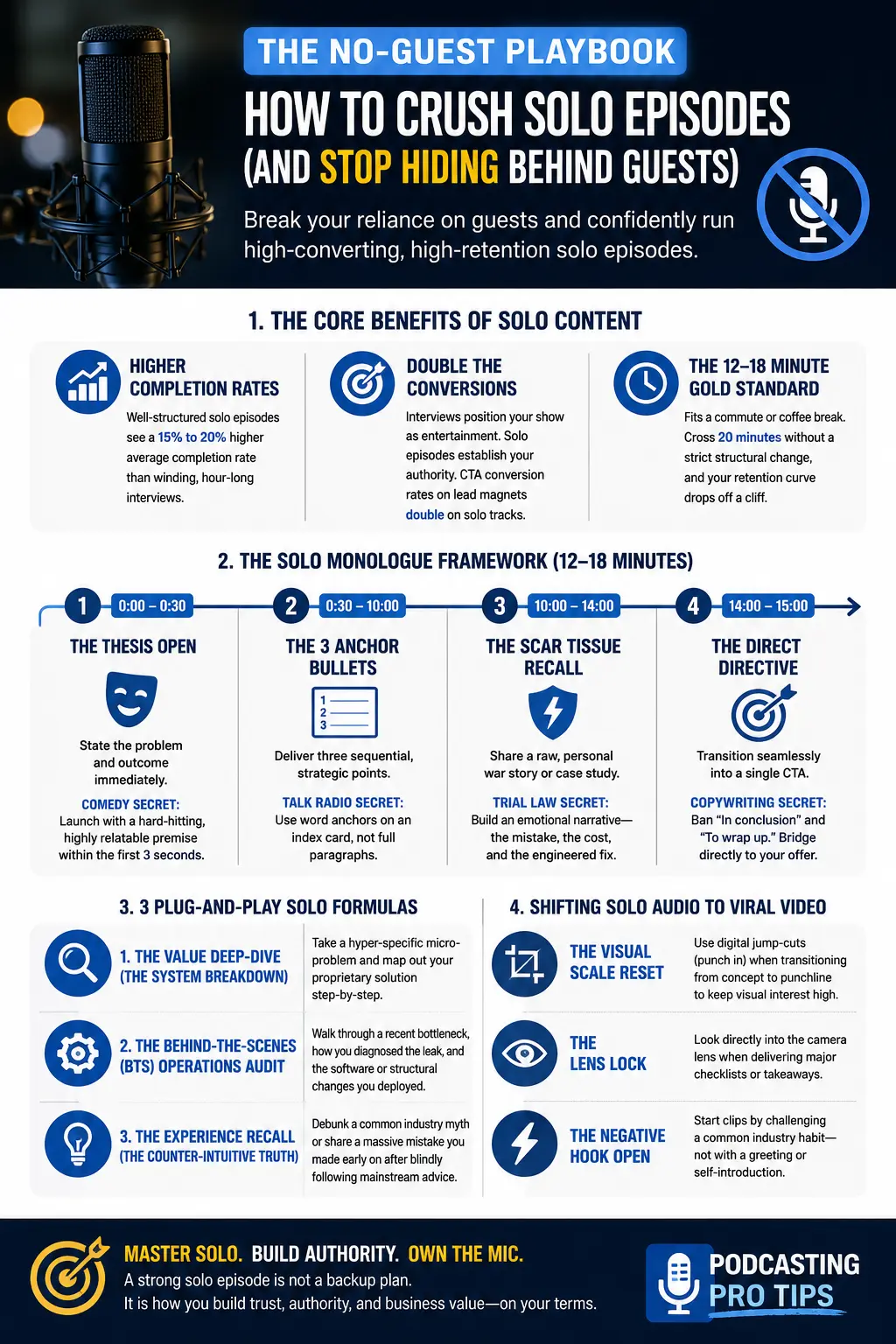
If guest dependency is part of the reason you are rethinking your format, start with The No-Guest Playbook: How to Crush Solo Episodes (And Stop Hiding Behind Guests).
It is inside the Free Podcasting Pro Tips Vault, along with The Topic Flow Drill: How to Eliminate Script Reliance and Speak with Natural Authority.
Use them to build stronger solo episodes without turning every recording into a word-for-word script.
When an Interview Is the Better Format
An interview earns its place when the guest can contribute something the host cannot simply reproduce alone.
That may be:
- Firsthand experience
- A detailed case study
- Specialized knowledge
- A genuinely different point of view
- Access to a story the audience would not otherwise hear
- A useful disagreement or comparison
- A relationship that makes sense for the show and its larger purpose
The guest should make the episode better because of what they uniquely bring to the conversation.
Not because Thursday is “guest day.”
A strong interview also needs preparation. I prefer to prepare around what the conversation needs to uncover rather than building a wall of generic questions and reading them in order. The article on preparing podcast interviews around real objectives breaks that process down further.
And there is another important distinction:
An interview can create relationship value, authority value, audience value, or useful content. But none of those outcomes happen automatically just because another person appears on camera.
The episode still needs a job.
Solo vs. Interview Podcast: Use This Decision Test
Before you choose the format, run the idea through a few questions.
| Question | Lean Solo | Lean Interview |
|---|---|---|
| Can I explain the core idea myself? | Yes | Not necessarily |
| Does the value depend on firsthand experience I do not have? | Less likely | Yes |
| Do I need to publish quickly? | Often easier | Scheduling may slow it down |
| Is an outside perspective central to the promise? | Not required | Yes |
| Is the episode designed to make my own thinking clearer? | Strong fit | Possible, but shared |
| Does the conversation itself create the value? | Less likely | Strong fit |
| Is the guest only here because I needed an episode? | Choose another idea | Do not book yet |
That last question matters.
If you cannot explain why this particular guest needs to be part of this particular episode, you probably do not have an interview yet.
You have a calendar appointment.
Build a Format Mix Instead of a Format Rule
Once you know what each format is supposed to do, you can design a publishing mix around your actual show.
There is no universal solo-to-interview ratio.
A 3:1 mix could be right for one show. Alternating formats could make sense for another. A third show might publish mostly solo episodes and use interviews only when a particularly strong guest or subject appears.
The ratio is downstream of the show.
Start with these four decisions.
1. Protect the Parts That Should Stay Consistent
Keep the audience, positioning, core promise, and quality standard recognizable.
That gives you room to vary the delivery without making the feed feel random.
2. Assign a Job to Each Format
For example:
Solo teaching episode: Explain a decision directly and establish the host’s point of view.
Interview: Add outside expertise, experience, or a story the host cannot provide alone.
Case study: Show what an idea looks like in practice.
Commentary: Respond to a change, question, trend, or misconception.
You do not need all four.
You just need to know why the ones you use exist.
3. Build Around Your Real Production Capacity
Format decisions affect more than what happens on the microphone.
They affect:
- Guest outreach
- Scheduling
- Research
- Preparation
- Recording
- Editing
- Approvals
- Promotional coordination
This is why format belongs in your podcast pre-production planning, not just in your content calendar.
A format you cannot reliably produce is not a very useful format strategy.
4. Test the Mix Before Turning It Into a Permanent Rule
If you have been publishing only interviews and want to introduce solo episodes, you do not need to rebuild the show overnight.
Run a small test.
For example:
- Episode 1 — Solo teaching
- Episode 2 — Guest interview
- Episode 3 — Solo teaching
- Episode 4 — Guest interview
That is an experiment, not my universal podcast formula.
You could reverse it, use three solos and one interview, or substitute a case study.
The useful part is that you deliberately assign each episode a job, publish enough examples to learn something, and then review what happened.
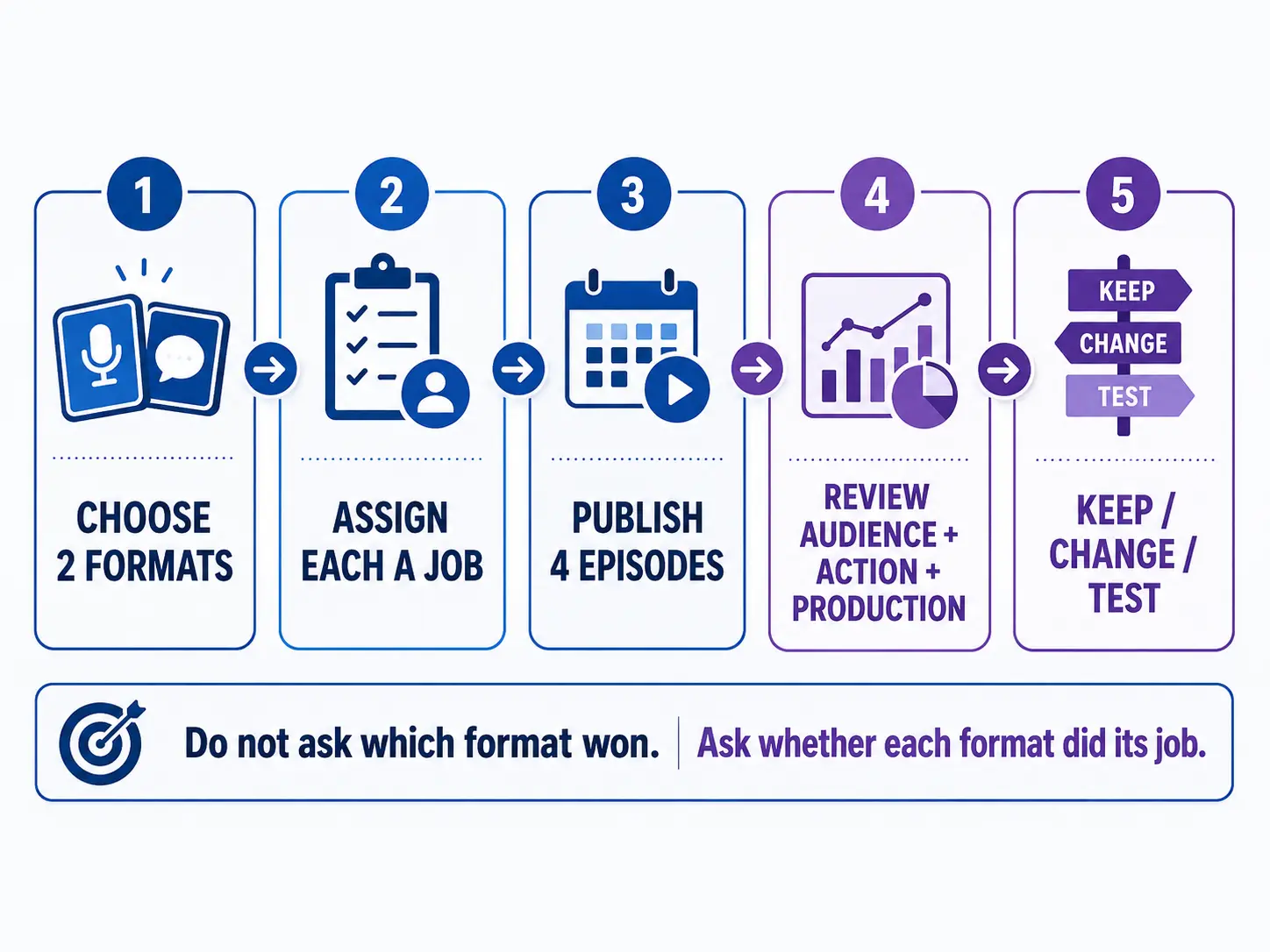
Do Not Ask Which Podcast Format “Won”
This is where format testing gets more interesting.
If your solo episode and interview were designed to do different jobs, comparing them on one number can give you a lousy answer.
Suppose the interview creates a valuable professional relationship and produces a strong piece of evergreen content.
The solo episode gets fewer plays but produces more clicks to a relevant resource.
Which format won?
Wrong question.
Instead, evaluate the format against its intended job.
Look at Audience Signals
Depending on the platforms and analytics available to you, that may include:
- Plays or views
- Consumption or retention
- Comments and replies
- Shares
- Saves
- Questions generated by the episode
- Qualitative listener feedback
Compare these against your own show history rather than assuming there is one magic benchmark every podcast should hit.
Look at Action Signals
If the episode was supposed to lead somewhere, look for evidence of that action.
Examples might include:
- Resource downloads
- Email signups
- Website visits
- Inquiries
- Product evaluation
- Registrations
- Replies
- Another measurable next step connected to the episode
This is also why I do not like evaluating a podcast only through downloads. If you want the deeper measurement side, read how to measure podcast value beyond CPM and downloads.
Look at Production Signals
This part gets ignored all the time.
Track what the format actually required:
- Preparation time
- Scheduling effort
- Recording time
- Editing complexity
- Guest coordination
- Approval delays
- Promotional workload
- How difficult it was to maintain the publishing schedule
A format that performs reasonably well but consumes three times the production capacity may deserve a different place in the mix.
That does not mean kill the format.
It means understand the tradeoff.
When Mixing Podcast Formats Becomes a Problem
Variety is not automatically a strategy.
A mixed-format show can become confusing when the episodes stop serving the same audience or promise.
Watch for these warning signs:
- Solo episodes feel like filler between “real” interviews.
- Guests are chosen because they are available rather than relevant.
- Every format targets a different kind of listener.
- Production quality changes dramatically between formats.
- The show changes tone and purpose every week.
- Nobody can explain what each format is supposed to accomplish.
If that is happening, adding more formats is not the solution.
You probably need to clarify the show underneath them.
Your Podcast Format Should Serve the System Behind the Show
Format is an important decision, but it is not the first decision.
Before deciding how many solo episodes or interviews you should publish, you should know:
Who is this show for?
What useful job is the podcast supposed to perform?
What kinds of episodes support that job?
What can you realistically produce?
What should happen after the listener receives value?
And how will you know whether the show is doing anything useful?
Once those decisions are clear, format becomes much easier.
A 12-minute solo with no purpose is still random content.
It is just random content with a shorter runtime.
Choose the job first.
Then choose the format that helps you do it.
And if you want to get more comfortable making solo episodes part of that mix, start with The No-Guest Playbook inside the Free Podcasting Pro Tips Vault.
Frequently Asked Questions
Can a podcast have both solo episodes and interviews?
Yes. A podcast can use both formats as long as the episodes continue serving a recognizable audience and show promise. Give each format a clear job instead of adding variety simply for variety’s sake.
Should every podcast episode be the same length?
No. Episode length should follow the amount of useful material and the job of the episode rather than an arbitrary runtime. Consistency in purpose and quality matters more than forcing every recording into the same number of minutes.
Are solo podcast episodes better than interviews?
Neither format is automatically better. Solo episodes are often useful when the host can teach or explain the value directly. Interviews are stronger when another person brings expertise, experience, perspective, or stories that materially improve the episode.