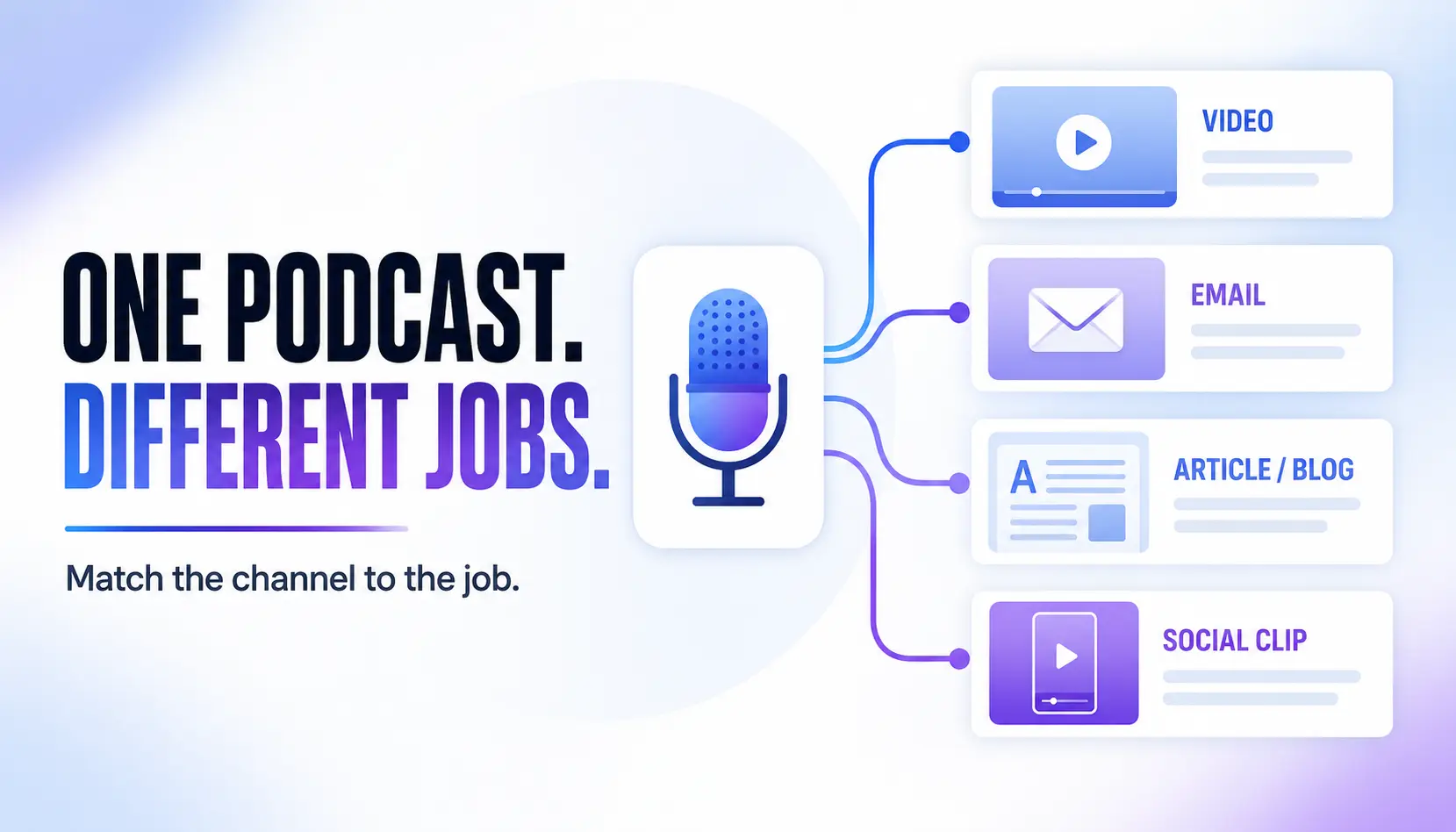
You record a podcast episode.
Then you cut three vertical clips.
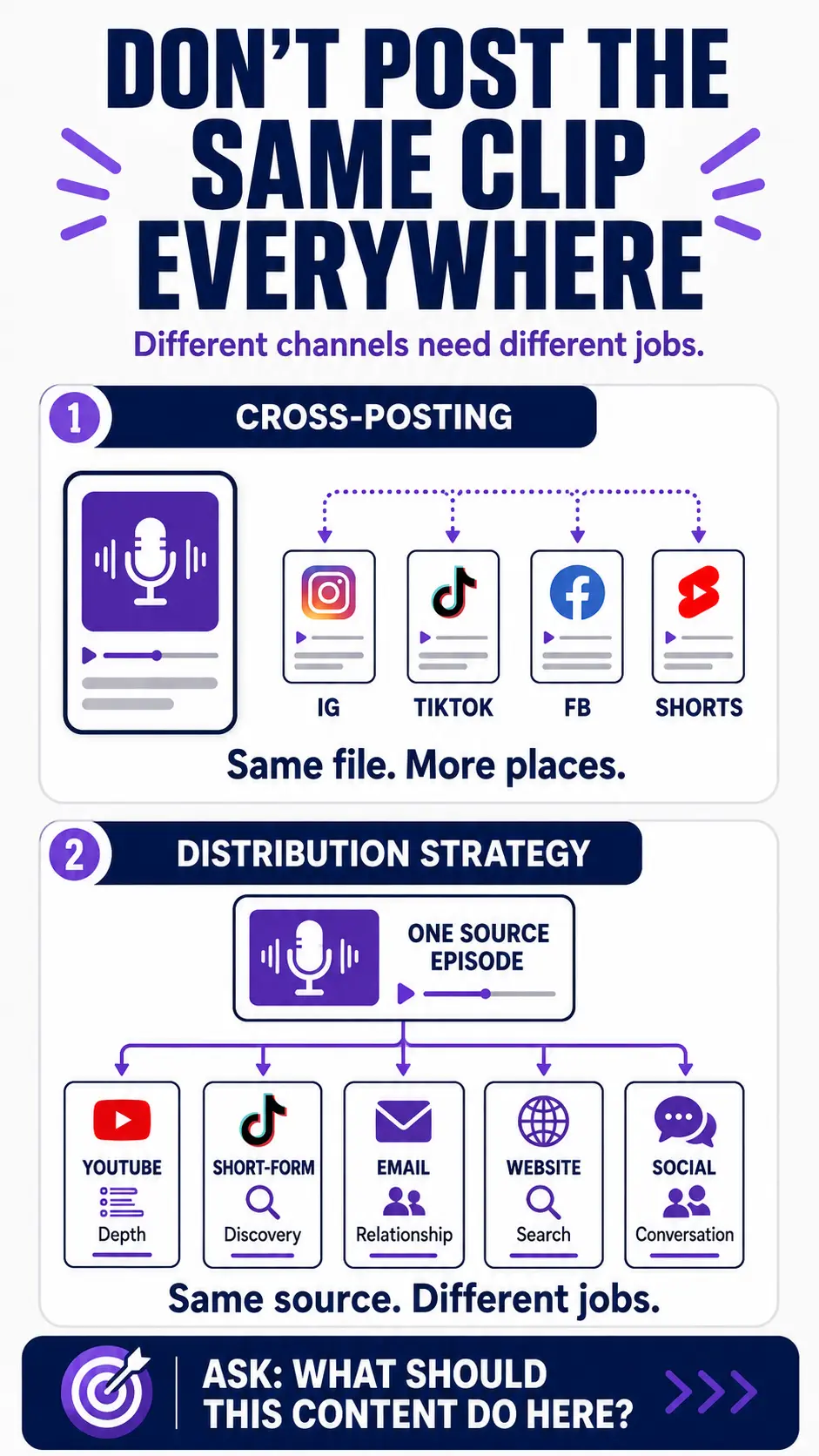
Then you post basically the same clips to Instagram, TikTok, Facebook, and YouTube Shorts.
Done. Multi-platform content strategy.
Except that is not much of a strategy.
You changed where the file was uploaded. You did not really change what the content was supposed to do.
And the bigger problem is that a lot of podcasters stop there. They are so focused on making short clips that they never build an email list, turn their expertise into useful website content, create a real YouTube strategy, or think about how the full podcast, social content, search content, and owned audience should work together.
Your podcast can feed all of those channels.
They just should not all get the same thing.
Same source. Different channel. Different job. Different packaging.
That is a much more useful way to think about podcast content distribution.
Disclosure: Some software links in this article are affiliate links. If you purchase through them, I may earn a commission at no extra cost to you.
Cross-Posting Is Not the Same as a Distribution Strategy
Cross-posting means taking essentially the same piece of content and publishing it in multiple places.
There is nothing inherently wrong with that.
In fact, publishing tools make it incredibly easy. Meta Business Suite, for example, can publish content across Facebook and Instagram from the same environment.
The convenience is useful.
But convenience does not tell you what the content should accomplish.
A distribution strategy answers a different set of questions:
- Why are you using this channel?
- What type of content makes sense there?
- What part of the podcast should become that content?
- How much context does somebody need?
- What should they do after consuming it?
- How will you know whether it did its job?
That is where repurposing becomes more than clipping.
Your Podcast Actually Has Several Different Distribution Jobs
It helps to stop thinking about “social media” as one giant bucket.
Your podcast content can perform several different jobs.
Discovery
This content helps somebody encounter you who may have no idea who you are.
Short-form video is an obvious example.
A Reel, TikTok, or YouTube Short might introduce one strong problem, idea, mistake, or distinction from an episode.
The person should not need to hear the previous 27 minutes for the clip to make sense.
Depth and Authority
Some people want more than a 40-second answer.
Long-form podcast episodes, YouTube videos, detailed articles, interviews, and deeper teaching give you room to demonstrate how you actually think.
That matters if your podcast exists partly to build expertise and trust.
Relationship
Other channels help you continue the conversation.
Email is especially important here.
Someone who joins your email list has chosen to hear from you again without requiring an algorithm to put your next clip in front of them.
Search and Reference
Some content should still be useful three months or three years from now.
A useful article, resource page, YouTube video, episode page, FAQ, or tutorial can continue answering a question long after the social post disappears down somebody’s feed.
Google’s current guidance continues to emphasize useful, people-first content rather than content created primarily to manipulate search rankings.
Conversion
Eventually, some content needs to help the right person take another useful step.
That could mean:
- listening to another episode;
- reading an article;
- joining your email list;
- downloading a resource;
- trying a tool;
- requesting information;
- buying something.
Not every asset needs to sell.
But your whole content system should not lead nowhere either.
What Podcast Content Should Go on Each Channel?
Here is the part many podcasters never actually plan.
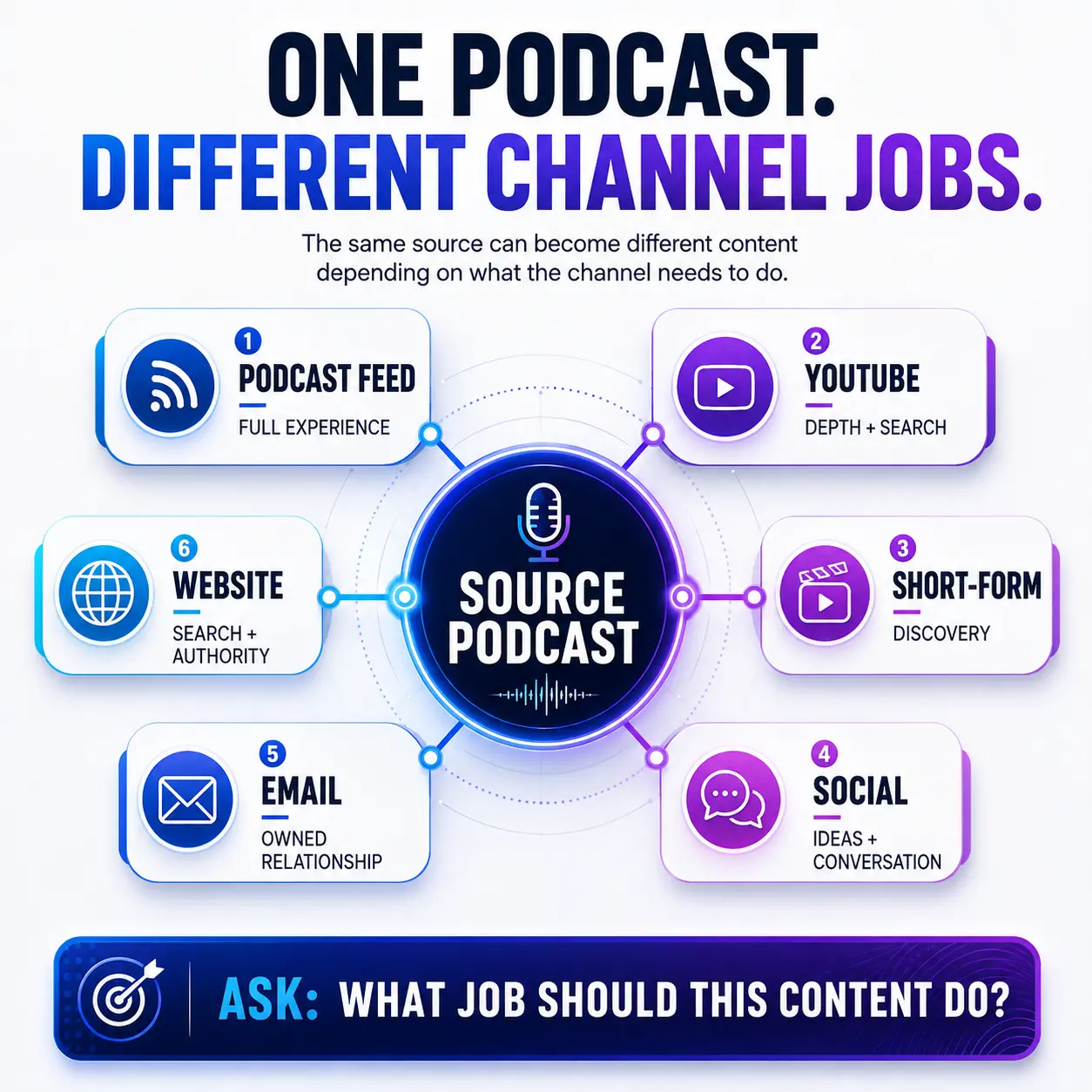
The same episode can feed several channels, but the strongest asset for each channel may be completely different.
| Channel | Main Job | Good Podcast-Derived Content |
|---|---|---|
| Podcast apps / RSS | Full listening experience | Complete episode, clear description, chapters, one CTA |
| YouTube long-form | Depth, search, authority | Full video podcast, focused teaching videos, demonstrations |
| YouTube Shorts | Discovery | One problem, mistake, distinction, framework step or payoff |
| Discovery, familiarity, visual teaching | Reels, carousels, concise visual explanations, selected clips | |
| TikTok | Short-form discovery | Self-contained vertical ideas, reactions, explanations, stories |
| Authority and professional discussion | Native text, selected video, frameworks, observations, articles | |
| Community, discussion, sharing | Selected video, discussion posts, explanations, community content | |
| Owned relationship | Lessons, stories, commentary, links and relevant next steps | |
| Website / Blog | Search and owned authority | Articles, episode resources, FAQs, comparisons, tutorials |
| Graphics / Carousels | Explanation and reference | Processes, checklists, frameworks, comparisons |
The important word in that table is job.
If you do not know why a channel is part of your content system, posting more often on it probably will not fix the problem.
Podcast Apps: Give the Full Episode Somewhere to Live
Your podcast feed is still the home of the complete audio experience.
Do not treat Apple Podcasts, Spotify, and the other podcast apps like dumping grounds where the MP3 goes while all the “real content marketing” happens somewhere else.
The episode itself needs a job.
Give it:
- a clear title;
- a useful episode description;
- understandable show notes;
- chapters when they improve navigation;
- one primary next step.
If you use chapters, podcast timestamps and chapter titles can also make the episode easier for people to navigate.
And remember that podcast hosting and social publishing are different parts of the system. Your host manages the feed and distribution infrastructure behind the show.
If you are evaluating podcast hosting, Captivate is one of the platforms worth looking at. Its current platform includes podcast distribution and analytics tools.
But hosting the podcast is only one layer.
It does not automatically give you the rest of the content strategy.
YouTube Long-Form: Do More Than Upload the Podcast File
YouTube deserves to be treated as more than another place to mirror your podcast.
YouTube currently supports long-form video, Shorts, live content, and podcasts inside the same broader creator environment.
That opens several possibilities.
A strong video episode may work as the full podcast.
But you can also extract a topic from a larger conversation and create a tighter standalone teaching video around that one question.
For example, imagine a 45-minute episode about podcast growth.
Inside it you spend six good minutes explaining:
Why posting more clips does not fix weak podcast positioning.
That may deserve its own YouTube video.
Not because you need another asset for the spreadsheet.
Because there is a complete question and answer hiding inside the episode.
And packaging matters here. A YouTube viewer encounters a title and thumbnail before they encounter your expertise, which is why podcast YouTube titles and thumbnails need their own strategy.
YouTube Shorts: Pull Out One Complete Idea
A Short does not need to summarize the full episode.
It needs to make one useful idea understandable quickly.
Good candidates include:
- a mistake;
- a surprising distinction;
- one step from a framework;
- a myth correction;
- a specific example;
- a short story with a payoff;
- an answer to one question.
The key test is simple:
If someone never watches the complete episode, does this clip still make sense?
If the clip begins:
“And that’s the second reason I stopped doing it that way…”
you probably do not have a finished asset yet.
You have an excerpt.
Add the missing context or choose another moment.
Instagram: Think Beyond Podcast Clips
Instagram can absolutely be part of a podcast distribution strategy.
But that does not mean your Instagram account needs to become a wall of talking-head excerpts.
One podcast episode could produce:
- a Reel built around one useful idea;
- a carousel breaking down a process;
- a short written caption expanding on a point;
- a visual comparison;
- a behind-the-scenes production observation;
- a story directing existing followers toward something deeper.
A strong framework from the podcast may actually work better as six swipeable cards than as a talking-head video.
That is the decision repurposing should help you make.
Not:
“Where else can I upload this clip?”
But:
“What is the clearest way to communicate this idea here?”
TikTok: Do Not Assume the Podcast Context Came With the Clip
The audience encountering a TikTok may know absolutely nothing about the episode, the guest, the show, or you.
Plan accordingly.
If a podcast moment is going to become short-form discovery content, the opening needs enough context to stand alone.
Instead of:
“Like I was telling John earlier…”
try:
“If your podcast clips get views but nobody ever makes it to the full show, this may be why.”
Now the viewer has a reason to care even if they have never heard of John, the episode, or your podcast.
This is a useful rule for nearly all discovery content:
Do not make the viewer earn the context. Give it to them.
LinkedIn: Your Best Asset May Not Be the Video Clip
This is one of the clearest examples of why channel strategy matters.
You may record a great podcast segment and discover that the best LinkedIn asset is not the video.
It may be the idea.
LinkedIn currently supports feed posts, images, video, articles, and newsletters. Its own help documentation distinguishes short feed posts from long-form articles and newsletters.
Suppose you said this during an episode:
Most podcasters think they have a promotion problem. A lot of them actually have a positioning problem. Promoting an unclear show just helps more people misunderstand it.
You could post the video.
Or you could turn that idea into a native LinkedIn post:
You may not have a podcast promotion problem.
You may have a positioning problem.
If somebody cannot quickly understand who your show is for, why it exists, and why this episode matters, increasing distribution only increases the number of people seeing an unclear message.
Before adding another promotion tactic, check the show itself.
Same source idea.
Completely different asset.
Facebook: Give People Something to Respond To
Facebook does not need to be treated as Instagram with another upload button.
A podcast-derived post can become a discussion starter, useful explanation, group conversation, selected Reel, community update, or link to a deeper resource.
A clip that works as pure discovery content somewhere else could be paired with a question on Facebook:
Where does your podcast promotion actually break down: creating the content, publishing it, or figuring out what to do with it afterward?
Now the content has a different job.
That is the broader rule:
Do not adapt content just because the technical dimensions changed. Adapt it because the audience experience changed.
Email: Stop Renting Your Entire Audience
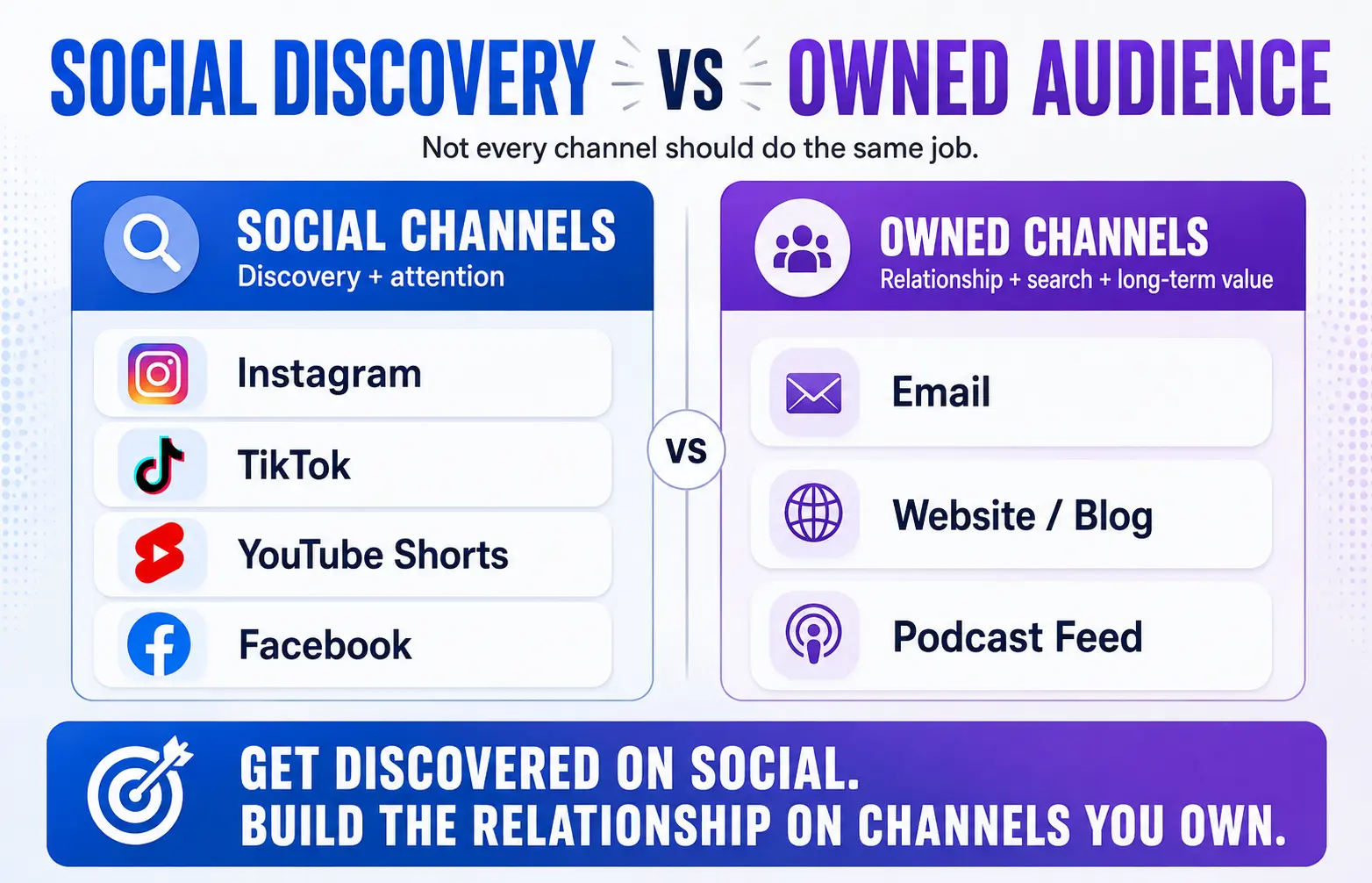
This is the channel many clip-focused podcasters never build.
They have Instagram followers.
TikTok viewers.
Facebook followers.
Maybe YouTube subscribers.
But no direct audience they can reliably contact.
Your email newsletter gives you another kind of relationship.
Someone has intentionally given you permission to continue the conversation.
That does not mean your weekly email should say:
New podcast episode! Click here to listen!
Take the strongest lesson from the episode and make the email useful by itself.
For example:
Subject: Your podcast probably doesn’t need another social account
Then teach the idea.
Tell the story.
Give the example.
And when it makes sense, connect that lesson to the complete episode or another useful next step.
If you do not have an email platform yet, Kit is built around creator email lists, newsletters, forms, landing pages, and automation.
The important part is not the software.
The important part is that your entire relationship with your audience should not depend on whether a social platform decides to distribute your next post.
Your Website and Blog: Build Something You Own
Your website performs a completely different job than TikTok.
It does not need to behave like TikTok.
A useful podcast website can become the permanent information layer behind the show.
An episode may become:
- an episode page;
- a detailed article;
- a tutorial;
- an FAQ;
- a comparison;
- a checklist;
- a resource page;
- a supporting video;
- an internal link into another useful topic.
Do not simply copy the transcript, add an H1, and call it a blog strategy.
A spoken conversation and a useful search article are different products.
Take the expertise from the recording and rebuild it for someone who is trying to understand that subject in writing.
That matters even more now that Google’s own guidance continues to emphasize useful, original, people-first information for both traditional and AI-assisted search experiences.
If you do not yet own a website, Bluehost offers WordPress hosting, and GeneratePress is a lightweight WordPress theme focused on speed, stability, and accessibility.
But again, buying a website does not create the strategy.
The website needs a job too.
Start With the Idea, Not the Video Timeline
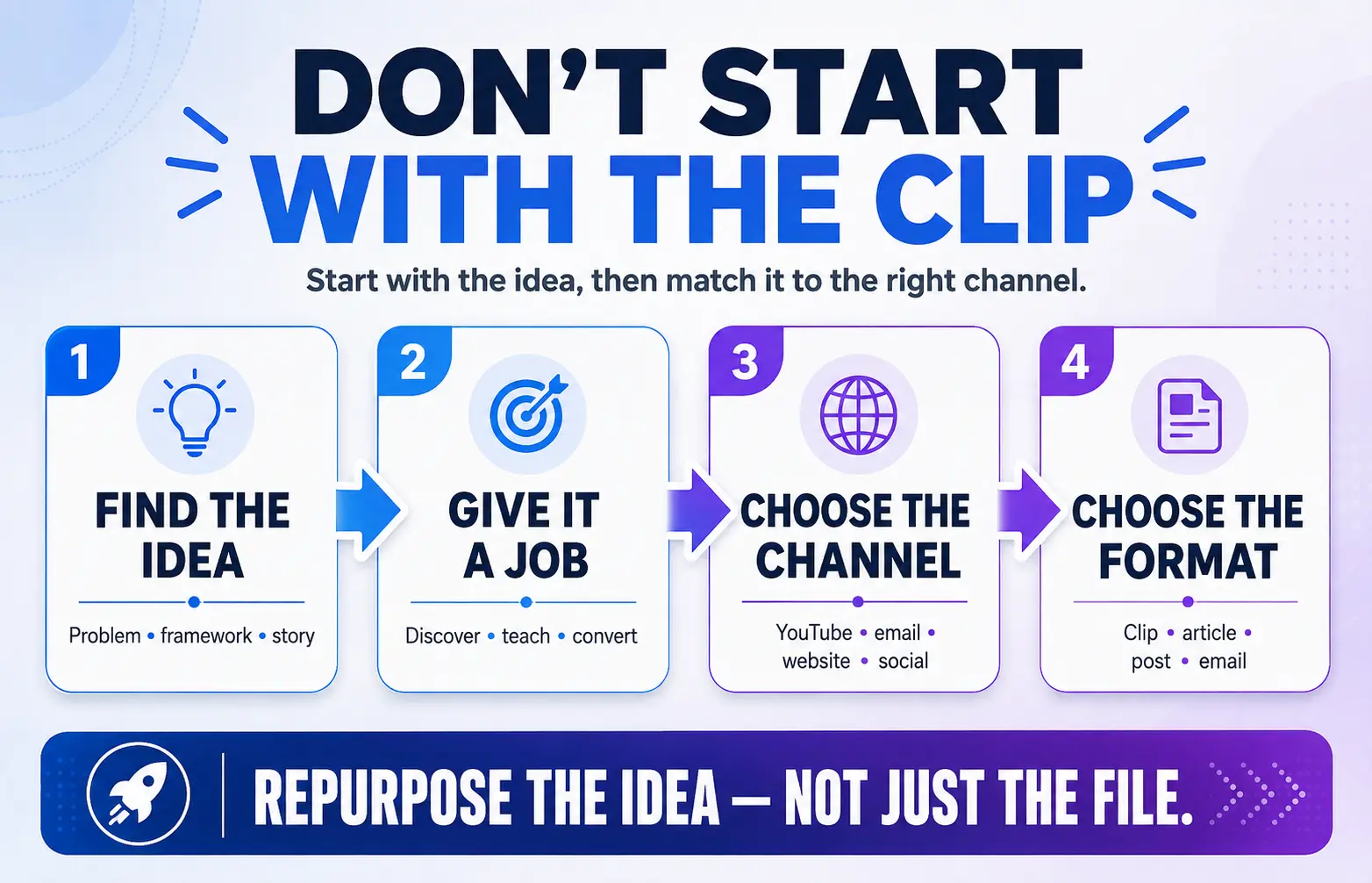
Once you understand that different channels require different assets, your repurposing workflow changes.
Do not begin by asking:
“Where are the clips?”
Start by asking:
“Where are the ideas?”
A transcript is extremely useful for this.
Instead of scrubbing through an hour-long timeline hunting for moments that looked energetic, scan the transcript and label useful sections.
Look for:
PROBLEM
A frustration or mistake your audience recognizes.
POINT OF VIEW
Something you believe or interpret differently.
FRAMEWORK
A process, checklist, or sequence.
STORY
A real example that makes the lesson easier to understand.
FAQ
A question that deserves a direct answer.
PROOF
A supported example or experience that strengthens the explanation.
NEXT STEP
A logical continuation for somebody who wants more.
Then decide what each idea should become.
That workflow is much more useful than forcing every interesting sentence into vertical video.
If transcript-based editing fits your production style, Descript currently lets you transcribe audio and video and edit media through the transcript itself.
And if the production process itself keeps getting out of control, fix the podcast workflow before multiplying the number of assets you publish.
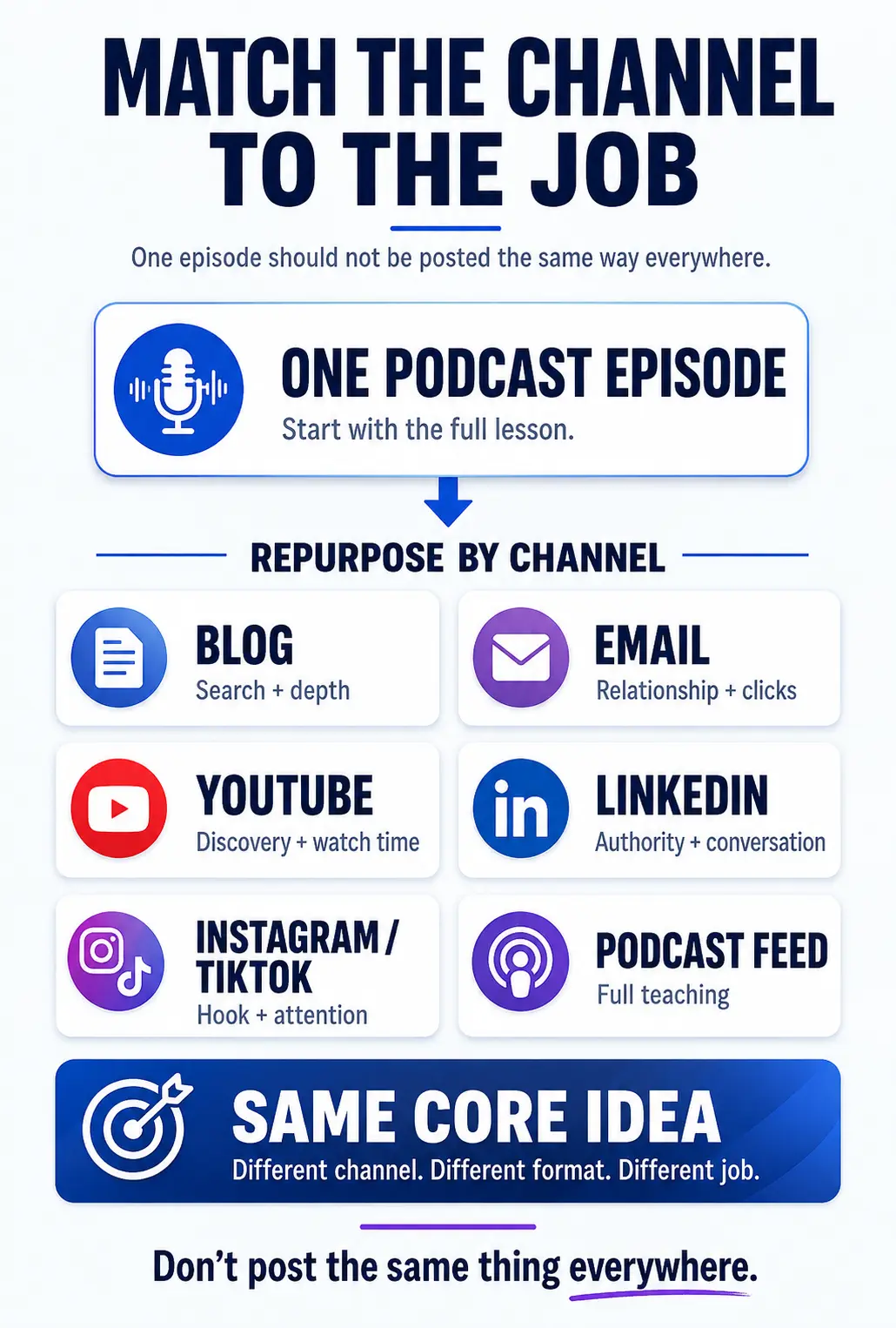
One Episode Can Produce Different Content for Seven Channels
Here is a practical example.
Suppose your podcast episode is:
Why Your Podcast Clips Aren’t Growing the Show
Inside the episode you teach three ideas:
- Clips need enough context to stand alone.
- Different channels perform different jobs.
- The CTA should match the reason the content exists.
You could distribute that source episode like this:
Podcast Feed
Publish the complete conversation.
CTA: Read the channel-by-channel guide.
YouTube
Publish a focused long-form version:
Why Posting More Podcast Clips Isn’t Growing Your Show
YouTube Short
Extract:
“A podcast clip is not useful just because somebody said something interesting.”
Then explain the context test.
Create a carousel:
5 Signs Your Podcast Clips Have No Distribution Strategy
Write a native post:
You probably don’t need more podcast clips. You need to decide what each channel is supposed to do.
Then explain the distinction.
Send:
Subject: You’re treating every channel like TikTok
Teach one lesson and point to the full article.
Website
Publish the comprehensive guide you are reading right now.
Seven assets.
One underlying idea.
But none of them had to be identical.
That is multi-platform repurposing.
Your CTA Should Change With the Channel Too
One CTA everywhere can be just as clumsy as one piece of content everywhere.
Imagine somebody discovers a 30-second clip for the first time.
Asking them to immediately buy your highest-priced offer may be a pretty large jump.
A more natural next step might be:
Watch the complete explanation.
Somebody reading a detailed article may be further along.
Their next step could be:
Use the template.
An email subscriber who has been hearing from you for months might reasonably receive:
Take a look at the product.
The CTA should follow the content.
If you want to tighten this part of the system, I break down the same principle in the guide to building a podcast outro around one relevant next step.
Your distribution channel changes.
Your audience’s relationship with you changes.
The CTA may need to change too.
Do Not Measure Every Channel With the Same Number
Once each channel has a different job, measuring everything by views becomes pretty useless.
A discovery clip might be evaluated partly by whether it reaches the right new people.
A long-form video may be more about sustained viewing and continuation.
An email may be trying to produce clicks or replies.
An article may attract relevant search traffic over time.
A product-focused page may be judged by qualified actions.
And the full podcast may be supporting trust, authority, relationships, and business outcomes that do not fit neatly into a single download count.
That is why podcast downloads are useful evidence, but they are a poor universal definition of podcast value.
Different jobs need different evidence.
You Probably Do Not Need Every Channel
After reading all of this, do not respond by creating nine new accounts tonight.
That would miss the point spectacularly.
Start with a manageable system.
For example:
CORE CONTENT
Your full podcast.
DEPTH / VIDEO
YouTube.
DISCOVERY
One or two short-form channels that make sense for your audience and production capacity.
OWNED RELATIONSHIP
Email.
OWNED SEARCH / RESOURCE
Your website.
That alone is a much more complete content system than:
Instagram + TikTok + Facebook + 14 identical clips.
Then pay attention to what actually happens.
Maybe LinkedIn becomes important.
Maybe Instagram does.
Maybe your email becomes the strongest path into the business.
Maybe searchable articles quietly produce useful traffic for years.
Let the evidence improve the distribution plan.
Do not build the plan around assumptions about where people like you are “supposed” to post.
The Bigger Content Strategy Comes Before the Clip Strategy
If every week begins with:
“What should we post?”
you may be diagnosing the problem too far downstream.
Your podcast should already know:
- who it is for;
- what job it performs;
- what subjects reinforce that job;
- what you want to be known for;
- what content deserves to be expanded;
- what channels deserve your production time;
- what action makes sense afterward.
When those decisions are clear, repurposing gets much easier.
When they are not, a clip factory simply creates random content faster.
If that sounds familiar, start by looking at the content strategy behind the podcast before producing another pile of assets.
Build a Content Distribution System, Not a Clip Factory
Your podcast should be able to produce more than a podcast episode.
But that does not mean the goal is to squeeze ten files out of every recording.
The real opportunity is to take one useful source idea and let it do different jobs in different places.
A complete episode can build depth.
A Short can create discovery.
A LinkedIn post can expose your point of view.
An email can deepen the relationship.
An article can answer a search question.
A graphic can explain the framework.
A CTA can move the right person forward.
That is what multi-platform podcast distribution should look like.
Not the same clip everywhere.
A connected content system.
Want a Repeatable Way to Pull the Assets Out of Each Episode?
If you understand the channel strategy but still need a practical way to find and organize the content inside each recording, use the 1-Into-10 Podcast Content Kit inside the Podcasting Pro Tools Library.
It includes the transcript-first repurposing playbook, Clip Finder Workbook, Mute-Proof Mobile Clip Checklist, Transcript-to-Content AI Prompt Pack, Episode-to-10-Assets Worksheet, and 7-Day Drop Calendar.
The point is not to force ten assets out of every episode.
Use it to find the ideas worth distributing—and then give each one the right job.
Frequently Asked Questions
Should I post the same podcast clips on every social platform?
You can cross-post a strong clip when it genuinely fits more than one channel, but do not make identical cross-posting your entire distribution strategy. Consider the audience, context, format, CTA, and job of the content on each channel.
Which social media platform is best for a podcast?
There is no single best platform for every podcast. Choose channels based on where the people you want to reach actually spend attention, what type of content you can produce well, and what job you need the channel to perform.
Does a podcast need an email newsletter?
Not every podcast needs one, but an email list gives you a direct audience relationship that does not depend entirely on social-feed distribution. It is especially useful when the podcast supports a business, organization, product, service, community, or ongoing educational relationship.
Should a podcast have a blog?
A blog can be valuable when the show regularly answers questions that also deserve searchable written resources. Do not simply publish raw transcripts. Turn strong podcast ideas into useful articles designed for someone who wants the information in written form.
How many channels should I use to promote my podcast?
Use as many as you can operate intentionally and consistently. A smaller system with a clear podcast feed, one discovery channel, YouTube, email, and a useful website can be stronger than maintaining many accounts without knowing what each one is supposed to accomplish.