Podcasting isn’t shrinking in 2026. It is reaching more people than ever.
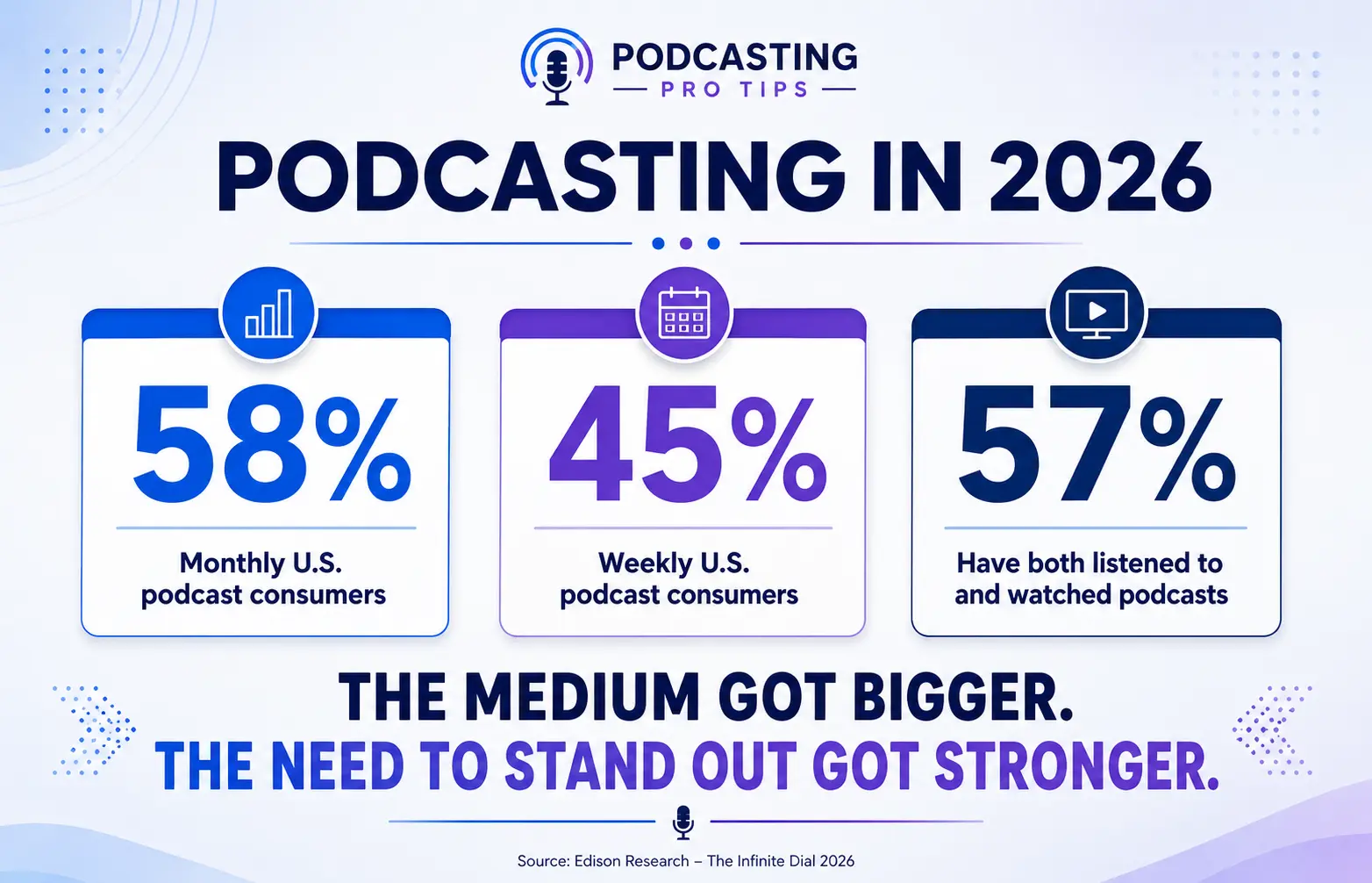
Edison Research’s Infinite Dial 2026 found that 58% of Americans age 12 and older consumed a podcast in the previous month, while 45% consumed one in the previous week. Both are record highs.
The advertising market didn’t disappear either. IAB and PwC reported that U.S. podcast advertising revenue reached $2.9 billion in 2025, growing 17.6% year over year.
So the interesting story in 2026 isn’t that podcasting died, CPM advertising collapsed, or everybody suddenly stopped caring about audience size.
The medium got bigger.
It also became more visual, more competitive, and more spread across different listening and viewing environments. That changes the question a business-minded podcaster should be asking.
Instead of:
How do I build the biggest podcast possible?
A better question is:
How do I become genuinely useful and recognizable to the right audience?
That’s where niche authority becomes much more interesting than vanity reach.
Podcasting Is Bigger in 2026—And More Visual
Podcasting is now firmly an audio-and-video medium.
Edison found that 57% of Americans age 12+ have both listened to and watched a podcast.
YouTube reported more than one billion monthly active viewers of podcast content as of January 2025, while Spotify said in May 2026 that more than 500 million users had streamed a video podcast.
That doesn’t mean every podcast suddenly needs six cameras, a glowing neon logo, and enough RGB lighting to land a small aircraft.
It means the category has expanded.
Someone may discover your show through an audio app, YouTube search, a video recommendation, a clip, an article, an email, or another piece of content built from the original episode.
That makes the podcast itself part of a larger media system.
If you’re building a business, brand, nonprofit, creative practice, educational platform, or professional reputation around your show, that’s useful. One strong episode can continue working beyond the original podcast feed when you have a deliberate multi-platform podcast distribution and repurposing system.
But wider distribution creates another problem.
There is also much more content competing for attention.
Being available everywhere doesn’t give someone a reason to care.
The Real Problem With Broad Podcasting
A broad podcast isn’t automatically a bad podcast.
Entertainment shows can serve broad audiences extremely well. News, comedy, sports, culture, storytelling, and major interview properties can all benefit from scale.
But a podcast designed to support a business or organization has a different job.
If you’re using your show to build authority, educate customers, develop an audience, generate inquiries, support products, strengthen relationships, attract referrals, or create reusable content, being broadly interesting isn’t necessarily enough.
Your audience needs to understand why your show is specifically relevant to them.
That’s why defining your podcast concept before piling on episodes matters so much.
Compare these two ideas:
Broad:
A podcast about marketing.
More useful:
A podcast helping independent retailers turn local customer attention into repeat business.
Or:
Broad:
A podcast about wellness.
More useful:
A show helping fitness professionals build better client adherence without relying on constant motivation.
Or:
Broad:
A podcast about music.
More useful:
A show helping independent artists understand the business decisions behind releasing and promoting their work.
The second version doesn’t necessarily need to exclude everybody else.
It simply gives the right person a much clearer reason to listen.
Niche Doesn’t Have to Mean Tiny
This is where the term “hyper-niche” can get misleading.
You don’t have to keep narrowing your audience until only seven people on Earth qualify to hear the show.
A useful niche is specific enough to create relevance but broad enough to sustain meaningful content and opportunity.
You can narrow around:
- a particular problem;
- a particular stage;
- a professional role;
- a use case;
- an industry;
- a customer type;
- a geographic market;
- a point of view;
- or a combination of those factors.
For many business podcasts, I prefer thinking about the problem before obsessing over demographics.
Two listeners may work in completely different industries but have the same podcast problem.
They both publish consistently.
They both have good equipment.
They both create clips.
And neither can explain what the show is actually doing for the business.
That’s a meaningful audience connection.
The niche isn’t their job title. It’s the problem they’re trying to solve.
Authority Is Different From Popularity
A podcast can attract attention without building much authority.
Authority is what happens when your content repeatedly demonstrates that you understand a problem, have a useful way of thinking about it, and can help the listener make a better decision.
You don’t create that by repeatedly announcing your credentials.
You create it through the episodes.
The listener begins to recognize:
- what you understand;
- what you believe;
- what you notice that others miss;
- what experience or proof supports your thinking;
- and how you approach the problem.
That’s particularly important now because generic information is cheap.
Anyone can publish “five tips for better marketing,” “three ways to grow your business,” or another broad interview in which the guest spends the first twelve minutes explaining how they got started.
Useful authority content has more fingerprints on it.
It shows how you think.
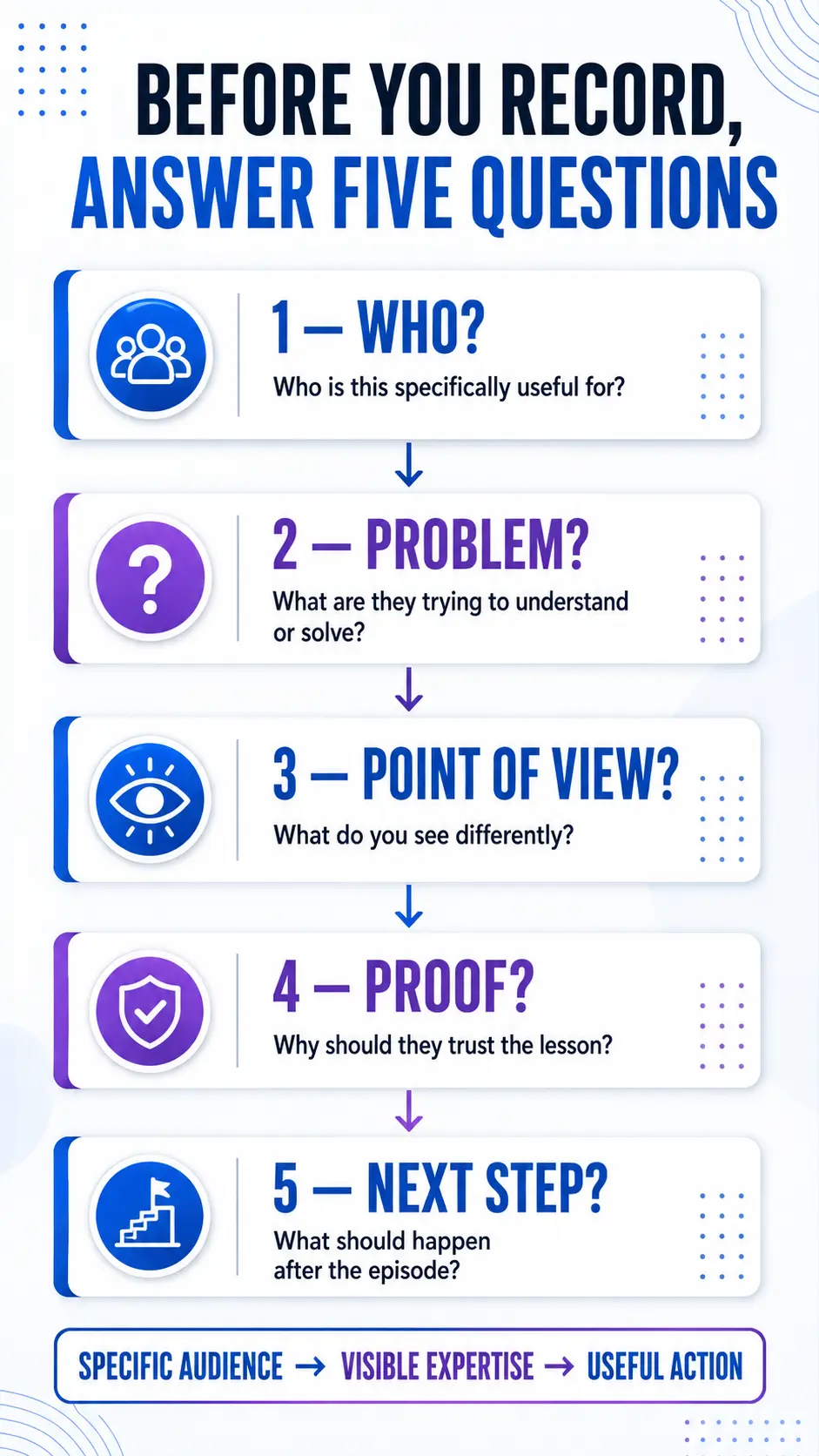
Use This Five-Question Niche Authority Test
Before you plan another episode, answer these five questions.
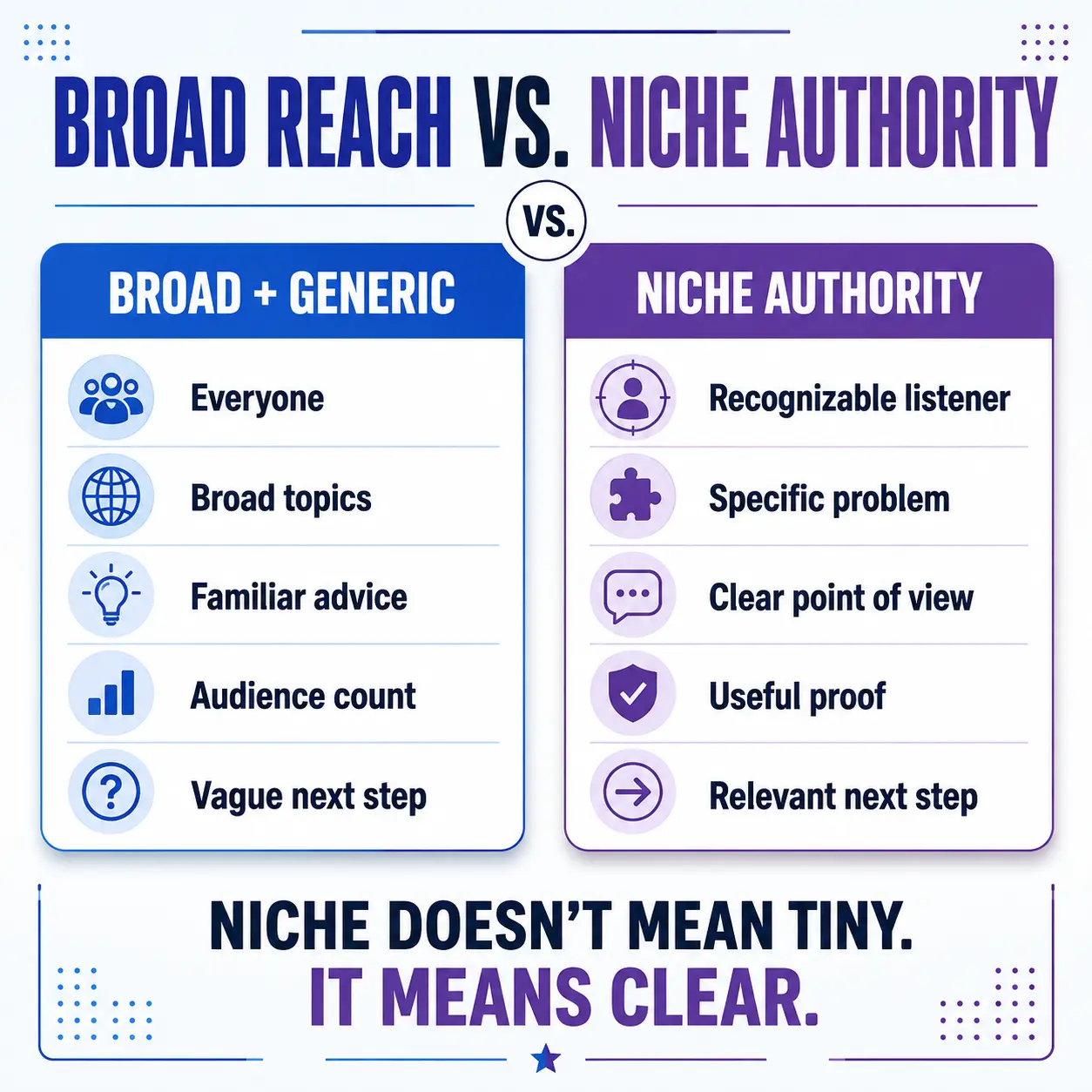
1. Who is this specifically useful for?
Not everybody who could technically listen.
Who is most likely to immediately recognize the problem?
2. What problem does this episode help them understand or solve?
“Marketing” is a subject.
“Why your email list isn’t growing from your podcast even though downloads are increasing” is a problem.
That distinction matters.
3. What is your point of view?
You don’t need a manufactured hot take.
You do need some interpretation.
What do you believe the listener is misunderstanding? What have you learned? What distinction would help them make a better decision?
4. What makes the lesson credible?
Use the appropriate proof.
That might be experience, a real example, a demonstration, a process, data, a client pattern you have permission to discuss, or a credible outside source.
Authority gets stronger when proof supports the teaching instead of interrupting it.
5. What should happen next?
The episode should lead somewhere.
That may be another episode, an email signup, a resource, a product, an inquiry, an event registration, a conversation, or simply one useful action the listener can take.
A podcast with no intended next step can still be worthwhile.
But if you’re expecting the show to support a business, you should know what role the episode is supposed to play.
Downloads Still Matter. They Just Don’t Tell You Everything.
This is where podcast measurement gets distorted.
Downloads are useful.
They give you evidence of reach and consumption. Audience growth can be healthy. A larger qualified audience can create more opportunities.
The mistake is turning the download count into the complete definition of success.
A podcast with 20,000 listeners isn’t automatically more valuable to its owner than a podcast with 2,000.
And a podcast with 200 listeners isn’t automatically an amazing business asset simply because somebody called it “niche.”
You still have to look at what the audience does.
That’s the problem behind the podcast vanity metric trap.
For a business-minded show, useful signals might include:
- qualified audience growth;
- episode completion or consumption;
- replies and conversations;
- resource downloads;
- email signups;
- website visits;
- inquiries;
- bookings;
- referrals;
- product evaluation;
- direct conversions;
- assisted conversions;
- reusable content;
- and authority or relationship value.
Which ones matter depends on what the podcast is supposed to accomplish.
That’s why I prefer measuring podcast ROI beyond CPM and download counts instead of trying to force every show into an advertising-media model.
A Smaller Audience Is Only Valuable if It’s the Right Audience
There’s another trap here.
Don’t romanticize being small.
A podcast with 300 listeners who don’t care isn’t more valuable than one with 30,000 listeners who do.
Niche authority works when three things connect:
Relevant audience → useful authority → meaningful next step
Lose any one of those and the model gets weaker.
You can have a perfectly defined niche but weak content.
You can publish excellent content to an audience that has no real connection to your business.
Or you can build trust and then send the listener toward a completely unrelated CTA.
The pieces have to work together.
That’s why podcast positioning can’t live in one document you create before launch and never look at again. It needs to influence the topics you choose, the guests you invite, the examples you use, the offers you mention, the clips you publish, and the measurements you watch.
Video Doesn’t Fix Weak Positioning
The rise of video podcasting is one of the clearest changes in the medium, but it doesn’t change the basic rule.
Better packaging can improve the way content is discovered and consumed.
It can’t supply a missing point.
A beautifully lit 4K interview about “success, mindset, and entrepreneurship” is still a broad interview about success, mindset, and entrepreneurship.
There may even be a fake plant involved. It remains innocent.
Before adding more production complexity, make sure you can answer:
Who is this for?
Why should they care?
What do we want this show to be known for?
What useful job does the podcast perform?
Once those answers are clear, production can amplify them.
Without those answers, production mostly makes the confusion look nicer.
What the State of Podcasting in 2026 Really Means
Podcasting in 2026 is larger than the old audio-only picture of the medium.
Audience consumption is at record levels. Video is firmly part of podcast behavior. Podcast advertising continues to grow. Major platforms are investing in podcast discovery, viewing, engagement, and monetization.
For an independent business-minded podcaster, though, you don’t need to win the entire market.
You need to earn relevance with the people your show is actually designed to serve.
That means being clear enough to be recognized.
Useful enough to be remembered.
And consistent enough that the audience begins to understand how you think.
That’s niche authority.
And in a medium with more content, more platforms, and more competition for attention, that clarity becomes more valuable—not less.
Frequently Asked Questions
Is podcasting still growing in 2026?
Yes. Edison Research reports record U.S. podcast consumption in 2026, with 58% of Americans age 12+ consuming podcasts monthly and 45% consuming them weekly.
Is a niche podcast better than a broad podcast?
Not automatically. A niche helps when it makes the show’s audience, problem, promise, and point of view clearer. A poorly executed niche podcast can still struggle, while some broad entertainment shows are built specifically for large audiences.
Do podcast downloads still matter?
Yes. Downloads remain useful evidence of audience reach and consumption. The problem is treating them as the only measure of podcast value when the show may also support authority, relationships, signups, inquiries, conversions, referrals, and reusable content.
Do I need video for a podcast in 2026?
Not every podcast requires the same production format, but video has become an important part of podcast consumption. Edison found that 57% of Americans age 12+ have both listened to and watched podcasts, and both YouTube and Spotify report substantial video-podcast audiences.
Turn Your Expertise Into an Authority Asset
Being more specific is only the beginning. Your episodes still have to make your expertise visible.
The Podcast Authority Builder Playbook helps you sharpen your point of view, turn broad topics into authority assets, use proof without turning the episode into a résumé, and build content that shows listeners how you think.
Explore the Podcast Authority Builder and Podcasting Pro Tools