A strong podcast outro call to action does not need to sell hard, list every link you have, or squeeze five requests into the final 30 seconds.
It needs to do something simpler:
Connect the value of the episode to one useful next step and make that step easy to take.
That next step might be downloading a guide, listening to another episode, joining your email list, visiting a product page, replying with a question, booking a call, or simply applying what you just taught.
The important part is that the listener should not have to figure out what you want them to do.
That is where a lot of podcast outros fall apart.
Your Podcast Outro Is Not a Link Dump
You have probably heard some version of this:
“Thanks for listening. Make sure you subscribe, leave a five-star review, follow us on Instagram, check out YouTube, visit the website, join the newsletter, and share this episode with a friend.”
Every one of those actions could be useful.
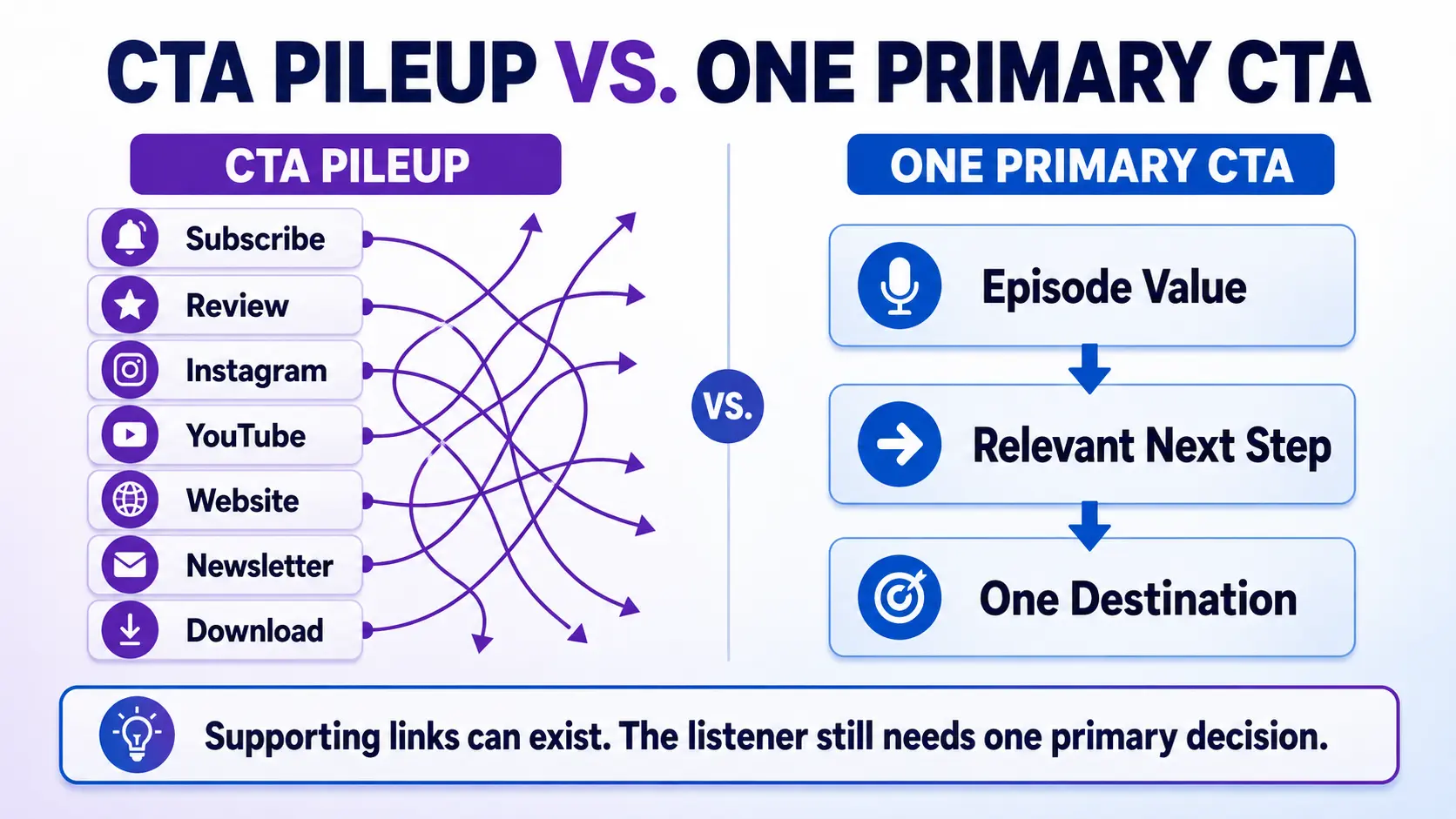
The problem is asking for all of them at the same time.
The listener has just spent 15, 30, maybe 45 minutes following one conversation. Then the episode suddenly hands them a menu.
Subscribe.
Review.
Follow.
Watch.
Download.
Visit.
Share.
Buy.
That is a lot of decisions for the final few seconds of an episode.
A better approach is to decide which action matters most for this particular episode.
Your outro becomes much easier to write once that decision is made.
Start With One Primary Podcast CTA
One episode should normally have one primary next step.
That does not mean your website can only contain one link. It does not mean you can never mention another resource during an episode.
It means the listener should leave the episode understanding the main thing you are asking them to do next.
For example:
An episode about planning a solo podcast could point to an episode-planning resource.
An interview about a complicated business problem might point to a deeper guide.
A product-comparison episode might naturally lead to a product page.
An educational episode for a new listener might simply direct them to another article or episode.
A community-focused show might ask the listener to reply, contribute a question, attend an event, or support a cause.
The right CTA depends on what the episode just helped the listener understand and what would genuinely help them next.
That is a much better standard than automatically ending every episode with the same generic commercial.
Use the Conversion Outro Formula
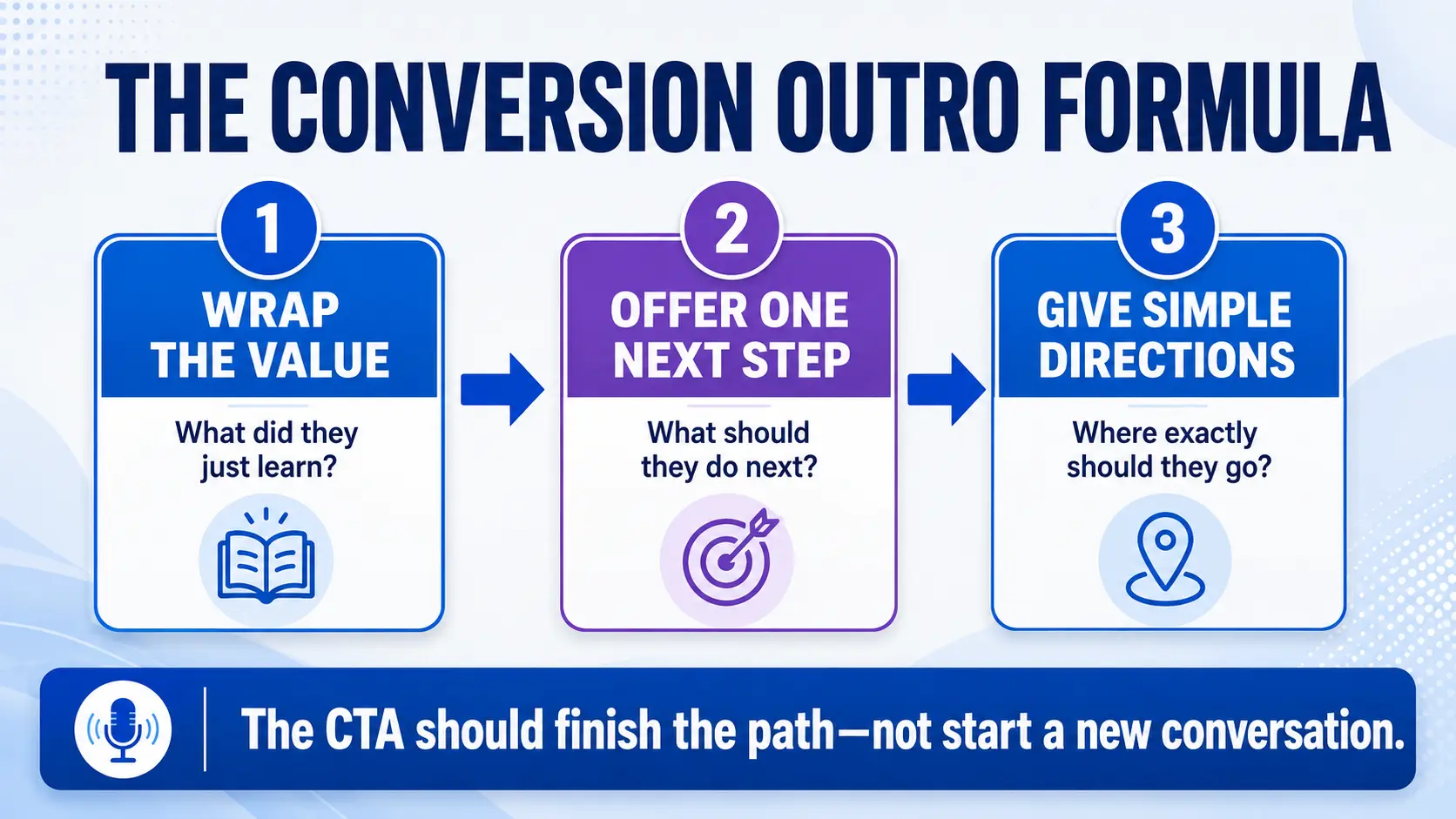
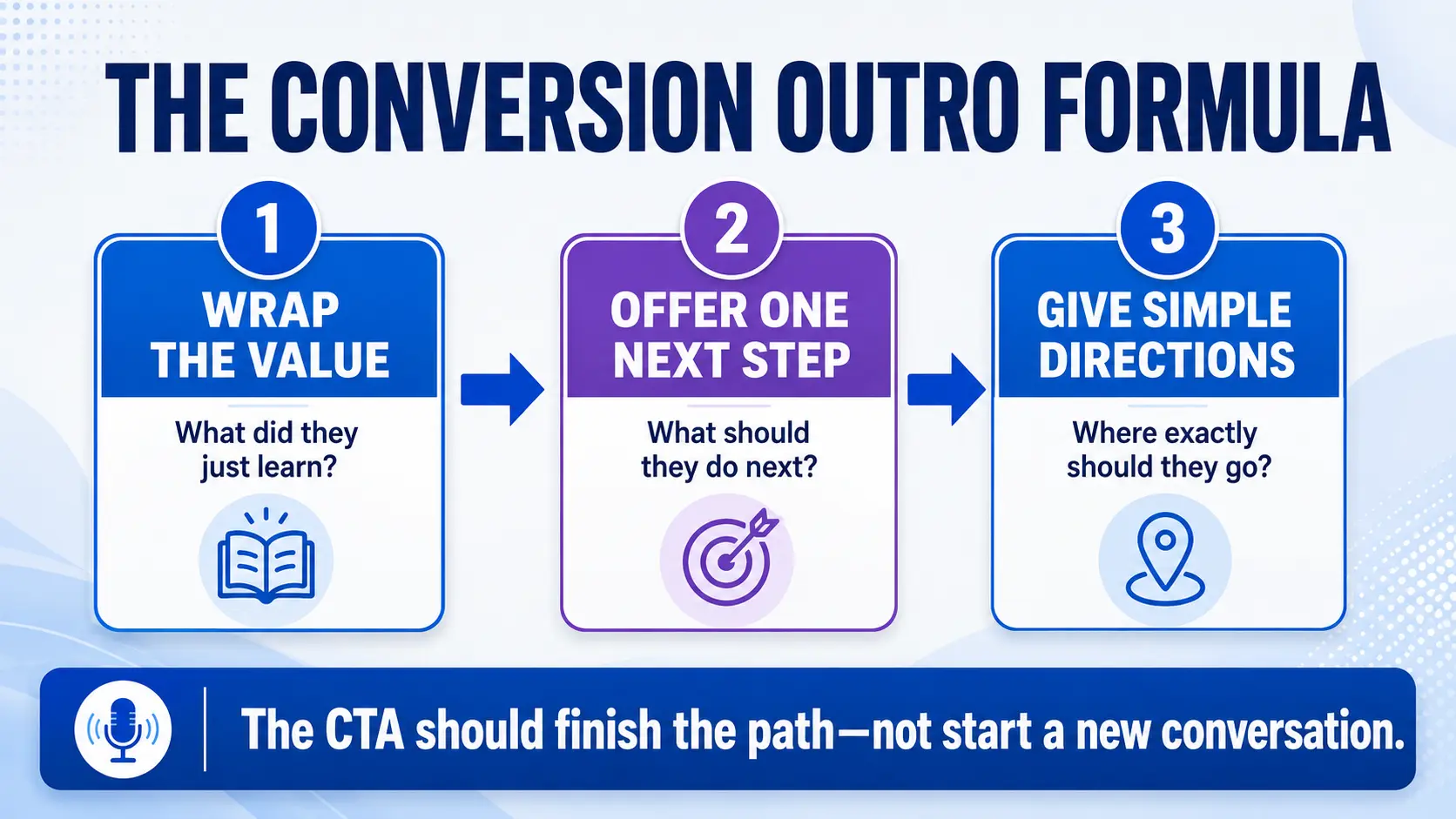
I use a simple three-part structure when an episode needs a clear next action:
Wrap the Value → Offer One Next Step → Give Simple Directions
1. Wrap the Value
Start by reminding the listener what they just figured out.
You are not giving them another complete episode summary. One sentence is enough.
For example:
“Today we broke down why your podcast outro gets weaker when you try to give the listener six different directions at once.”
That line does two things.
It closes the teaching loop, and it gives you something natural to connect the CTA to.
Compare that with abruptly shifting from the lesson to:
“Okay, now go download my thing.”
You can hear the difference.
One continues the conversation. The other sounds like somebody switched on an ad.
2. Offer One Next Step
Now connect the lesson to one relevant action.
For example:
“If you want help writing a cleaner CTA for your own show, the next step is to use a CTA planning template before you record.”
The important part is the connection.
The CTA makes sense because of what the listener just heard.
That is what keeps the promotion from feeling random.
3. Give Simple Directions
Finally, tell them how to do it.
Do not assume the listener knows where your resource lives.
Do not make them search through six pages of your website.
And remember that podcast listeners may be driving, walking, exercising, cooking, or doing something else while they listen.
Make the direction easy to understand.
For example:
“Open the episode description and use the first link.”
Or:
“Go to the Podcasting Pro Tools page and choose the Podcast CTA Swipe File.”
That is enough.
You do not need another paragraph of selling after the instruction.
Here Is the Full Podcast Outro Structure
Put those three pieces together and you get something like this:
“Today we broke down why a podcast outro gets weaker when you give the listener too many competing directions. If you want help applying this to your own episodes, the next step is the Podcast CTA Swipe File. It gives you adaptable CTA structures for episodes, clips, email, and show notes. You can find it on the Podcasting Pro Tools page.”
Notice what is missing.
No Instagram handle.
No YouTube pitch.
No review request.
No newsletter pitch.
No “and while you’re there…”
One idea.
One next step.
One destination.
The Best Podcast CTA Is Decided Before the Outro
This is the part that gets missed.
A weak podcast CTA is not always a copywriting problem.
Sometimes it is a planning problem.
If you reach the final two minutes of an episode and ask:
“What should I promote?”
you are making a business decision very late in the production process.
A better episode plan answers a few questions before you press record:
- What is this episode supposed to help the listener understand?
- Who is this episode for?
- What should change after they hear it?
- What is the most useful next step?
- Where will that next step take them?
- Is there any way to recognize whether people acted on it?
Once those decisions are made, the CTA usually becomes easier to write.
You are no longer trying to bolt a promotion onto an episode.
You are finishing a path that was already there.
This is one reason I treat the CTA as part of episode planning rather than something you improvise while recording the last sentence.
Match the CTA to the Episode
Not every episode should sell the same thing.
The strongest next step depends on what the listener needs after the episode.
| Episode situation | Possible next step |
|---|---|
| Listener needs more education | Related episode, article, or guide |
| Listener needs help applying the idea | Worksheet, template, or toolkit |
| Listener is evaluating a solution | Product or service page |
| Listener has a specific problem requiring help | Booking or contact path |
| Episode is community-focused | Reply, question, contribution, or participation |
| No offer genuinely fits | Simple application of the lesson |
That last one matters.
A podcast does not need to turn every outro into a sales pitch.
Sometimes the strongest ending is:
“Before your next recording, decide the one thing you actually want your listener to do when the episode ends.”
That is still a call to action.
The action is just the lesson itself.
Should You Ask Listeners to Subscribe or Leave a Review?
You can.
The question is whether that is the most important action for that episode.
There is nothing automatically wrong with asking someone to follow a show, leave a review, watch on YouTube, share an episode, or join an email list.
The problem starts when every one of those requests gets stacked together.
If reviews are the priority, make the review request the CTA.
If email growth is the priority, direct them to the email resource.
If the episode naturally leads to a tool, make the tool the next step.
Do not make the listener prioritize your marketing goals for you.
You make the decision first.
If podcast reviews are an important part of your strategy, I also break down what podcast reviews actually do and what they do not do.
Does the CTA Have to Be at the Very End?
The final outro is a natural place for the primary CTA because you can connect it directly to the lesson you just completed.
But it is not the only place a relevant next step can appear.
A brief contextual promotion can also make sense inside an episode when the resource clearly belongs with what is being discussed.
The key word is contextual.
If you are teaching something and a resource genuinely helps the listener apply it, the mention can feel like part of the lesson instead of an interruption.
That is the same idea behind a well-placed podcast mid-roll that connects the promotion to the surrounding content.
What I would avoid is treating the episode like three separate commercial breaks:
one offer in the intro,
another in the middle,
and something completely different in the outro.
You may technically have three promotions.
The listener now has three decisions.
Make the CTA Measurable When the Action Matters
If the podcast is supposed to support a business or organization, the CTA gives you something useful to evaluate.
Instead of asking only:
“How many people downloaded the episode?”
you can also ask:
Did anyone click the episode link?
Did someone download the resource?
Did the episode produce email signups?
Did people reply?
Did anyone visit the offer?
Did a customer or client later mention the podcast?
You will not always be able to trace every action cleanly back to one episode.
That is normal.
But a defined CTA gives you a much better starting point than publishing an episode with no intended next step at all.
If you are working on that larger measurement problem, see how to measure podcast ROI beyond downloads.
A Simple Podcast CTA Checklist
Before you publish the episode, ask:
- What did this episode help the listener understand?
- What is the most useful next step?
- Does that next step actually fit the episode?
- Am I asking for one primary action?
- Have I explained why the action matters?
- Have I told the listener exactly where to go?
- Is the destination working?
- Can I recognize or measure the action if that matters?
If you cannot answer number two, the problem may have started before the outro.
You may not have decided what job the episode was supposed to perform.
And that is worth fixing upstream.
Build the CTA Before You Press Record
A strong podcast outro is not about becoming more aggressive at the end of the episode.
It is about becoming clearer.
Wrap the value.
Offer one useful next step.
Give simple directions.
Then stop talking.
If you want adaptable CTA structures you can use for podcast episodes, clips, email, show notes, and other podcast content, get the Podcast CTA Swipe File.
Use it before your next recording so the CTA is part of the episode plan instead of something you invent after the teaching is already finished.
Frequently Asked Questions
How many calls to action should a podcast episode have?
Most episodes should have one primary CTA. Supporting links can still appear in the show notes, but the listener should be able to identify the main action you want them to take.
What should I say at the end of my podcast?
Resolve the main value of the episode, connect it to one useful next step, and tell the listener exactly how to take that step. You do not need a long closing speech.
Should every podcast episode have a sales CTA?
No. A CTA can lead to another episode, a free resource, a reply, an email signup, a community action, a product, a service, or simply an action the listener should take after hearing the lesson.
Want help writing the actual CTA?
The Podcast CTA Swipe File gives you adaptable scripts for episodes, clips, show notes, email, and social posts—so you can turn podcast attention into one clear next step.