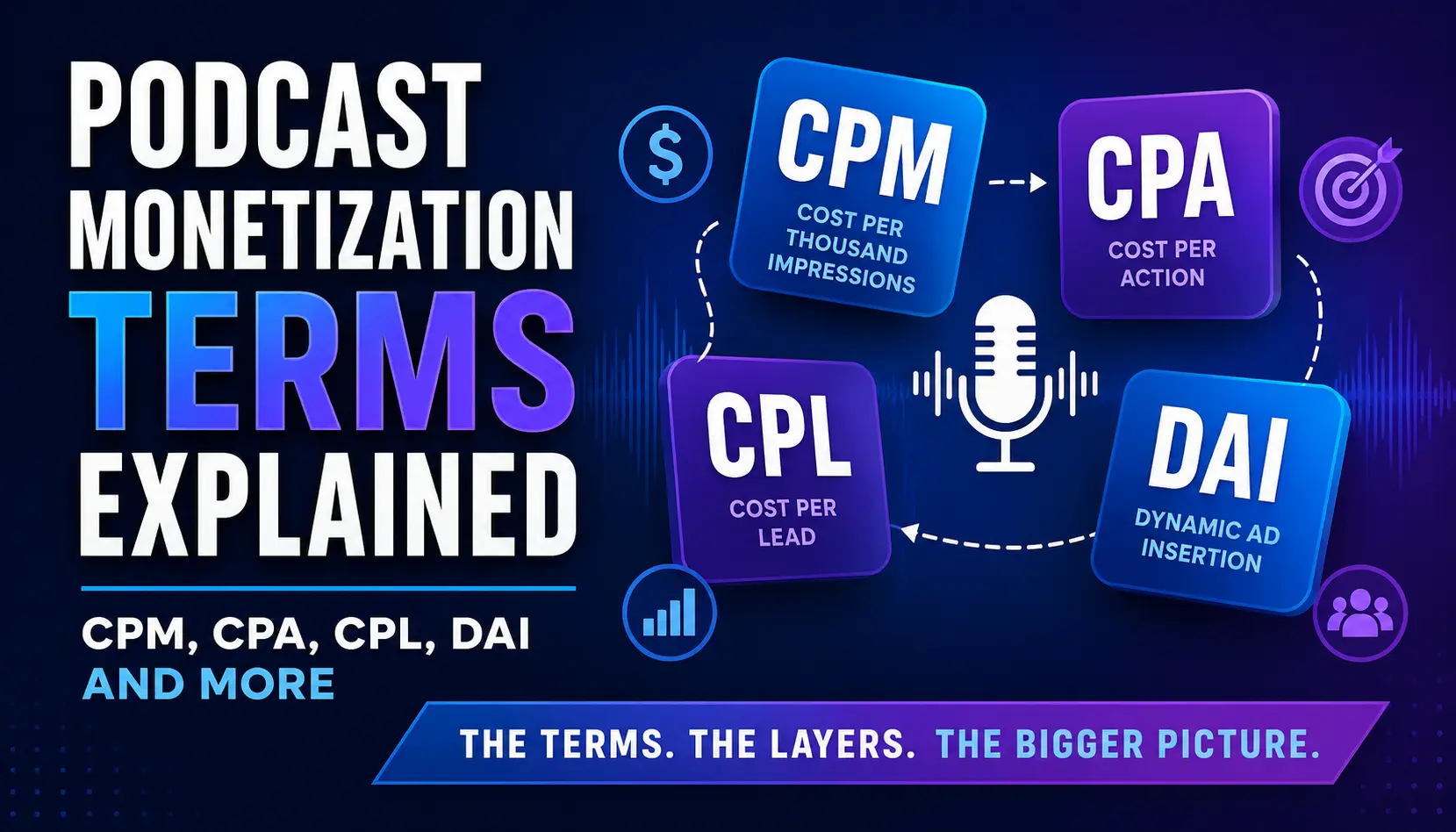
Podcast monetization terminology sounds more complicated than it really is because people often mix several completely different parts of an advertising deal together.
CPM tells you one thing. Dynamic ad insertion tells you another. “Host-read” describes something else entirely.
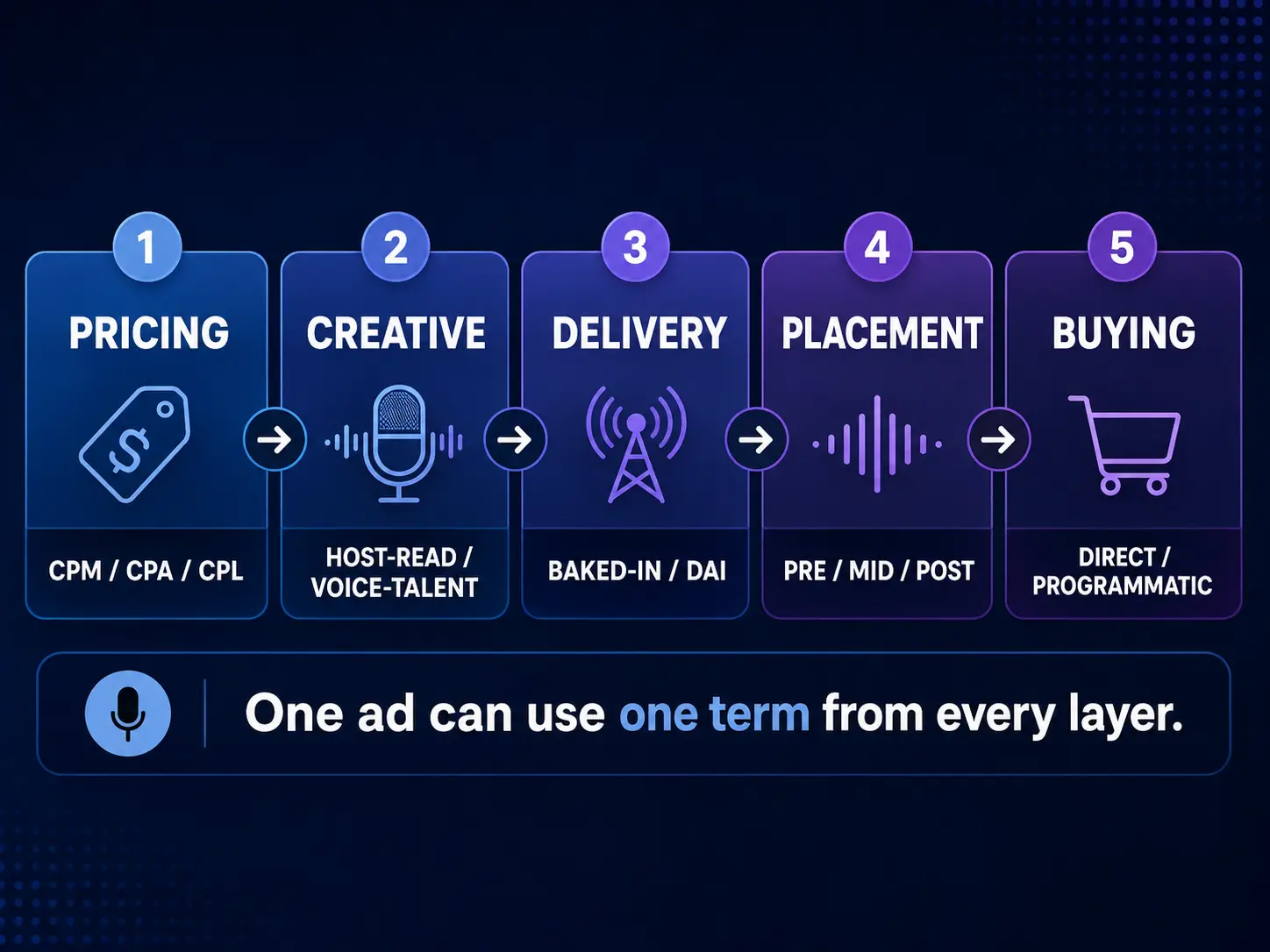
The easiest way to understand the language is to separate it into a few basic questions:
- How is the money calculated?
- Who reads or produces the ad?
- How does the ad get into the episode?
- Where does the ad appear?
- How is the advertising inventory bought?
Once you separate those pieces, terms like CPM, CPA, CPL, DAI, host-read, baked-in, and programmatic become much easier to understand.
Podcast Monetization Terms at a Glance
| Term | Plain-English Meaning | What It Describes |
|---|---|---|
| CPM | Cost per 1,000 impressions | Pricing |
| CPA | Cost per action or acquisition | Performance |
| CPL | Cost per lead | Performance |
| Baked-in ad | Ad permanently included in the episode file | Delivery |
| DAI | Ad dynamically inserted into an available ad break | Delivery |
| Host-read | Ad voiced by the podcast host | Creative |
| Announcer/voice-talent ad | Ad voiced by someone other than the host | Creative |
| Pre-roll | Ad near the beginning | Placement |
| Mid-roll | Ad within the episode | Placement |
| Post-roll | Ad near the end | Placement |
| Programmatic | Automated buying and selling of ad inventory | Buying method |
| Direct-sold | Advertiser and publisher negotiate the placement directly | Buying method |
The important thing to notice is that these terms aren’t mutually exclusive.
You could have a host-read, dynamically inserted, mid-roll ad sold on a CPM basis through a direct sponsorship.
Every word in that sentence describes a different part of the deal.
CPM: Cost Per Thousand Impressions
CPM stands for cost per mille, or cost per thousand.
In a CPM advertising deal, the advertiser pays according to the number of qualifying ad impressions delivered.
The basic calculation is:
Impressions ÷ 1,000 × CPM rate = advertising cost
So CPM answers the question:
How much is the advertiser paying for exposure?
What CPM does not automatically tell you is exactly how an impression is being measured.
Podcast advertising has some unusual measurement challenges because traditional RSS-delivered podcasts are commonly distributed through downloaded or progressively downloaded audio rather than a permanently open streaming connection. IAB Tech Lab maintains technical guidelines specifically for podcast downloads, audience measurement, and ad delivery; its current published Podcast Measurement Technical Guidelines are Version 2.2.
That means a serious CPM agreement should make the measurement method clear rather than simply saying, “We’ll pay you per thousand listeners.”
For more on why CPM shouldn’t automatically become the definition of a podcast’s value, see Beyond the CPM: Redefining Podcast ROI.
CPA: Cost Per Action or Acquisition
CPA measures the cost associated with getting someone to complete a defined action or acquisition.
Depending on the campaign, that action might be:
- purchasing a product;
- starting a trial;
- booking an appointment;
- creating an account;
- completing another defined conversion.
The important word is defined.
If somebody tells you a campaign is based on CPA, your next question should be:
What exactly counts as the action?
CPA is also frequently used as a campaign performance metric rather than literally describing how the podcaster is paid. IAB’s podcast buyer-seller guidance, for example, discusses CPA as a possible campaign KPI.
So don’t assume that seeing “CPA” automatically means you are entering some kind of affiliate arrangement.
Find out what is being measured, how it is attributed, and what actually triggers payment.
CPL: Cost Per Lead
CPL stands for cost per lead.
Instead of measuring a completed purchase, CPL focuses on generating an identifiable prospective customer.
That could mean someone:
- joins an email list;
- requests information;
- registers for an event;
- completes a lead form;
- starts a product trial;
- requests a consultation.
Again, the definition matters.
One advertiser might call any email signup a lead. Another may only count somebody who completes several qualification fields.
A CPL arrangement therefore needs a clear answer to:
What qualifies as a lead?
Without that definition, the acronym doesn’t tell you very much.
Baked-In Ads vs. Dynamic Ad Insertion
This is where podcast monetization terminology often gets tangled.
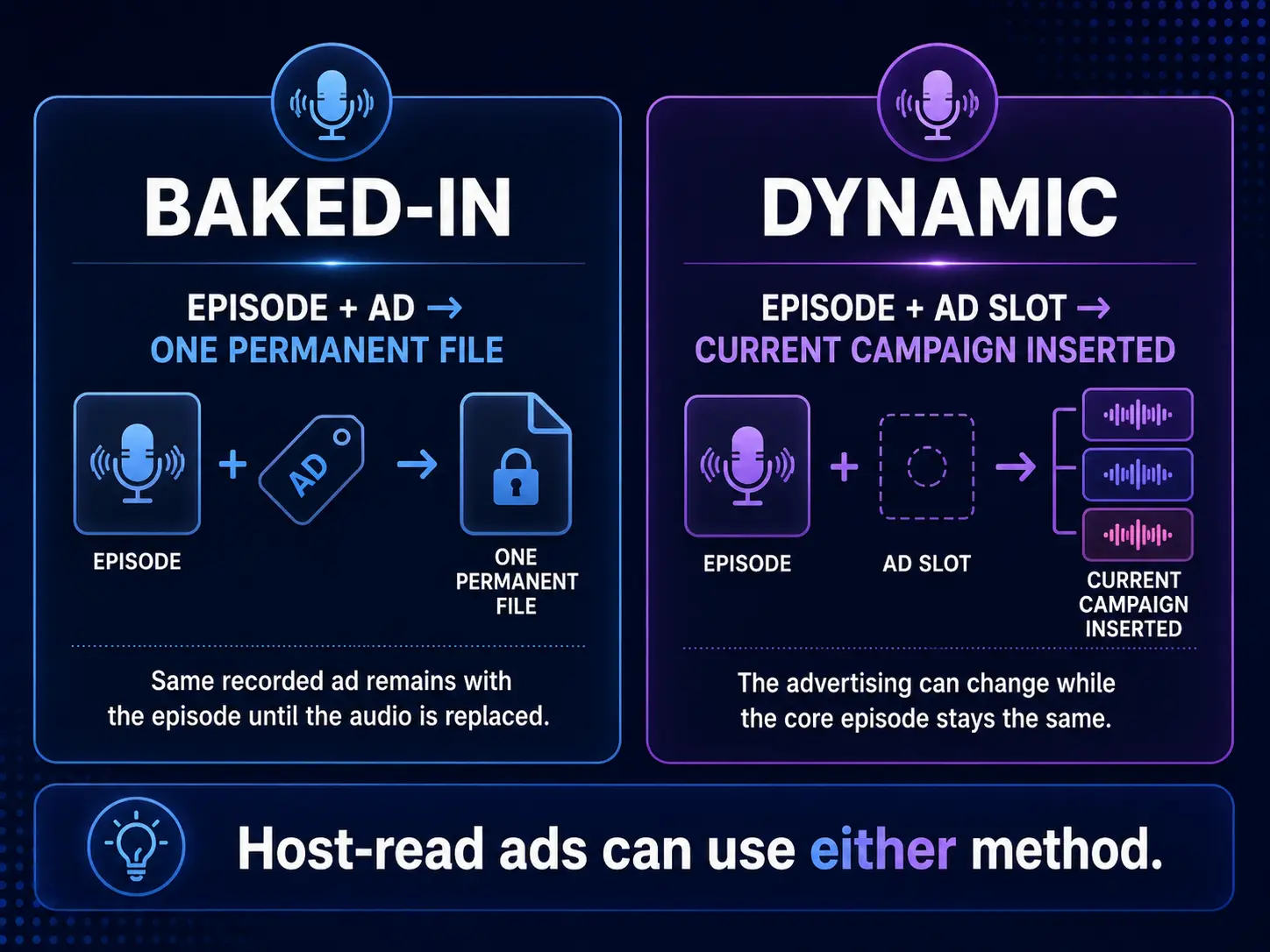
Baked-in and dynamic describe how the advertising gets into the episode. They do not describe who reads the ad or how the advertiser pays for it.
What Is a Baked-In Podcast Ad?
A baked-in, or embedded, ad is part of the episode’s actual audio file.
If you record a sponsor message, place it at 14:30 in your editing timeline, export the final episode, and publish that file, the advertising is embedded in the episode.
IAB defines embedded ads as advertising integrated into the original podcast file downloaded by the listener. Unless somebody replaces or edits that audio later, the same advertisement remains part of that episode.
This can work perfectly well for evergreen sponsorships.
It becomes less convenient when the message contains something temporary:
“Register before Friday.”
“Use this holiday code.”
“Doors close September 15.”
Now your old episode contains an offer that may no longer make sense.
What Is Dynamic Ad Insertion?
Dynamic Ad Insertion, or DAI, separates the advertising slot from the permanent episode content.
The episode can contain designated ad breaks, and the hosting or advertising system determines which active creative should be delivered into those positions.
IAB describes podcast DAI as inserting advertising into designated breaks when the listener initiates a podcast episode download. This allows different advertising to be delivered to different listeners or during different campaign periods, depending on the system and campaign configuration.
That makes several things possible:
- campaigns can start and stop without permanently changing the editorial recording;
- older catalog episodes can carry current advertising;
- different campaigns can occupy the same inventory at different times;
- targeting may be available where the platform, campaign, data permissions, and privacy rules support it.
If you want to go deeper into the hosting and implementation side, see The Dynamic Ad Landscape.
A Host-Read Ad Can Still Be Dynamic
This distinction is worth slowing down for because it causes a lot of confusion.
Host-read does not mean baked-in.
Host-read simply means the podcast host voices the commercial.
That recording could be permanently edited into an episode, or the host could record a standalone commercial that gets dynamically inserted into multiple episodes.
IAB’s buyer-seller guidance explicitly discusses host-read advertising being either embedded directly into an episode or dynamically inserted. Spotify likewise currently offers host-read executions in both dynamic and baked-in contexts.
So think of it this way:
Host-read = who says it.
DAI = how it gets there.
Two completely different questions.
Pre-Roll, Mid-Roll, and Post-Roll
These terms simply describe location.
Pre-Roll
A pre-roll advertisement appears near the beginning of the episode.
Mid-Roll
A mid-roll appears during the main episode.
A show can have one mid-roll or several designated mid-roll positions depending on its format and advertising strategy.
Post-Roll
A post-roll appears toward the end of the episode.
Amazon and Spotify both currently use these basic placement categories when explaining podcast advertising options.
Placement should not be confused with delivery.
A mid-roll can be baked in.
A mid-roll can be dynamically inserted.
A mid-roll can be host-read.
A mid-roll can be a pre-produced brand commercial.
Again, each term answers a different question.
Direct-Sold vs. Programmatic Podcast Advertising
Now we move from the ad itself to how the advertising is bought.
Direct-Sold Advertising
A direct deal is negotiated between the advertiser and the show, publisher, network, or sales representative.
The parties may negotiate things such as:
- placement;
- campaign dates;
- host involvement;
- creative requirements;
- pricing;
- impression commitments;
- category exclusivity;
- reporting.
Direct deals might use CPM pricing, a flat sponsorship fee, or another agreed structure.
Programmatic Advertising
Programmatic advertising uses technology to automate media buying and selling.
That does not automatically mean “cheap ads,” and it doesn’t mean the same thing as dynamic ad insertion.
Programmatic describes the transaction.
DAI describes the delivery.
Spotify, for example, currently offers podcast inventory through direct sales, self-service advertising tools, and programmatic buying through its ad exchange.
So a dynamically inserted ad does not have to be programmatic, and a podcaster can use dynamic insertion without opening every available slot to an automated advertising marketplace.
Two More Terms Worth Knowing: Inventory and Impressions
Podcast Ad Inventory
Your inventory is the advertising opportunity available across your episodes.
If you have designated pre-roll and mid-roll positions across a catalog, those placements represent potential advertising inventory.
IAB describes podcast inventory in terms of the ad impressions available across a show or group of shows.
Podcast Ad Impression
An ad impression represents qualifying delivery of an advertisement according to the measurement methodology being used.
That is different from simply looking at total episode downloads and assuming every download produced an advertising impression.
This distinction matters when money is changing hands.
If somebody is buying 100,000 impressions, both sides should know how those impressions are defined, measured, reported, and reconciled.
Podcast Monetization Doesn’t Have to Mean Selling Advertising
This is the part I think gets lost in a lot of conversations about podcast monetization.
If you run an entertainment show whose business model depends primarily on selling audience attention, advertising may be the product.
But many podcasts exist to support something else.
Maybe you run a local business.
Maybe you’re an educator.
Maybe you sell a product.
Maybe the podcast supports memberships, classes, events, services, referrals, donations, or customer education.
Maybe its job is to build enough trust that the right listener eventually starts a sales conversation.
In those cases, your most valuable podcast inventory may not belong to somebody else’s advertisement.
The podcast can direct listeners toward your own next step.
That doesn’t mean outside sponsorships are bad. It means you should decide what job the podcast is supposed to perform before automatically assuming monetization means filling every available break with somebody else’s commercial.
That is also why podcast downloads shouldn’t be treated as the entire measurement system.
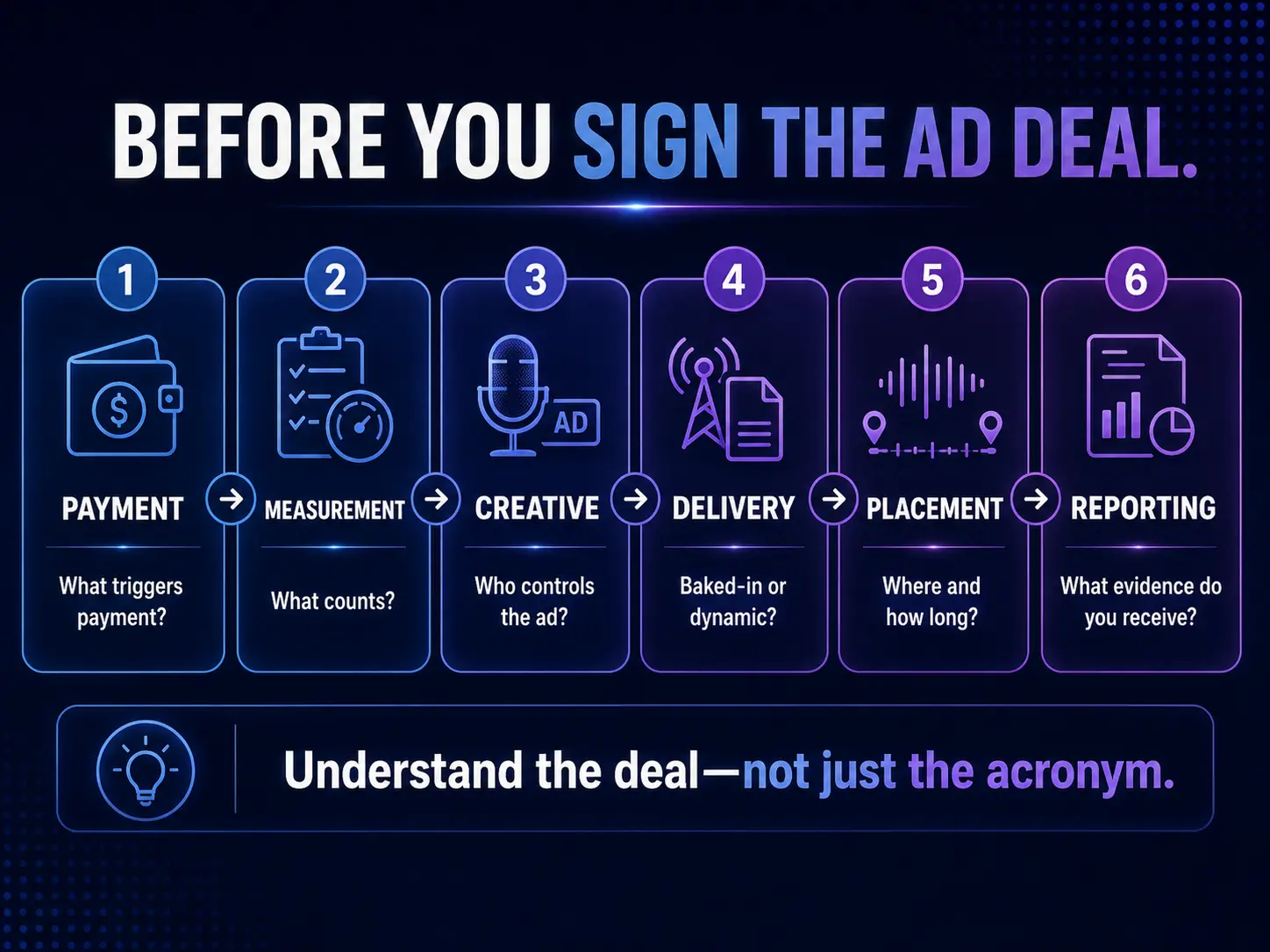
Before You Accept a Podcast Advertising Deal, Ask These Questions
You don’t need an advanced degree in media buying. You do need to know what you’re agreeing to.
Before accepting a network, sponsor, or advertising arrangement, get clear on:
- What exactly generates payment?
Impressions, actions, leads, purchases, a flat sponsorship fee, or something else? - How is that result measured?
Which reporting system and measurement standard will be used? - Who controls the creative?
Are you reading it, personalizing talking points, or playing advertiser-produced audio? - How is the advertising delivered?
Baked into individual episodes or dynamically inserted? - Where will it run?
Pre-roll, mid-roll, post-roll, specific episodes, the full catalog, or some combination? - How long does the campaign run?
What happens if it over-delivers or under-delivers? - What reporting and attribution do you receive?
Don’t wait until the campaign ends to discover that your definition of “success” and the advertiser’s definition were completely different.
Those questions matter more than memorizing the acronyms.
The Bottom Line
CPM, CPA, CPL, DAI, programmatic, host-read, and mid-roll aren’t seven competing ways to monetize a podcast.
They’re descriptions of different parts of the system.
Remember the layers:
Pricing → Creative → Delivery → Placement → Buying → Measurement
Once you know which layer somebody is talking about, the alphabet soup becomes much easier to decode.
And if your podcast exists to support a business, organization, or professional goal, don’t stop at the question, “How much can I charge for an ad?”
The more important question may be:
What valuable action is this podcast supposed to create—and how will I know whether it influenced that result?
If you want to build those decisions into the show instead of treating monetization, production, conversion, ROI, and attribution as separate problems, the Podcast Business System + Podcast Production OS is designed to connect them into one working system. That pathway is consistent with the approved Podcasting Pro Tips offer architecture and measurement direction.
Frequently Asked Questions
Is CPM the same thing as podcast downloads?
No. CPM means cost per thousand impressions. Podcast downloads may contribute to the underlying measurement process, but the campaign should define what qualifies as a billable ad impression.
Can a host-read podcast ad use dynamic ad insertion?
Yes. Host-read describes who delivers the commercial, while dynamic ad insertion describes how that recorded commercial is delivered into the episode.
Is dynamic ad insertion the same as programmatic advertising?
No. DAI is an ad-delivery method. Programmatic advertising is an automated way of buying and selling media inventory.
Which podcast monetization model is best for a small show?
There is no universal best model. A smaller show with a narrowly defined audience may evaluate sponsorships, performance-based arrangements, affiliate relationships, its own products or services, or a combination depending on the show’s actual business job.