A guest can give you the best answer of the entire interview—and you can completely miss it.
Not because you weren’t prepared.
Sometimes it happens because you were too attached to your preparation.
You asked Question #3. The guest answered it. Somewhere in that answer they mentioned an unexpected failure, changed their tone, contradicted a common belief, or casually introduced the most interesting idea of the conversation.
And while they were saying it, you were already looking at Question #4.
That’s what I call the Audience Member Trap.
You’re technically there. You hear the guest talking. But instead of actively hosting the conversation, you’re waiting for your next turn to read from the interview plan.
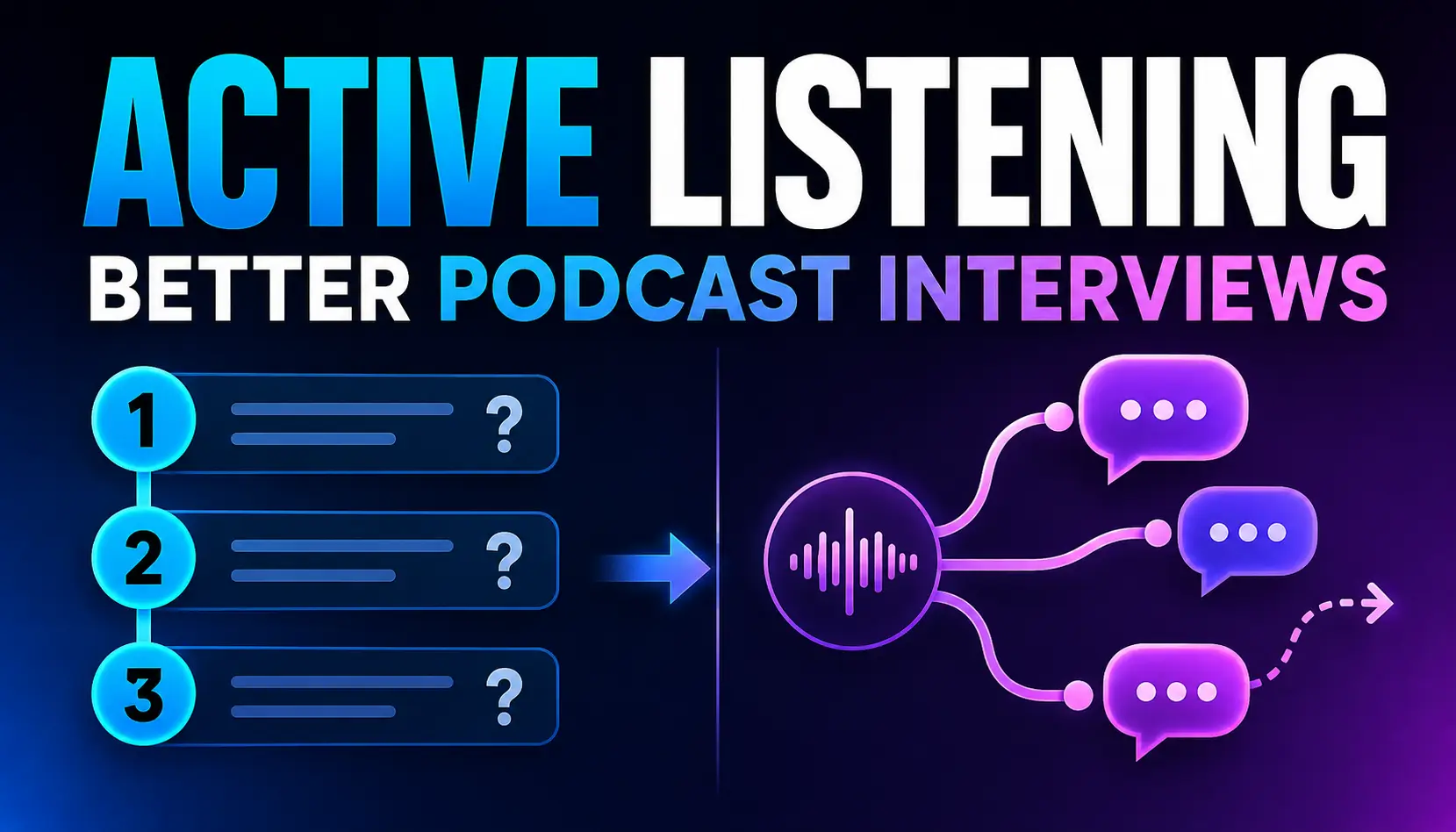
Better podcast interviews require a different skill: active listening.
Active listening means paying enough attention to what your guest actually says that you can recognize when an answer deserves clarification, a story, a concrete example, a challenge, or one more question before you move on.
The original question opens the door.
Very often, the follow-up is where the good interview starts.
What Is Active Listening in a Podcast Interview?
Active listening in a podcast interview means responding to the guest’s actual answer instead of simply progressing through your prepared questions.
You are still prepared.
You still know where the episode is supposed to go.
But you aren’t treating your interview plan like a teleprompter.
Instead, you’re listening for useful openings inside the answer.
That might be:
- a strong claim;
- an emotional word;
- an unexpected opinion;
- a contradiction;
- an unfinished story;
- a specific result;
- a moment of hesitation;
- a technical idea that needs translation;
- a vague statement that needs an example;
- or a phrase that suddenly changes the direction of the conversation.
When you hear one, you decide whether it deserves another question.
That’s the important distinction.
Active listening does not mean chasing every tangent your guest introduces.
It means knowing which threads are worth following for your audience.
Passive Listening vs. Active Listening
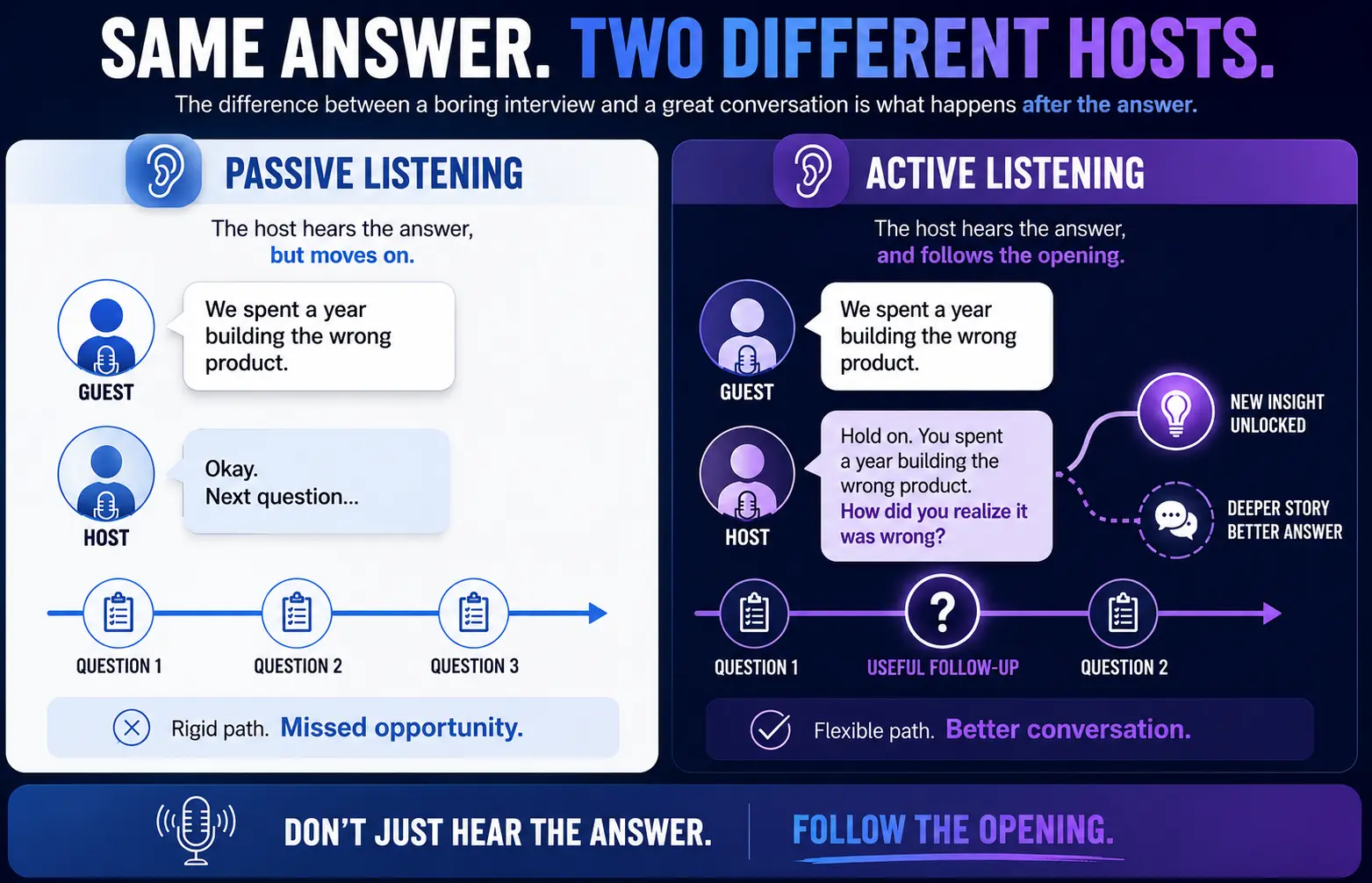
Here’s what passive podcast listening often sounds like.
Host: “What was the hardest part of launching the company?”
Guest: “Probably realizing our original product wasn’t actually solving the problem we thought it was. We had spent nearly a year building the wrong thing.”
Host: “Interesting. So who is your ideal customer today?”
There’s nothing technically wrong with the second question.
But the guest just handed the host an entire story.
What was wrong with the original product?
How did they discover it?
What did that mistake cost them?
What changed?
What would they tell someone making the same mistake?
An active host hears the opening.
Host: “Hold on. You said you spent nearly a year building the wrong thing. How did you finally realize that?”
Now the interview has somewhere to go.
That single follow-up may produce a better story, a more useful lesson, and a stronger clip than the next five prepared questions.
The Problem Isn’t Having Prepared Questions
This is where podcast interview advice can get oversimplified.
You absolutely should prepare.
Walking into an interview with no direction and saying, “We’ll just have a conversation,” is not automatically more authentic. Sometimes it simply produces 45 minutes of wandering conversation that your audience has to sort out later.
Good preparation matters.
The mistake is preparing only a list of questions.
A stronger approach is to prepare the path of the interview.
Before recording, know:
- why this guest belongs on the episode;
- what your audience should understand by the end;
- which major subjects need to be covered;
- what stories or ideas are worth exploring;
- and what useful takeaway you want to reach.
I go deeper into that distinction in The 85-Cent ChatGPT Trap: How to Prepare for a Better Podcast Interview.
And it connects to a larger pre-production lesson: strong podcast pre-production gives you direction before you record without scripting every second of the conversation.
Your plan should make it easier to listen.
If your plan requires so much attention that you stop hearing your guest, it is working against you.
What Should You Listen for During a Podcast Interview?
You do not have to analyze every sentence.
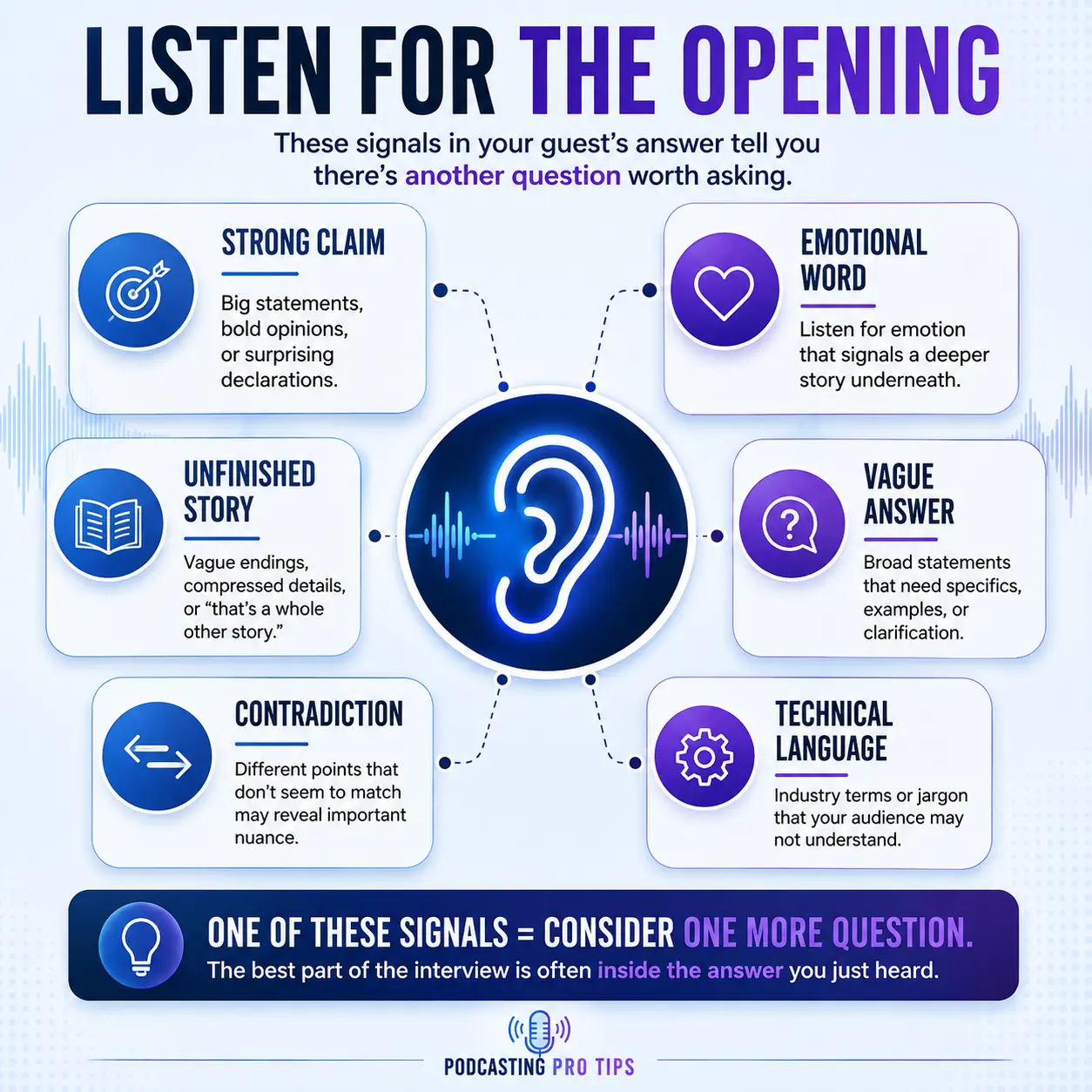
Listen for a handful of signals that tell you an answer may deserve another question.
1. Strong or Unexpected Claims
Listen for statements such as:
“The biggest mistake people make is…”
“That advice actually made things worse.”
“The real problem wasn’t what we thought.”
A strong claim creates natural tension.
Don’t automatically agree and move on.
Ask:
“Why do you think that happens?”
or:
“What makes you say that?”
or:
“What are people missing?”
You are giving the guest a chance to support the idea rather than leaving a provocative statement hanging in the air.
2. Emotional Language
People signal important moments with language.
Listen for words such as:
- terrified;
- relieved;
- frustrated;
- embarrassed;
- surprised;
- exhausted;
- angry;
- stuck;
- excited.
You do not have to turn every interview into therapy.
But emotion often tells you that there is a story underneath the surface answer.
Try:
“You said that was frustrating. What was actually happening at that point?”
Or simply:
“What made that so difficult?”
3. Half-Told Stories
Guests frequently compress stories because they assume the details aren’t important.
You might hear:
“We tried that once and it was a disaster, so we changed the process.”
That sentence contains a flashing neon FOLLOW-UP sign.
Ask:
“What happened?”
Sometimes the simplest follow-up is the best one.
Other useful options:
“Can you walk me through that?”
“Where did it start going wrong?”
“What changed after that?”
Now the guest has room to turn a summary into a story.
4. Vague Advice
Guests—especially experts—can unintentionally speak in abstractions.
You hear:
“You really need to understand your customer.”
Fine.
But what does that actually mean?
Instead of letting the statement float by, ask:
“What does that look like in practice?”
“Can you give me an example?”
“What would someone actually do first?”
Specificity makes the answer more useful.
It also tends to create much stronger standalone clips because the person watching the clip can understand the point without hearing ten minutes of context first.
5. Technical Language
Experts forget what beginners don’t know.
If a guest starts using terminology your audience may not understand, don’t nod along merely because you understand it.
Translate on behalf of the listener.
Try:
“For somebody who doesn’t work in this every day, what does that mean?”
Or:
“Can you put that into plain English for us?”
That isn’t dumbing down the conversation.
It’s hosting.
6. Contradictions and Tension
Interesting conversations often contain tension.
Maybe a guest says:
“Consistency is incredibly important.”
Then ten minutes later:
“Sometimes the smartest move is to stop publishing for a month.”
Those ideas may both be true.
Your job is to help the audience understand the distinction.
Ask:
“Earlier you said consistency matters. How do you square that with intentionally stopping?”
That kind of question helps the guest sharpen the idea instead of leaving the listener to reconcile it alone.
7. A Shift in Energy
Not every useful signal appears in the words.
Sometimes the guest speeds up.
Sometimes they pause.
Sometimes they suddenly become much more animated.
Sometimes an answer that had been polished and automatic becomes noticeably more thoughtful.
Pay attention to those changes.
You don’t need some elaborate psychological interpretation.
Just notice when the person in front of you suddenly seems to care more about what they’re saying.
There may be something there worth following.
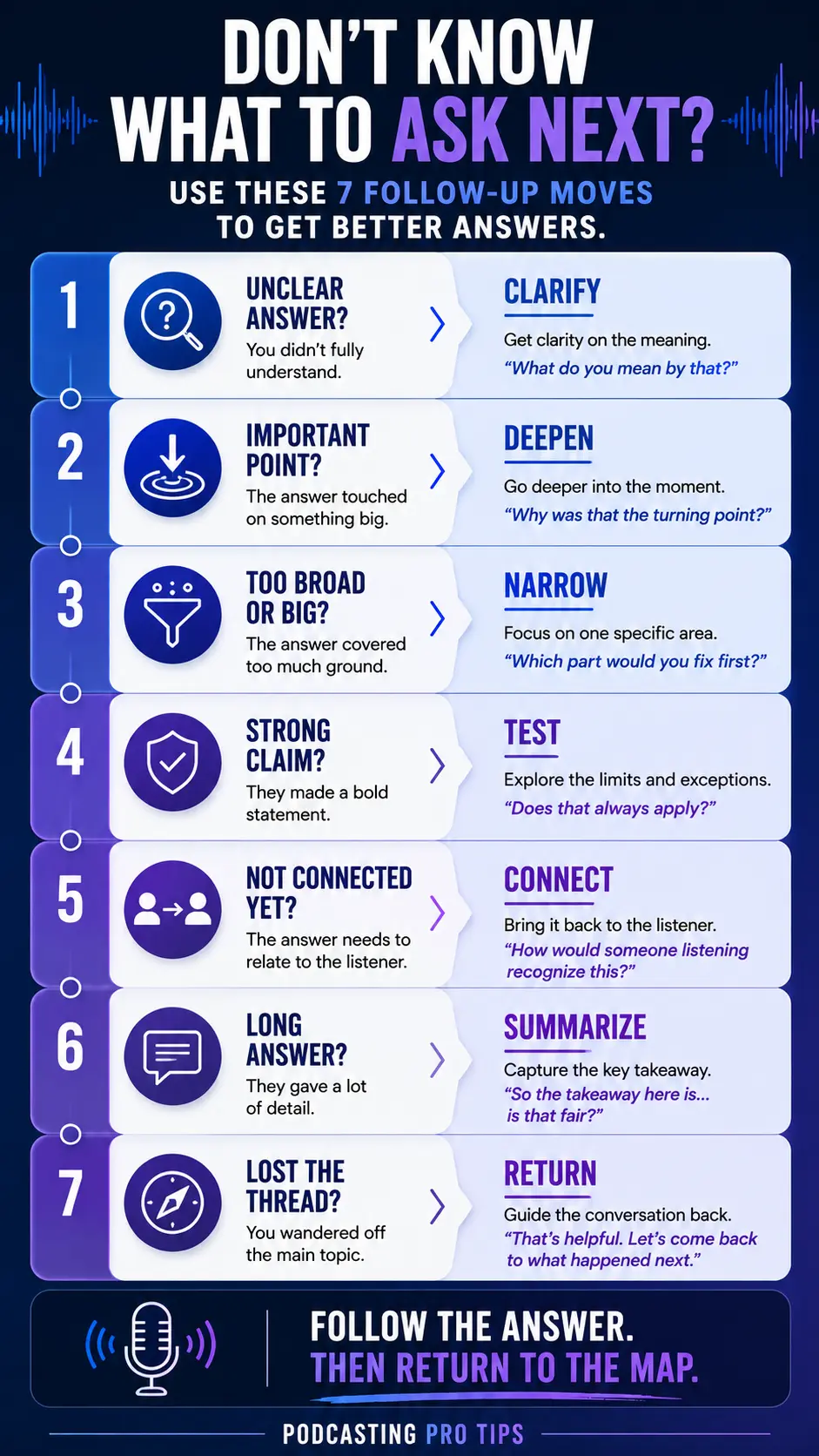
Seven Useful Types of Podcast Follow-Up Questions
You do not need 75 clever follow-ups memorized.
You need a few reliable moves.
Clarify
Use this when the answer is confusing or broad.
“What do you mean by that?”
“Can you explain that another way?”
Reflect
Use this to check that you understood the point.
“So if I’m hearing you correctly, the real problem wasn’t the technology—it was the process?”
This also gives the guest a chance to correct you.
Narrow
Use this when the answer covers too much ground.
“Of those three problems, which one would you fix first?”
Deepen
Use this when the guest has reached something important.
“Why was that the turning point?”
“What changed for you after that?”
Test
Use this when the guest makes a strong claim.
“Does that apply in every situation, or are there cases where you’d do the opposite?”
That produces nuance rather than an argument.
Connect
Use this when the answer needs to return to your audience.
“How would someone listening recognize that problem in their own situation?”
Summarize
Use this after a longer answer or section.
“So the practical takeaway here is to solve X before you start worrying about Y. Is that fair?”
You help the listener re-enter the conversation and give the guest a chance to tighten the lesson.
The Follow-Up Is Often Better Than the Original Question
This is one of the most useful interview lessons to learn.
Your planned question exists before the guest says anything.
Your follow-up exists because of what the guest just said.
That makes it specific to this guest, this moment, and this conversation.
Consider:
Prepared question:
“What advice would you give someone starting a business?”
Versus:
Follow-up:
“You said you almost closed the company six months in. What happened during those six months that made you reconsider?”
The first question could be asked to ten thousand guests.
The second could only happen in this conversation.
That specificity is one reason good interviews feel alive rather than interchangeable.
How Do You Follow a Tangent Without Losing the Interview?
Active listening has a failure mode too.
You can become so interested in every side road that the episode loses its point.
So use a simple rule:
Follow the thread when it strengthens the episode objective. Return to the map when it doesn’t.
Suppose your episode is about how a founder rebuilt a failing service business.
The guest briefly mentions an unusual hiring decision that changed everything.
That may deserve exploration.
Ask the follow-up.
Get the story.
Then bridge back:
“That explains the team change. I want to come back to what happened with the business after you made it.”
You are not choosing between structure and spontaneity.
You are using structure to make useful spontaneity possible.
Use an Interview Map Instead of a Giant Question List
A practical way to make active listening easier is to reduce the amount of material you’re staring at during the interview.
Instead of 25 questions, build three or four major conversation blocks.
For example:
Block 1 — Context
What does the listener need to understand about the situation?
Block 2 — Problem or Tension
Where did things get difficult, confusing, or interesting?
Block 3 — Method or Turning Point
What changed and why?
Block 4 — Application
What should the listener understand or do with this?
Under each block, keep:
- one anchor question;
- one or two likely follow-ups;
- a few backup prompts.
That gives you a destination without forcing you to follow a script.
It also matches the interview approach behind the Podcast Guest Prep Kit: define the objective, map the arc, use research anchors, and then listen for stronger follow-ups while you record.
A Simple Active Listening Drill
You can practice this before your next real interview.
Take a five- or ten-minute interview clip from YouTube or a podcast.
After each answer, pause it.
Before you hear the interviewer’s next question, write down the follow-up you would ask.
Then continue.
Ask yourself:
- Did the person say anything surprising?
- Did they make a strong claim?
- Was there an unfinished story?
- Was anything vague?
- Was there an emotional shift?
- Did they use a technical term that needed clarification?
- Was there something the audience would want applied to their situation?
You are training yourself to hear openings.
Eventually, you start recognizing them without consciously running through a checklist.
Active Listening Is Part of Podcast Pre-Production
This may sound like a skill you use only once the recording begins.
It isn’t.
Your ability to listen during the interview depends heavily on what you prepared beforehand.
If you have no idea where the episode is going, you will cling to your questions.
If you know the objective, the major conversation blocks, the important research anchors, and the intended listener takeaway, you have more freedom.
You know what has to be covered.
That gives you room to explore what deserves exploration.
Preparation gives you the map.
Active listening lets you notice the better road.
Stop Managing the Interview. Start Hosting It.
Your guest should not have to compete with your question list for your attention.
Prepare enough that you know where the conversation needs to go.
Then look up.
Listen.
Notice the unexpected phrase.
Ask for the story.
Clarify the vague answer.
Challenge the interesting claim.
Translate the technical explanation.
And when the useful side road is finished, guide the conversation back.
That is the difference between somebody who asks podcast questions and somebody who actually hosts an interview.
Want a Better System for Your Next Guest Interview?
The Podcast Guest Prep Kit includes the Active Listening Prompt Bank, Interview Arc Planner, Research Anchor tools, question-rewrite cheat sheets, Ramble Rescue Guide, guest preparation workflows, and additional interview resources designed to help you prepare the path without scripting the life out of the conversation.
Get the Podcast Guest Prep Kit and use the Active Listening Prompt Bank during your next recording.