If you’re brand new to hosting, jumping straight into guest interviews can make podcasting harder than it needs to be.
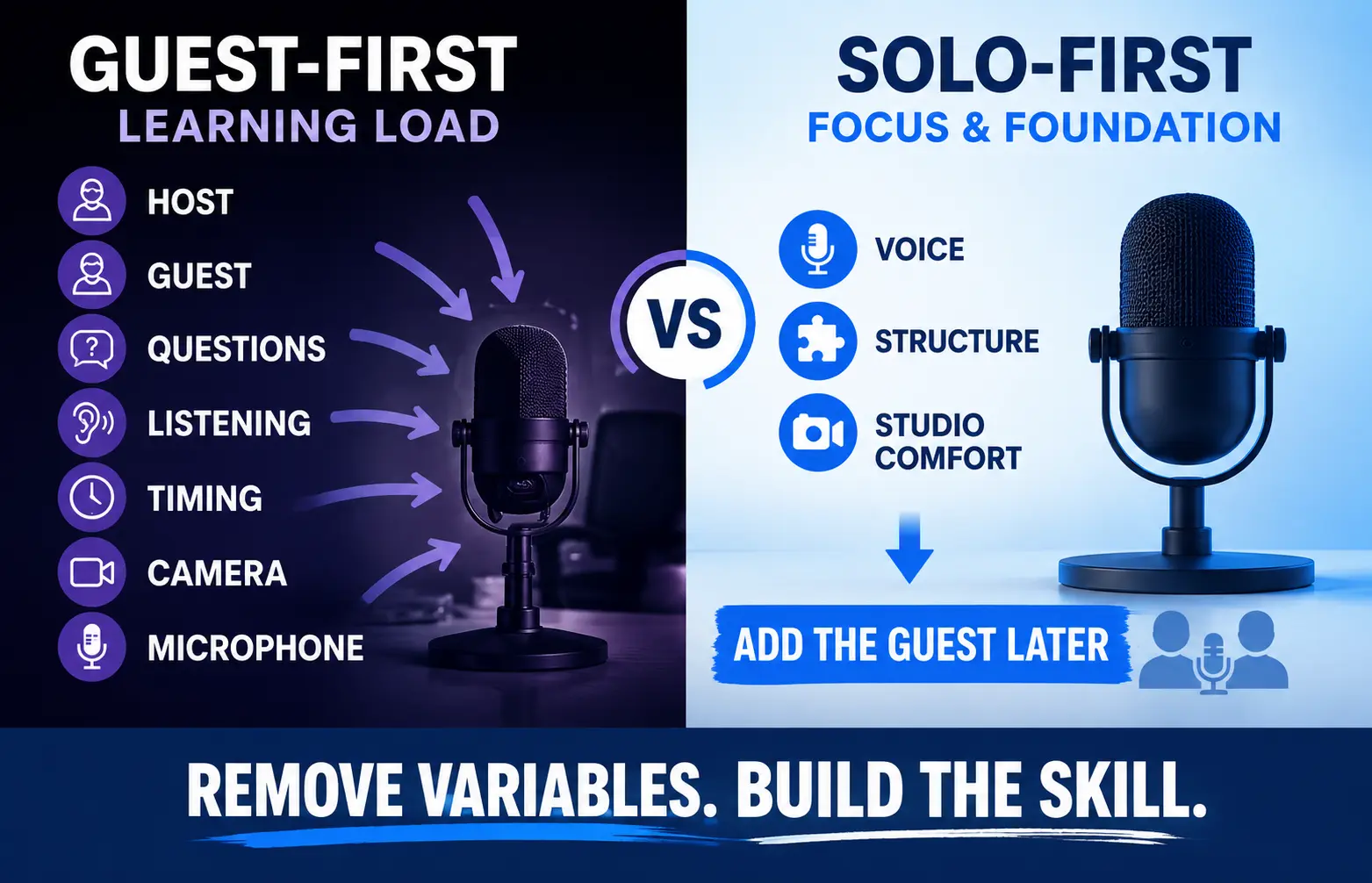
You’re not only learning how to talk into a microphone. You’re trying to watch the clock, remember your questions, listen to the guest, decide when to follow up, manage the camera, stay on topic, and somehow look relaxed while doing all of it.
That’s a lot of moving parts for Episode 1.
A better approach for many new hosts is to record a few solo podcast episodes first.
Not because every podcast needs to become a solo show. And not because guests are a bad idea.
You do it because solo episodes let you learn your part of the job before you add another person to the equation.
I Watched a New Host Learn This the Hard Way
I had a successful business owner come into the studio to launch a new podcast. They were ambitious, energetic, and had already lined up some impressive guests.
On paper, it looked like a great launch.
Once recording started, another problem appeared.
The host was learning how to use the microphone, interact with the camera, follow an interview structure, manage nerves, listen to the guest, formulate follow-up questions, and keep an episode moving—all at the same time.
The guests weren’t the problem.
There were simply too many new variables at once.
That’s one reason I like new hosts to get a few solo reps before they start depending heavily on interviews.
Think of it as spring training.
You aren’t trying to prove that solo podcasting is the superior format. You’re learning how to host before you make hosting more complicated.
Why Guest Interviews Are Harder Than They Look
A good interview is not just you reading questions while another person answers them.
You have to listen actively enough to notice when the guest says something worth exploring. You have to decide whether to follow that thread or bring the conversation back to the original point. You need to manage pacing without making the conversation feel controlled.
That’s an entirely different skill from knowing your subject.
If you eventually want to become a strong interviewer, learning the difference between active and passive listening during podcast interviews matters.
But before you can manage somebody else’s performance, it helps to get comfortable managing your own.
Solo Episodes Remove Variables
When you record alone, several things disappear.
There is no guest schedule.
No guest bio.
No unpredictable answer.
No question list to manage.
No need to decide whether you should interrupt.
No pressure to make another person feel comfortable while you’re still trying to remember where the camera is.
That gives you room to concentrate on a smaller set of skills:
- your voice;
- your pacing;
- your microphone technique;
- your camera presence;
- your episode structure;
- your transitions;
- your opening;
- your ending.
You’re simplifying the practice environment.
Once those things begin feeling normal, you can add another person.
The Camera Changes How You Speak
This catches a lot of new hosts off guard.
You might be perfectly comfortable teaching a class, leading a meeting, selling something, or talking with a client.
Then the camera light comes on.
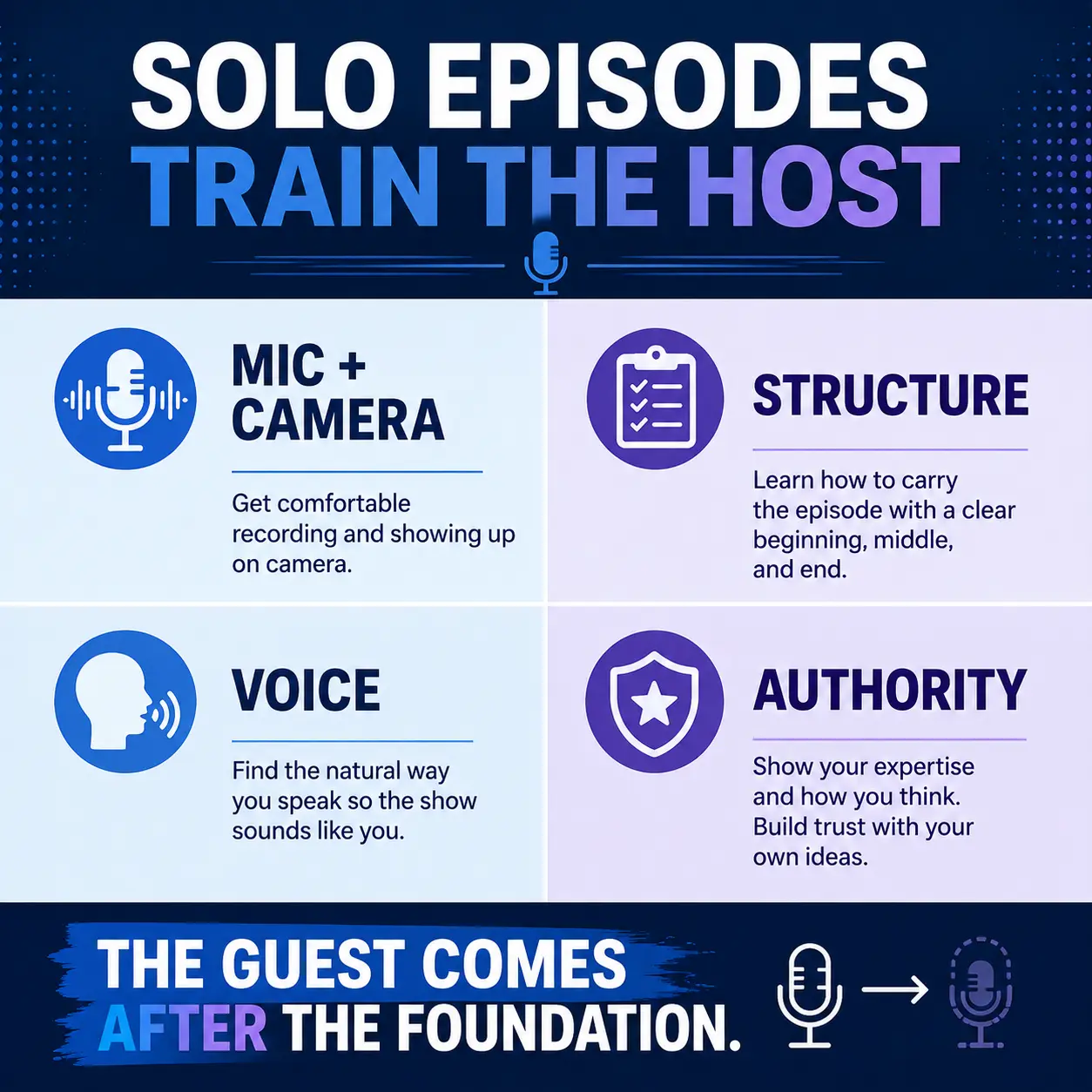
Suddenly you’re thinking about your voice, your posture, your face, your hands, the microphone, the headphones and whether you’re saying “um” too much.
Instead of communicating, you’re monitoring yourself.
The fix usually isn’t another camera.
It’s repetition.
Recording solo gives you a low-pressure way to become familiar with the physical experience of podcasting. If video is part of your show, your physical preparation and on-camera podcast presence deserve practice just like your content does.
Eventually the equipment stops feeling like the event.
You can concentrate on the idea you’re trying to communicate.
Solo Episodes Teach You How to Structure an Episode
This may be the bigger benefit.
A guest can accidentally hide weak structure.
If the guest is funny, charismatic or has great stories, the conversation may remain entertaining even when you never really designed an episode.
When you’re alone, there’s nowhere for weak structure to hide.
You quickly discover whether you know:
- what this episode is about;
- why somebody should care;
- where you’re taking them;
- what examples help explain the point;
- what they should remember at the end.
That’s why good podcast pre-production matters even for a short solo episode.
You don’t need to script every sentence.
You need a path.
A simple solo speaking map might look like:
Hook → Problem → Main Point → 2–3 Supporting Ideas → Example → Takeaway → Next Step
That gives you enough structure to stay focused without scripting the life out of the recording.
You Start Discovering the Voice of the Show
Your first episodes also help answer a question that’s difficult to solve on paper:
What does this show actually sound like?
You can write a mission statement before recording. You can choose your audience. You can design the artwork.
But speaking the show out loud exposes things a planning document can’t.
You’ll hear which phrases feel natural.
You’ll discover whether your intro is too long.
You’ll notice whether your topic is too broad.
You’ll find out whether your original episode format actually fits you.
You’ll start hearing the difference between your normal speaking voice and your “podcast host voice.”
The first one is usually better.
This is where your podcast concept and show foundation stop being theoretical and start turning into an actual program.
Solo Episodes Put Your Expertise in the Foreground
Guests can add expertise, perspective and credibility to a show.
But if every valuable idea comes from the guest, an interesting thing happens:
The audience may remember the guest more clearly than the host.
Solo episodes force you to explain the problem.
You make the argument.
You teach the process.
You choose the examples.
You show how you think.
That makes solo content especially useful when your podcast has a business, professional, educational or authority-building job.
You don’t have to announce that you’re an expert.
The episode can demonstrate it.
Solo Episodes Also Make Your Production System Stronger
There is another advantage that gets less attention.
Solo episodes are easier for testing your actual production workflow.
Can you prepare the episode efficiently?
Can you record it cleanly?
Can you get usable video?
Can you edit it without creating a six-hour project?
Can you publish the show notes, clips and related assets without everything becoming a fire drill?
Those questions matter.
A guest shouldn’t be the thing holding your publishing schedule together.
Once you know you can create a useful episode without one, a guest cancellation becomes an inconvenience instead of a missing episode.
That’s a much healthier production model.
What Should Your First Three Solo Episodes Be About?
You don’t need three giant “ultimate guide” episodes.
Use the first few recordings to practice different parts of the job.
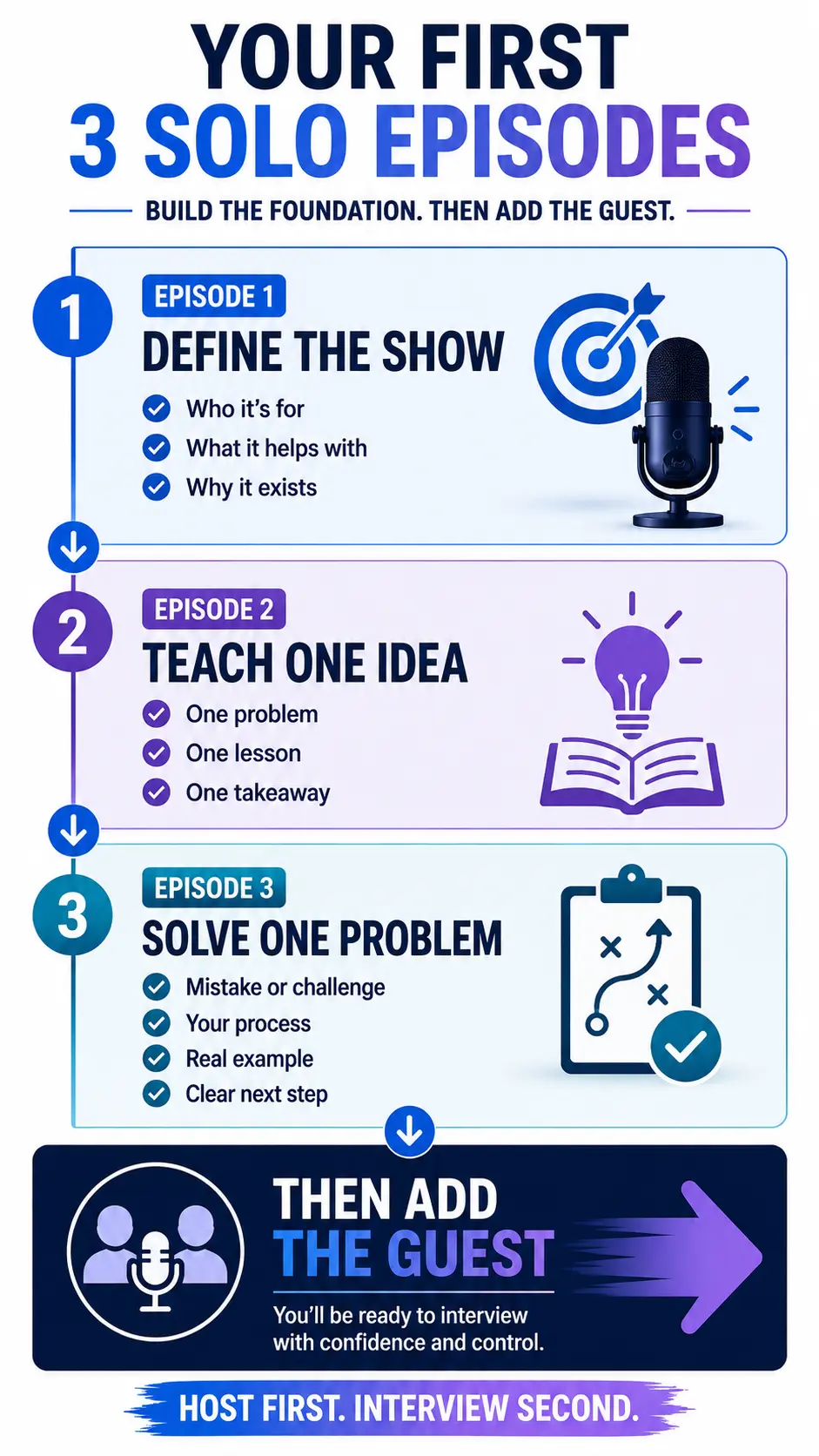
Solo Episode 1: Explain the Job of the Show
Don’t spend the entire episode telling your life story.
Explain:
- who the show is for;
- what problems you’ll help with;
- why those problems matter;
- what perspective you’re bringing;
- what the audience can expect.
This forces you to articulate the show promise in normal language.
Solo Episode 2: Teach One Useful Idea
Choose one real question your audience has.
Not five questions.
One.
Teach the answer in a short, structured episode.
This helps you practice opening with relevance, developing one idea and actually landing the point.
Solo Episode 3: Solve a Specific Problem
Take a mistake, obstacle, misconception or recurring question and walk through your way of handling it.
Now you’re practicing the skill that will matter throughout the life of the show: turning what you know into useful audio and video.
After those episodes, listen back.
Don’t ask whether you sounded like your favorite podcaster.
Ask:
- Was the point clear?
- Did the opening get there quickly?
- Did I ramble?
- Did the sections flow?
- Did I sound like myself?
- Was the ending clear?
- Could I record another one without rebuilding the process?
That’s useful feedback.
When Should You Start Bringing in Guests?
There isn’t a magic episode number.
You’re ready when adding a guest feels like adding value rather than adding chaos.
You should be reasonably comfortable with your microphone, camera and recording environment.
You should understand the basic shape of your episodes.
You should be able to open and close the show without scrambling.
And most importantly, you should know why you’re bringing that particular guest onto the podcast.
Once you’re ready, prepare the interview around the audience’s needs rather than simply collecting a long list of questions. My guide to better podcast interview preparation goes deeper into that transition.
The guest should enhance the show.
They shouldn’t be the show.
Solo Doesn’t Have to Mean Scripted
One reason people avoid solo episodes is the fear of rambling.
Then they solve that fear by writing 2,000 words and reading them into the microphone.
Now they aren’t rambling—but they don’t sound like themselves either.
The better middle ground is usually a speaking map.
Know:
- the opening;
- the main point;
- the two or three things you need to explain;
- your example;
- your takeaway;
- your next step.
Then talk through it.
You aren’t performing a memorized speech.
You’re explaining one useful thing to one person who needs it.
Want to Get Better at Recording Solo?
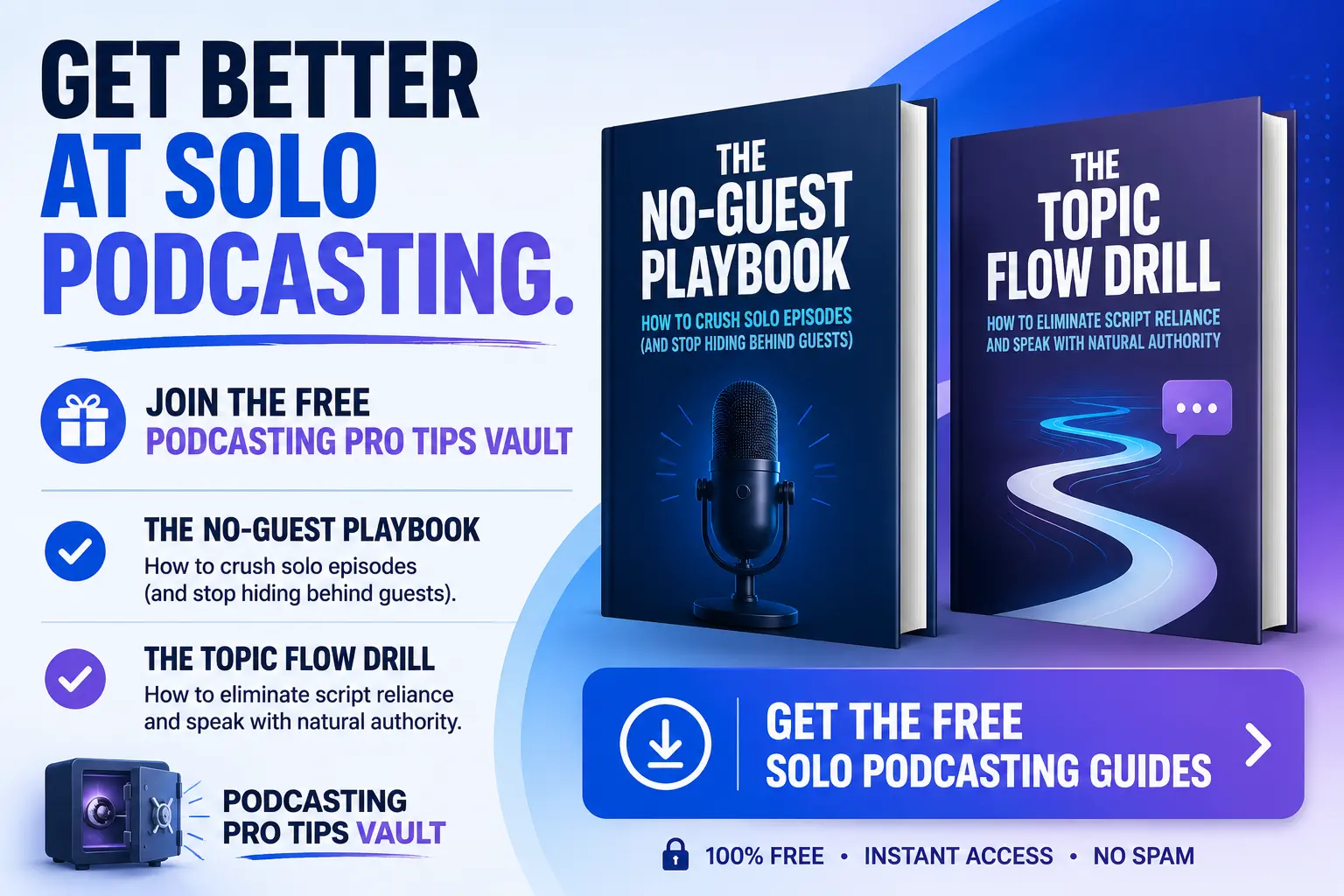
If guest dependency or script reliance is getting in your way, start with The No-Guest Playbook: How to Crush Solo Episodes (And Stop Hiding Behind Guests) inside the Free Podcasting Pro Tips Vault.
You’ll also find The Topic Flow Drill: How to Eliminate Script Reliance and Speak with Natural Authority there.
Use them to start building stronger solo episodes without turning every recording into a word-for-word script.
The Goal Isn’t to Stay Solo Forever
You may eventually build a heavily interview-driven show.
That’s fine.
Starting with solo episodes is not about locking yourself into one format.
It’s about developing the ability to carry your own show.
Learn your microphone.
Learn your camera.
Learn your structure.
Learn how you explain ideas.
Learn how the show gets produced.
Then bring in guests because they make a particular episode better—not because you need somebody else in the chair to make the podcast work.
That’s when interviews become a format choice instead of a dependency.
Frequently Asked Questions
How many solo podcast episodes should I record before interviewing guests?
There is no required number. Two or three focused solo episodes can give a new host useful practice with the microphone, camera, structure and production workflow. If those basics still feel overwhelming, keep practicing before adding another live variable.
Are solo podcast episodes boring?
They can be, but interviews can be boring too. Format is rarely the whole problem. A focused solo episode with a specific promise, useful structure and clear examples can be easier to follow than a long conversation with no real direction.
Does every podcast need solo episodes?
No. Some shows are intentionally built around co-hosts, documentary storytelling, panels or interviews. Solo episodes are especially useful when you want to develop hosting confidence, demonstrate your own expertise or create a reliable format that doesn’t depend on guest availability.