You do not necessarily need tens of thousands of downloads to get a podcast sponsor.
You do, however, need something an advertiser actually wants.
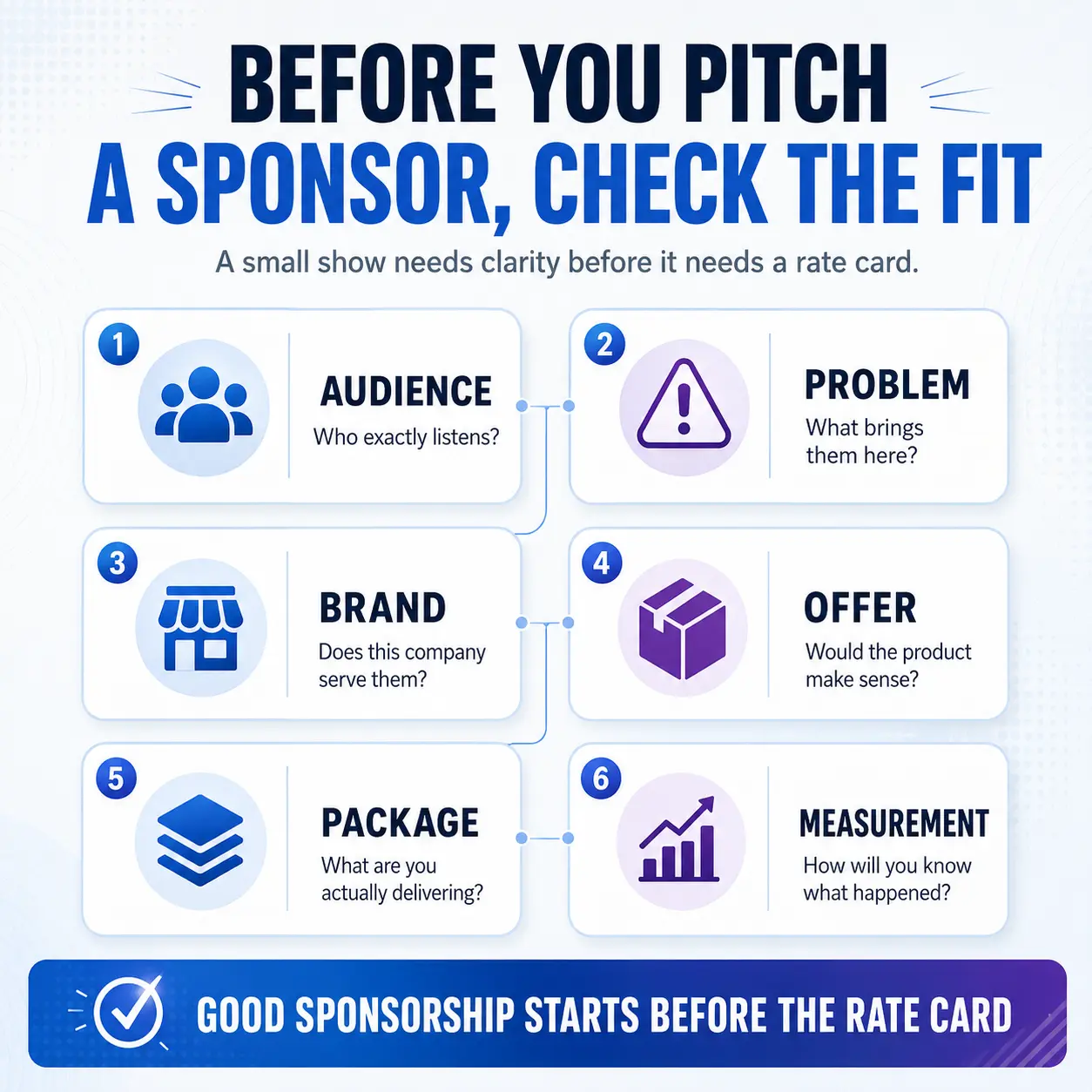
For a smaller podcast, that usually means a clearly defined audience, a strong connection between that audience and the sponsor, a credible sponsorship package, and some reasonable way to measure what happened.
That distinction matters.
A small audience isn’t automatically more engaged. A niche isn’t automatically valuable. And telling a company that your 500 listeners are “better than 50,000 normal listeners” isn’t much of a sponsorship pitch.
But a focused show can give the right advertiser something a large general-interest show may have trouble providing: concentrated relevance.
Acast’s Podcast Pulse research found that 80% of listeners surveyed said they listen to niche podcasts. Sixty percent described niche shows as more engaging, listeners reported being 63% less likely to skip advertising on those shows, and nearly 60% said they were more likely to trust recommendations on niche shows.
Meanwhile, podcast advertising itself isn’t disappearing. IAB/PwC reported $2.9 billion in U.S. podcast advertising revenue for 2025, a 17.6% increase from the previous year.
So the opportunity is real.
The question is whether you can make your particular audience useful to the right advertiser.
What Makes a Small Podcast Attractive to Sponsors?
A sponsor isn’t really buying your microphone time.
They’re buying access to an audience.
That means four things matter immediately:
Who listens?
Can you describe the audience clearly?
Why are they listening?
What problem, interest, profession, hobby, location or goal brings them together?
Does the sponsor belong in that conversation?
Would the sponsor’s product reasonably matter to these people?
Can you deliver and measure something useful?
Can you provide the promised placements and give the sponsor credible evidence afterward?
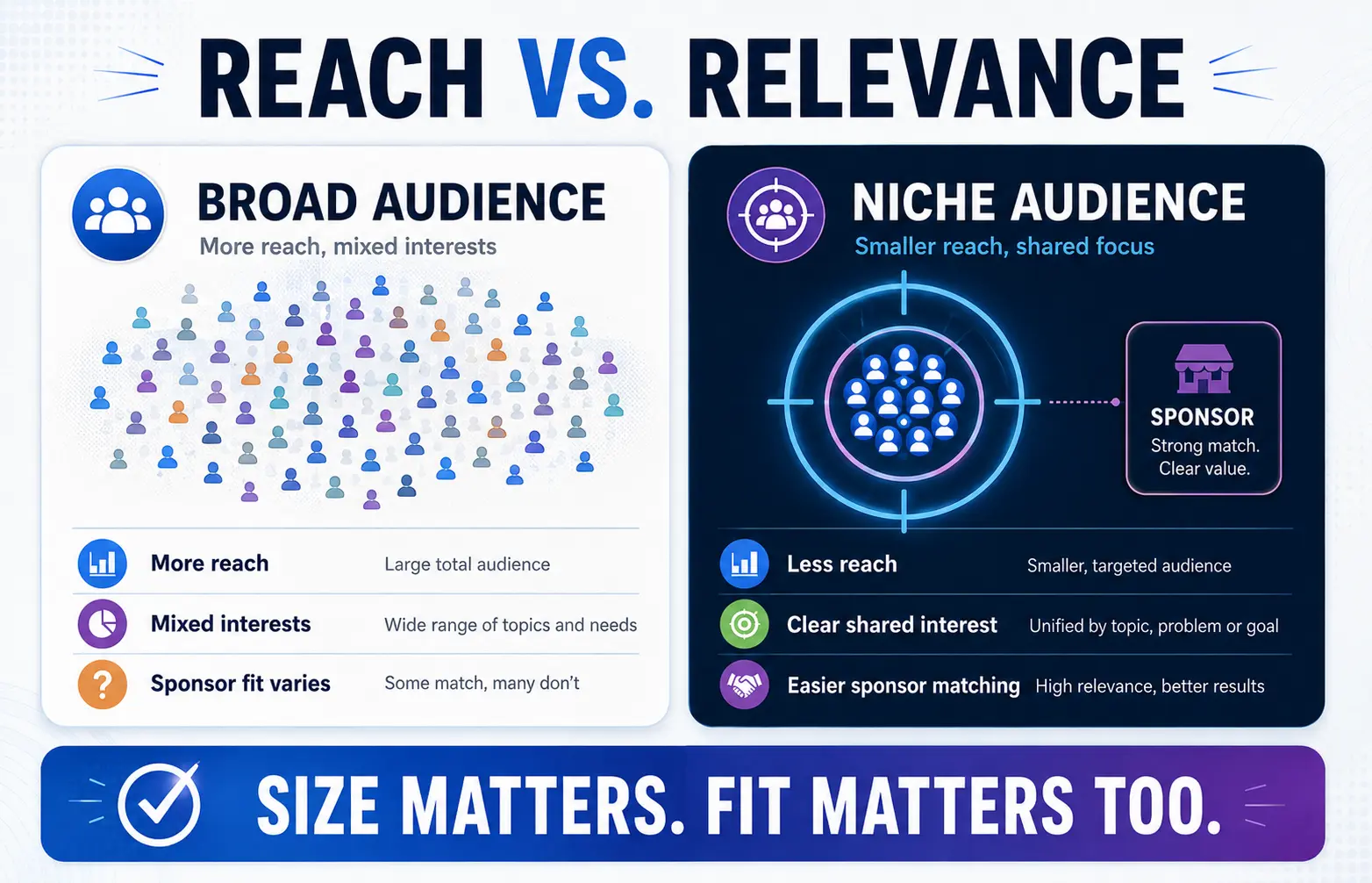
This is why niche matters.
Imagine one show reaches 20,000 people interested broadly in entrepreneurship.
Another reaches 2,000 independent veterinary practice owners.
The first show has much greater reach.
But if you’re selling veterinary practice software, the second audience may be extremely interesting.
That doesn’t mean the smaller show automatically performs better.
It means the advertiser can understand exactly who is in the room.
That is a much stronger starting point.
Small Doesn’t Matter Nearly as Much as Undefined
A lot of podcasters obsess over the wrong number.
They ask:
“How many downloads do I need before I can get sponsors?”
There is no universal download number at which sponsors suddenly become available.
Networks, marketplaces and individual advertisers may establish their own thresholds. Direct sponsorships are different because you and the advertiser can negotiate around the actual audience, campaign and deliverables.
The bigger problem for many small shows isn’t that the audience is small.
It’s that the audience is vague.
Consider the difference:
Weak:
“My podcast is for entrepreneurs.”
Better:
“My podcast helps independent gym owners build recurring membership businesses.”
Or:
Weak:
“My show is about healthcare.”
Better:
“My show is for independent physical therapists trying to build cash-pay practices.”
Now you can start identifying companies that serve exactly those people.
Specificity gives you a sponsor map.
Start With Audience Proof, Not a Rate Card
Before you pitch anybody, collect the evidence you already have.
You don’t need to turn this into a 37-slide media presentation with stock photos of people wearing headsets.
You need enough information to make the audience understandable.
Useful evidence might include:
- average episode downloads over a consistent measurement window;
- subscriber or follower counts where relevant;
- geographic concentration;
- occupation, industry or audience role when you can support it;
- recurring questions or problems listeners bring to you;
- newsletter size and engagement if you’re including email;
- social reach on channels included in the sponsorship;
- examples of topics that consistently attract the right audience;
- previous campaign evidence when you actually have it.
Don’t inflate any of it.
A sponsor trying to reach 800 precisely matched prospects may prefer accurate numbers to an impressive-looking media kit built out of fog.
Find Sponsors From the Audience Backward
Don’t start by making a list of famous brands you’d like to send invoices to.
Start with your audience.
Ask:
What does this audience already buy?
Then:
Which companies need to reach these people?
A podcast serving independent photographers might look at camera accessories, editing platforms, insurance providers, print labs, gallery software or business tools.
A podcast for commercial construction managers might look at project-management software, safety products, equipment providers, staffing companies or industry education.
A locally focused show might have opportunities with businesses that care much more about geography than national download volume.
This changes sponsor research from:
“Who sponsors podcasts?”
to:
“Who needs access to this exact group?”
That’s a much better question.
Pitch Audience Fit Before Audience Size
Your pitch should make the relationship between three things obvious:
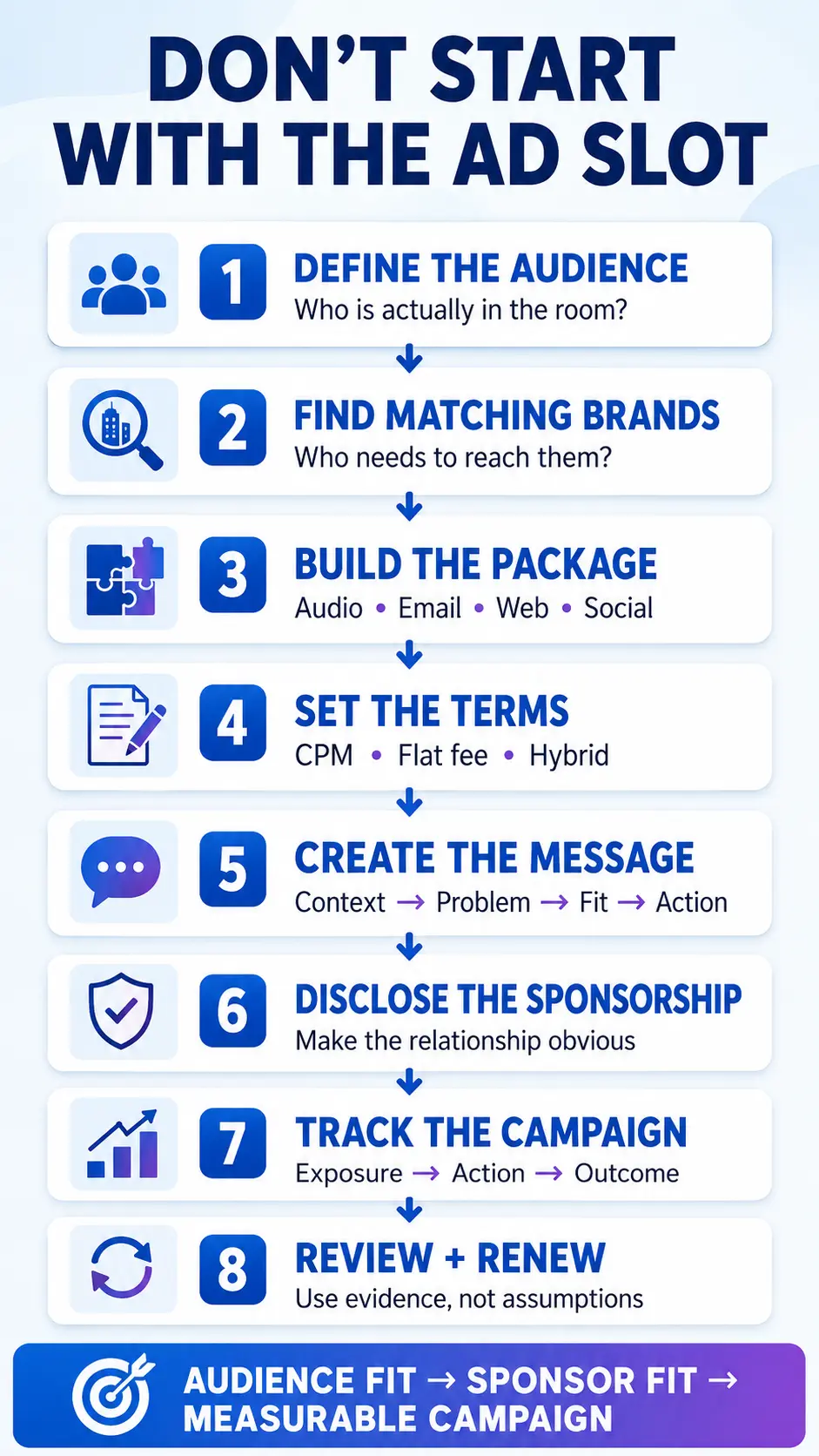
AUDIENCE → PROBLEM → SPONSOR FIT
Instead of:
“My show gets 1,200 downloads per episode and I’m currently accepting sponsors.”
Try something closer to:
“Every week, the show reaches independent practice owners dealing with staffing, patient acquisition and business operations. Your company already serves that market, which is why I think there may be a useful sponsorship fit.”
Then explain your audience evidence and campaign idea.
You are not hiding the download number.
You’re giving the number context.
There is a big difference.
CPM Is a Pricing Model, Not the Value of Your Show
CPM means cost per thousand qualifying impressions.
If you’re unfamiliar with CPM, CPA, CPL, host-read advertising, dynamic insertion and the other vocabulary involved, my guide to podcast monetization terms breaks those pieces apart.
CPM can make perfect sense for advertising sold primarily as scalable media inventory.
But it becomes awkward for a very small show.
Here’s simple hypothetical math.
At a $30 CPM, 500 qualifying impressions would produce:
500 ÷ 1,000 × $30 = $15
That doesn’t mean the show is only worth $15.
It means a $30 CPM applied to 500 impressions produces $15 in media cost.
Those are different statements.
For some smaller shows, a direct flat-rate sponsorship package can make more sense because the advertiser isn’t buying one isolated audio impression. They’re buying a clearly defined set of deliverables.
That might include:
- four episode integrations;
- a host-read sponsor message;
- show-notes placement;
- newsletter exposure;
- a social post;
- a video mention;
- category exclusivity during the campaign;
- a campaign report.
The important correction is this:
A flat fee doesn’t mean you sell guaranteed outcomes.
You sell defined deliverables, audience access and the opportunity for the campaign to perform.
The advertiser still needs a useful offer.
Your audience still needs to care.
And the results still need to be measured.
Build a Sponsorship Package Instead of Selling One Ad
One of the strongest ideas from the original version of this article is worth keeping: your podcast may be more useful to a sponsor when the campaign extends beyond audio.
Podcast audiences often interact with creators across several channels. Acast’s Podcast Pulse research reported that 80% of listeners surveyed follow media personalities across multiple platforms.
That gives you more possibilities.
A simple four-episode test campaign might include:
Podcast
One contextual host-read integration per episode.
Episode page
Sponsor link and approved campaign copy.
Email
One relevant sponsor mention alongside the episode.
Social or video
A defined number of supporting placements where they genuinely fit.
Reporting
Basic delivery numbers plus trackable actions you can reasonably verify.
That’s a sponsorship product.
“Sixty seconds somewhere around minute 14” is just inventory.
Host-Read Doesn’t Mean Read the Sponsor’s Brochure
The sponsor message still has to sound like your show.
Acast describes host-read sponsorships as commercial messages delivered by the host in a more personalized form, using the relationship and communication style already established with the audience.
That’s also why the sponsor needs to fit.
If your audience trusts you for practical advice and you suddenly spend a minute enthusiastically recommending something that makes no sense for them, you’re borrowing against that trust.
When you reach the creative stage, use the same principle I teach in my guide to making podcast mid-roll ads feel like part of the episode:
CONTEXT → PROBLEM → FIT → ACTION
Don’t transform into a completely different announcer voice just because money entered the room.
Make Sponsorship Disclosure Obvious
If a company is paying you, giving you free products or providing something else of value in connection with an endorsement, that relationship needs to be properly disclosed.
The FTC says material connections between an endorser and a marketer should be disclosed clearly and conspicuously, and its endorsement guidance applies across media including podcasts. Endorsements also need to reflect the endorser’s honest opinion and cannot be used to make misleading claims.
In practical podcast language, don’t make listeners decode whether something is an ad.
Say that it’s sponsored.
And don’t endorse a product in a way you can’t truthfully support.
Give a Sponsor Something You Can Measure
A small show becomes much easier to defend when the sponsorship isn’t followed by:
“So… how did it do?”
“I don’t know. The episode got some downloads.”
Decide what evidence you’ll collect before the campaign begins.
Depending on the campaign, that might include:
- a dedicated landing page;
- a trackable URL;
- UTM campaign tags;
- a promo code;
- clicks;
- signups;
- inquiries;
- purchases when they can be reliably attributed;
- sponsor-provided conversion information;
- listener surveys or direct responses.
And keep the evidence separated.
An impression is evidence of exposure.
A click is evidence of a click.
A lead is evidence of a lead.
A sale is evidence of a sale.
Don’t turn all four into “ROI.”
If you want the larger measurement model, see how to measure podcast ROI beyond CPM and downloads.
Run a Test Before You Promise a Partnership
You don’t need to sell a new advertiser a twelve-month naming-rights deal before either of you knows whether the relationship works.
A smaller campaign can give both sides useful information.
For example:
Four episodes. One month. One defined sponsor. One defined offer. One tracking plan.
Then review:
- Were all placements delivered?
- Did listeners respond?
- Which channel generated activity?
- Did the sponsor see the right audience?
- Did the offer actually fit?
- Did either side learn something that should change the next campaign?
- Does continuing make business sense?
Now a renewal conversation has evidence behind it.
Outside Sponsorship Isn’t Your Only Monetization Option
One more decision matters if your podcast already supports your own business.
Before you sell the attention to another company, compare the outside sponsorship with what that same attention could do for your own resource, product, membership, service, event or organization.
That doesn’t mean self-sponsorship is automatically better.
It means the inventory has an opportunity cost.
I break that decision down separately in How to Sponsor Your Own Podcast.
The best use of the inventory depends on what job the podcast is supposed to perform.
The Real Small-Podcast Sponsorship Advantage
A small podcast does not beat a large podcast simply because it’s small.
A niche does not automatically create purchase intent.
And a flat sponsorship fee doesn’t magically escape the need to prove value.
The advantage is focus.
When you know exactly who you’re serving, you can identify sponsors that genuinely belong in that conversation.
Then you can build the sponsorship like a system:
RIGHT AUDIENCE → RIGHT SPONSOR → RIGHT PACKAGE → RIGHT MESSAGE → MEASUREMENT
That’s a much stronger proposition than waiting for your download counter to reach some imaginary number before you’re “allowed” to monetize.
Frequently Asked Questions
Can a podcast with 500 downloads get sponsors?
Potentially, yes. There is no universal minimum audience size for a direct podcast sponsorship. A smaller show needs to make a particularly strong case around audience definition, sponsor relevance, campaign deliverables and measurement rather than relying primarily on reach.
How much should a small podcast charge for sponsorship?
There is no universal rate. Pricing can depend on audience size, audience quality, host-read versus produced creative, campaign length, exclusivity, usage rights, additional channels and the amount of work included. Use CPM benchmarks as one reference point rather than assuming they determine the complete value of a direct sponsorship.
Should a small podcast charge CPM or a flat fee?
Either can work. CPM is useful when you’re selling measured advertising impressions. Flat-fee pricing can make more sense for a defined sponsorship package that includes several placements or channels. Whatever model you use, spell out the deliverables clearly and don’t guarantee results.
Do I need a podcast media kit to get sponsors?
A media kit can help, but the important information is fairly simple: who the audience is, what the show covers, credible audience evidence, the sponsorship opportunity, available deliverables and how the campaign will be measured. A clear one-page sponsor brief can be more useful than a large presentation full of generic marketing language.
Build the Monetization System Before You Sell the Inventory
Sponsorship is only one layer of a podcast business.
Your audience, positioning, content, sponsor fit, CTA, measurement, ROI and attribution all affect whether monetization actually makes sense.
If those decisions are still being made separately, the Podcast Business System + Podcast Production OS is designed to connect them into one working system behind your show.