If your podcast exists to support a business, organization, product, service, or other useful outcome, you don’t necessarily have to wait for an advertiser to decide your audience is valuable.
You can sponsor your own podcast.
That doesn’t mean pretending your company paid your podcast an ad fee. It means treating some of your podcast’s attention as valuable inventory and deliberately using that attention to move the right listener toward your own next step.
The important part is what happens next.
Self-sponsorship works best when the episode, offer, call to action, destination, and measurement all connect. If you’re just interrupting the show three times to yell about your business, you’ve created commercials. You haven’t created a system.
What Does It Mean to Sponsor Your Own Podcast?
Self-sponsorship means using your podcast to promote a resource, product, service, event, membership, program, or other offer that belongs to the business behind the show.
Instead of:
PODCAST → OUTSIDE ADVERTISER
you’re building:
PODCAST → YOUR NEXT STEP → YOUR BUSINESS
For a business-purpose podcast, that can be a perfectly reasonable use of the inventory.
Imagine an educator whose podcast helps parents understand a particular learning challenge. One episode might naturally direct interested listeners toward a downloadable guide. Another could point toward an upcoming workshop.
The podcast isn’t just carrying an advertisement. The episode is creating a useful path between education and action.
That’s the distinction.
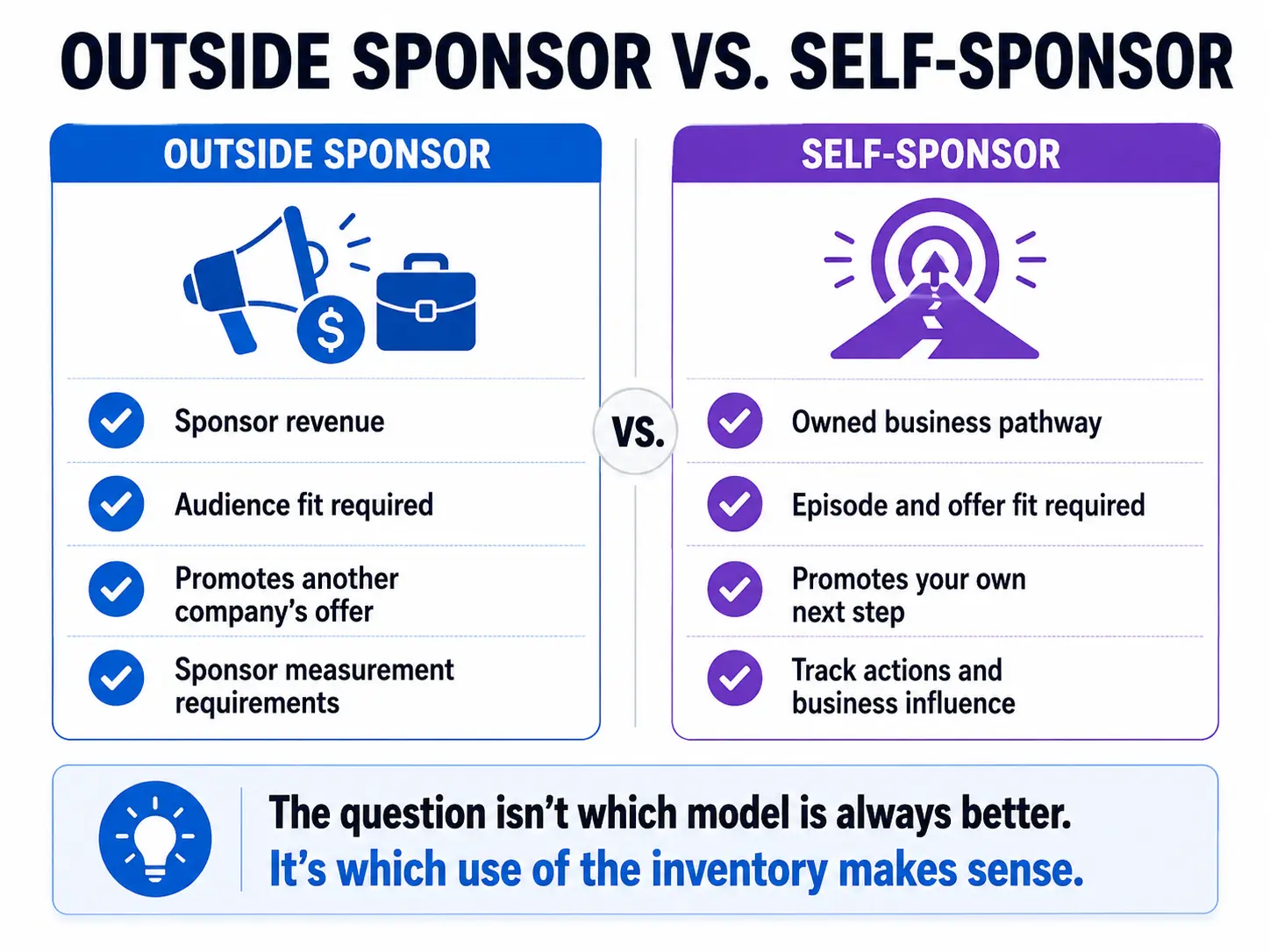
Self-Sponsorship Isn’t Automatically Better Than an Outside Sponsor
There are situations where an outside sponsor makes complete sense.
A sponsor may be a strong fit when:
- the product genuinely serves your audience;
- the sponsorship revenue is worth the inventory;
- the relationship doesn’t conflict with your own offers;
- you can deliver what the sponsor expects;
- the arrangement doesn’t weaken listener trust.
If you’re specifically trying to attract outside advertisers, see why small niche podcasts can still be useful to sponsors.
But don’t assume outside sponsorship is automatically the highest-value use of your airtime.
If your podcast already supports a business, you have another option to compare against it.
That’s the real question:
What is the best job for this piece of listener attention?
Don’t Start With the Ad Slot. Start With the Listener Path.
This is where I would change the traditional sponsorship thinking.
Don’t begin by asking:
Where can I put an ad?
Ask:
What should a qualified listener be able to do after this episode?
Then work backward.
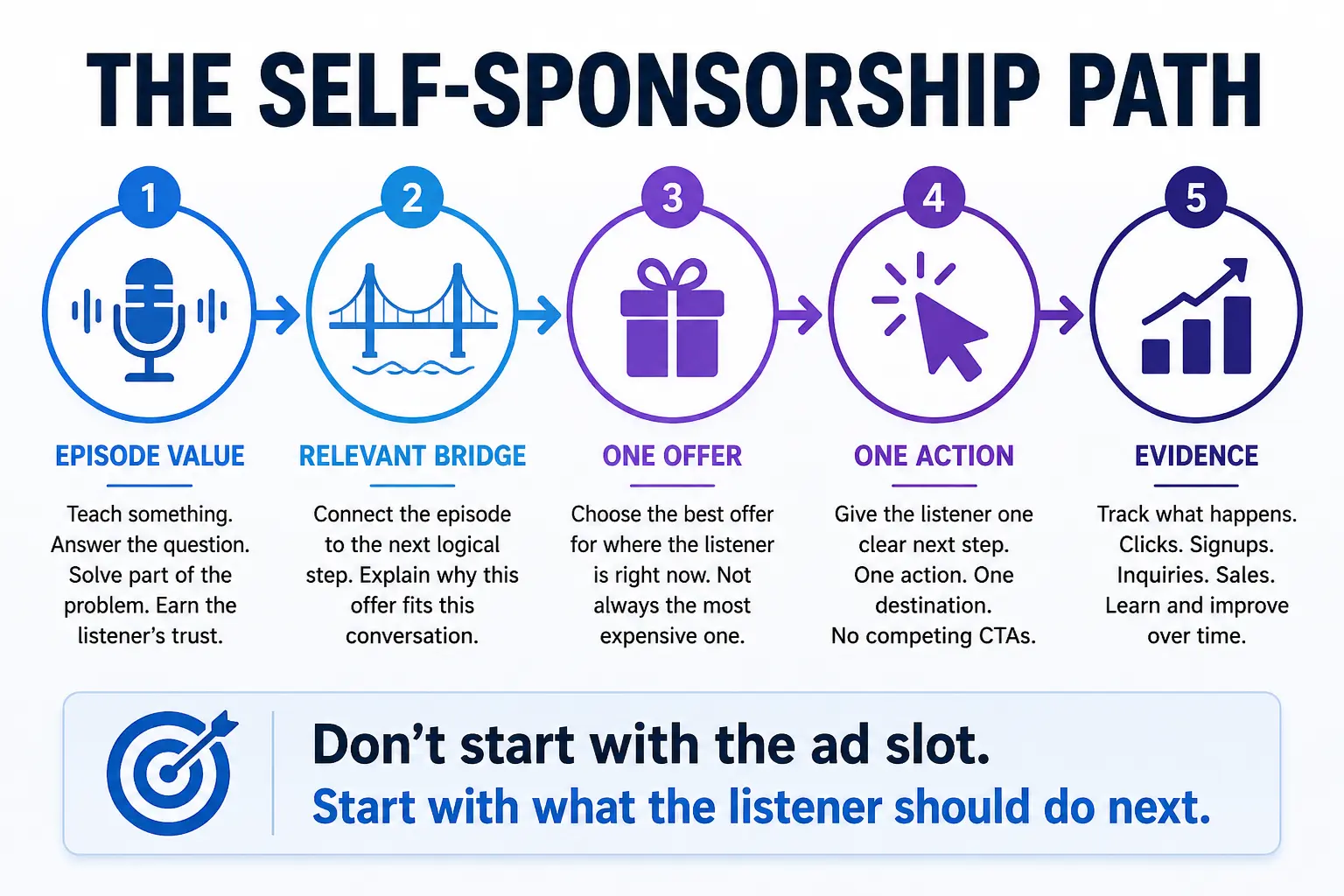
A simple self-sponsorship path looks like this:
EPISODE VALUE → RELEVANT BRIDGE → ONE OFFER → ONE ACTION → EVIDENCE
Episode Value
First, the episode has to do its actual job.
Teach something.
Answer the question.
Solve part of the problem.
Challenge the bad assumption.
Give the listener a reason to trust the next step.
Your offer does not rescue an episode that didn’t deliver useful value.
Relevant Bridge
The transition should explain why the offer belongs in this particular conversation.
Suppose your episode teaches people how to prepare for a difficult guest interview.
A natural bridge might be:
“Once you know what you want from the conversation, the next problem is turning that into an actual interview plan.”
That’s much stronger than suddenly announcing:
“Today’s episode is sponsored by my stuff.”
The bridge connects the problem you just discussed to the next useful action.
One Offer
Pick the offer that best fits what the listener now understands.
It might be:
- a free guide;
- a template or toolkit;
- a class;
- a product;
- a consultation;
- a membership;
- an event;
- a service;
- another relevant resource.
The most expensive thing you sell is not automatically the best podcast CTA.
Match the offer to the listener.
One Action
Now tell them what to do.
Not five things.
If you want the listener to download a guide, don’t also ask for an Apple review, YouTube subscription, Instagram follow, newsletter signup, consultation booking, and ceremonial ringing of the notification bell.
Give the episode one clear primary direction.
Evidence
Finally, decide how you will know whether anybody acted.
A self-sponsored message you never measure is still mostly a guess.
Where Should a Self-Sponsored Message Go?
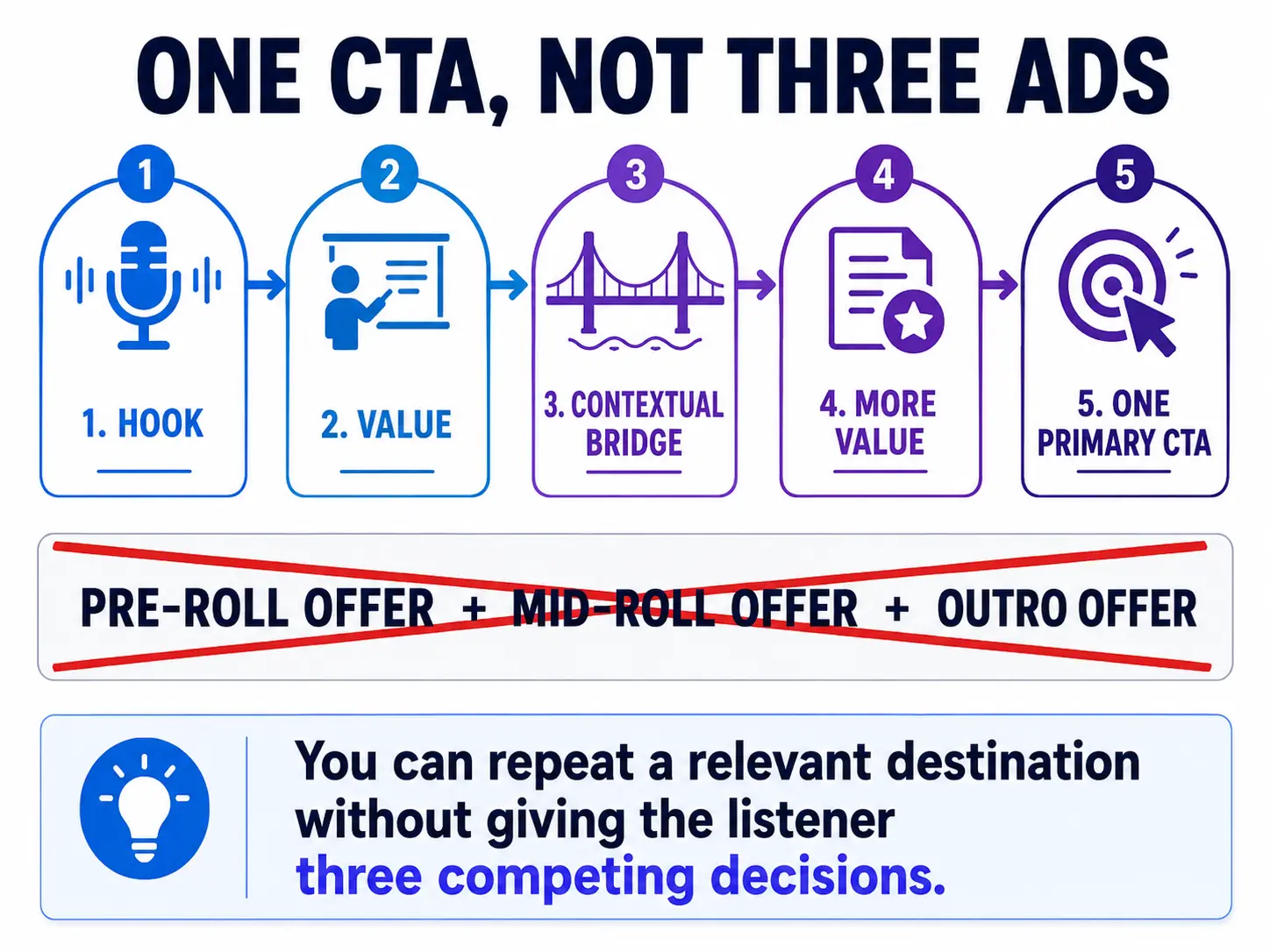
You do not need a pre-roll, mid-roll, and sales-heavy outro in every episode.
Especially if you produce shorter teaching episodes, that can become ridiculous pretty quickly.
Instead, choose the placement that fits the episode.
Early Resource Mention
An early mention can work when a resource is closely connected to what the listener is about to learn.
But protect the opening.
The first job of the beginning is still to establish why the episode is worth listening to. Don’t spend your opening pitching before the listener even understands the problem.
Contextual Mid-Episode Bridge
A mid-episode message works best when the teaching naturally creates a reason for the next step.
You explain the problem.
You show the listener what needs to change.
Then you briefly connect that problem to something that helps them apply the lesson.
If you want to develop that transition more deeply, see how to structure a podcast mid-roll without making it sound like a disconnected commercial.
Clean Outro
For many episodes, the end is enough.
Resolve the lesson, tell the listener the next useful action, give them a simple destination, and finish.
You don’t need to squeeze another miniature sales presentation into the final thirty seconds.
What Should You Promote When You Sponsor Your Own Show?
The offer should match how ready the listener is.
| Listener Situation | Better Next Step |
|---|---|
| “I’m just realizing I have this problem.” | Free guide or educational resource |
| “I understand the problem and want help fixing it.” | Relevant template, tool, product, or program |
| “I need this solved in my specific situation.” | Service, consultation, or qualified high-touch path |
| “I’m already comparing full solutions.” | Complete product or system |
This is why a generic “visit my website” CTA tends to be weak.
The listener shouldn’t have to land on your homepage and conduct an archaeological dig to figure out what you wanted them to do.
Send them somewhere that continues the exact conversation they were already having with you.
Be Careful With the CPM Comparison
One reason self-sponsorship gets interesting for smaller business podcasts is that outside advertising and owned offers use very different economic models.
CPM means cost per thousand measured ad impressions or qualifying downloads, depending on the buying and measurement arrangement. If you want the terminology in more detail, see this breakdown of CPM, CPA, CPL, and dynamic ad insertion.
Here’s a simple hypothetical.
Suppose somebody offers you a $25 CPM.
At 1,000 qualifying downloads:
1,000 ÷ 1,000 × $25 = $25
That’s $25 of advertising revenue for that placement.
That is sample math, not a claim that $25 is what your show should charge.
Now suppose you use the same inventory to promote your own offer.
You cannot simply say:
“My service costs $2,000, therefore that ad slot was worth $2,000.”
No.
The listener has to actually do something.
Maybe 12 people visit the resource page.
Maybe four sign up.
Maybe one eventually makes an inquiry.
Maybe nobody buys anything.
Now you have evidence.
Compare the actual outside-sponsorship opportunity with the actual results from your owned pathway. Don’t compare a real sponsor check against imaginary future customers.
Measure the Podcast’s Influence, Not Just the Click
This is where self-sponsorship becomes much more useful as a business system.
Track things such as:
- the episode or topic;
- the CTA used;
- the destination;
- the tracking link or campaign;
- resource downloads;
- email signups;
- inquiries;
- sales conversations;
- purchases when they can be verified.
Then separate two questions:
How did this person originally find us?
and:
Did the podcast influence what they did later?
Those are not always the same answer.
Someone might discover your business through Google, start listening to the podcast for three months, and eventually purchase because the show helped them understand and trust your approach.
Google may still be the original acquisition source.
The podcast may have influenced the decision.
That’s much more useful than giving the podcast credit for everything or, at the other extreme, giving it credit for nothing because the last click came from somewhere else.
For the larger measurement model, read how to evaluate podcast ROI beyond CPM and downloads.
Common Self-Sponsorship Mistakes
Pitching Before You’ve Earned the Attention
If the first thing the listener hears is a sales message, you’ve used the most valuable part of the episode to promote something before you’ve established why they should care.
Protect the hook.
Promoting the Same Offer in Every Episode
Different topics create different listener needs.
A relevant free resource may make sense in one episode. A product may fit another. Sometimes the right next step is simply another piece of content.
Sending Everyone to the Homepage
A homepage is usually a collection of choices.
A good podcast CTA should reduce choices.
Asking for Everything at Once
One episode doesn’t need to accomplish every marketing objective your business has.
Choose the job.
Treating Every Response as Proof of Podcast Revenue
A click is evidence of a click.
A signup is evidence of a signup.
A purchase is evidence of a purchase.
Podcast attribution gets stronger when you can connect those events responsibly rather than declaring victory because a dashboard moved.
Self-Sponsorship Is Really an Allocation Decision
The bigger idea here isn’t that outside sponsors are bad.
It isn’t that every podcast should run ads for its own products.
It’s that your podcast has limited attention.
That attention is an asset.
Before you sell a piece of it to somebody else, decide what that same attention could reasonably do inside your own business or organization.
For some shows, an outside sponsor will win that comparison.
For others, a relevant free resource, product, service, class, membership, event, or other owned pathway may be substantially more useful.
The important part is making the decision on purpose—and then measuring what actually happened.
Frequently Asked Questions
Can you sponsor your own podcast?
Yes. A business or organization can use its podcast to promote its own relevant resources, products, services, programs, events, or other next steps. The important part is making the promotion useful and connected to the episode rather than treating the podcast as nonstop advertising.
Should every podcast episode have a mid-roll?
No. Placement should depend on episode length, structure, listener readiness, and the offer. A short episode may only need one clear CTA near the end.
Is self-sponsorship only useful for high-ticket services?
No. It can support free resources, digital products, memberships, classes, events, retail products, services, consultations, registrations, donations, and other relevant organizational outcomes.
How do you measure a self-sponsored podcast?
Track the CTA, destination, campaign or episode, resulting actions, and eventual outcomes when possible. Keep original acquisition source separate from podcast influence so you don’t claim more attribution than the evidence supports.
If you already know what you want listeners to do but writing the transition still feels awkward, the Podcasting Pro Tools include the Podcast CTA Swipe File, with adaptable spoken and written CTA structures for episodes, clips, email, and show notes.
Turn passive listeners into paying clients
Stop leaving money on the table with vague endings and copy-paste these proven scripts to give your audience a clear path to convert.