A podcast intro becomes too long when the listener is still waiting to find out why the episode matters.
That can happen in 60 seconds. It can happen in 20 seconds. Frankly, you can waste somebody’s time pretty efficiently in eight seconds if you work at it.
The better question isn’t, “How many seconds should my podcast intro be?”
It’s:
How quickly does the listener understand why they should keep listening?
That changes how you build the entire opening.
Instead of starting with your show name, biography, guest credentials, theme music, housekeeping, or an explanation of what a podcast is, give the listener relevance first.
Then introduce the show.
What Makes a Podcast Intro Too Long?
A podcast intro is too long when the branding lasts longer than the listener’s reason to care.
Think about the typical opening:
“Hey everybody, welcome back to the show. I’m your host. I hope you’re having a great week. Before we get started, remember to subscribe, and today I have an amazing guest…”
There’s nothing technically wrong with any individual sentence.
The problem is the order.
The listener still doesn’t know why this particular episode deserves their time.
A stronger opening reverses that relationship:
“If your guest interviews sound fine while you’re recording but turn into a mess in editing, the problem probably started before the guest ever joined the call.”
Now I have a reason to keep listening.
You can tell me your name in a minute.
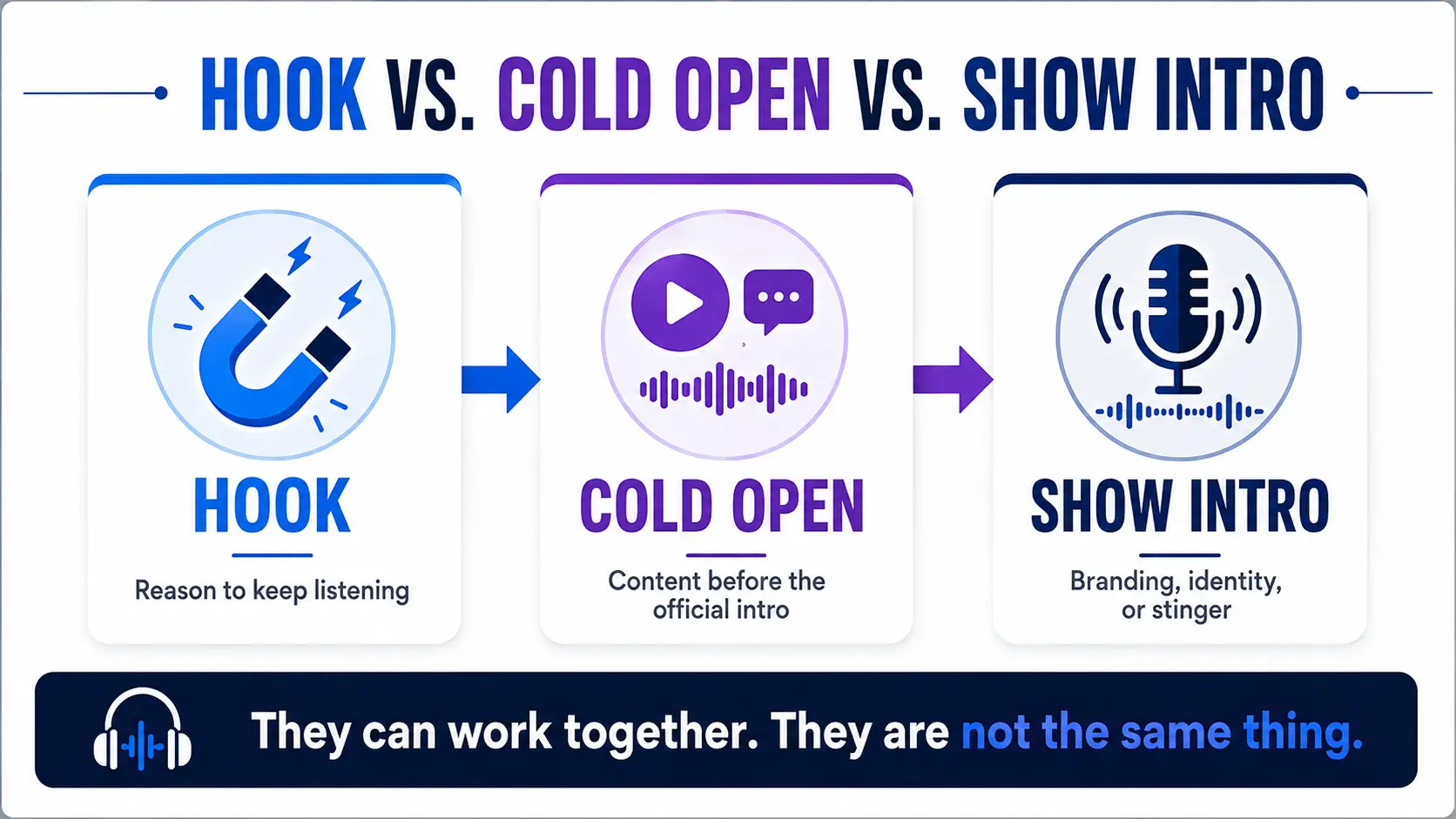
Hook, Cold Open, and Show Intro Are Not the Same Thing
These terms get mixed together constantly.
A hook gives the listener a reason to continue. It may create relevance, tension, curiosity, consequence, or a useful promise.
A cold open is a piece of content that happens before the official show introduction. It could be the host speaking, a guest soundbite, a story moment, a question, or a short clip from later in the episode.
A show intro or stinger is the branded part: the show name, sonic logo, music cue, short voice tag, or other recurring identifier.
They can work together.
They just do different jobs.
A cold open can contain the hook. A short stinger can then mark the transition into the show.
The mistake is assuming your branding has to happen before the listener receives any value.
A Simple Four-Part Podcast Intro Hook Formula
You do not need a dramatic movie trailer at the beginning of every episode.
For most teaching and business podcasts, a much simpler structure works.
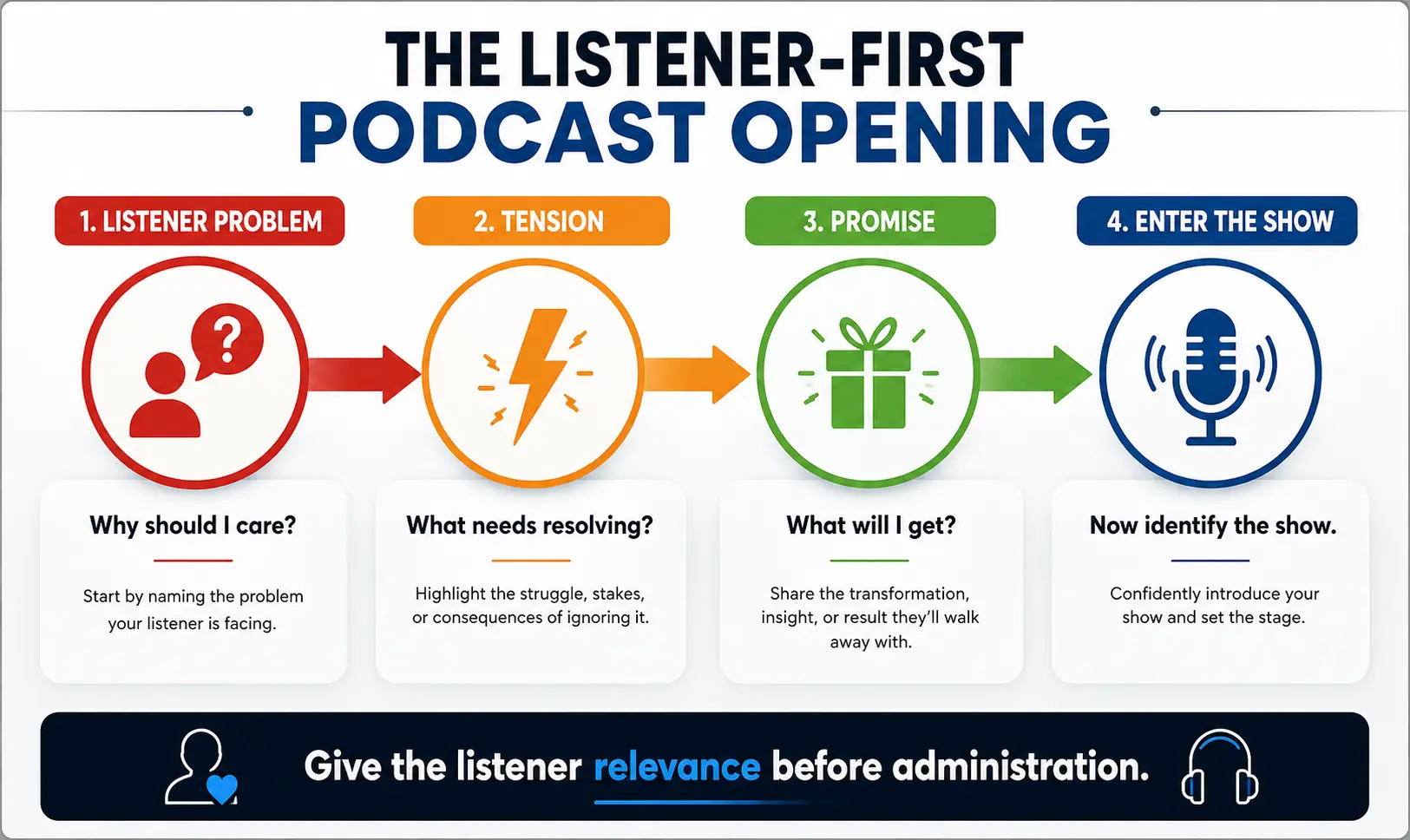
1. Start With the Listener’s Problem or Consequence
Give them something they recognize.
Instead of:
“Today we’re going to talk about podcast retention.”
Try:
“You can have a short podcast episode and still lose people early if the first minute gives them no reason to keep following.”
That immediately answers the listener’s silent question:
Why should I care?
2. Name the Tension
Now show them what is unresolved.
Maybe the common advice is incomplete.
Maybe they are fixing the wrong part of the problem.
Maybe something that appears harmless is creating extra work.
For example:
“The problem usually isn’t that your intro is 22 seconds instead of 12. The problem is that those 22 seconds are about you instead of the listener.”
Now the episode has somewhere to go.
3. Promise the Movement
Tell the listener what they will understand, decide, fix, or be able to do.
Not:
“I’ve got some great tips for you today.”
Something concrete:
“I’m going to give you a four-part opening you can use to get from the first sentence into your episode without a minute of throat-clearing.”
That gives the episode direction.
4. Enter the Show
Now you can introduce yourself, the guest, or the show.
For example:
“I’m Travis Dempsey, and this is Podcasting Pro Tips. Let’s build it.”
That branded transition is not gone.
It has simply moved behind the listener’s reason to care.
Weak Podcast Intro vs. Listener-First Opening
Here is the difference in practice.
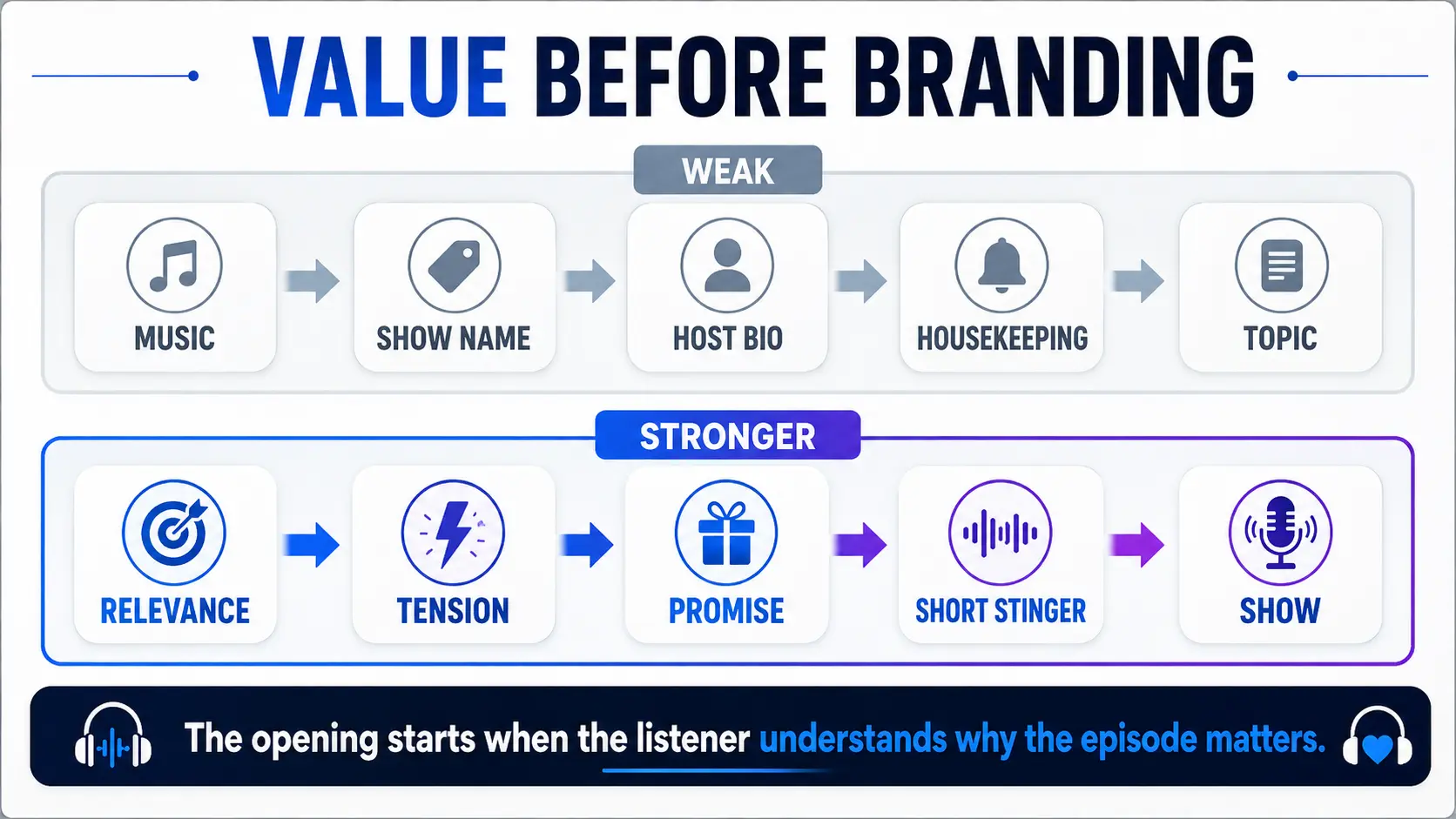
Weak opening:
“Welcome back to the Business Builder Podcast. I’m your host, John Smith. This week we have another great episode for you. Before we get started, make sure you subscribe to the show. Today we’re talking about why customer onboarding matters.”
Listener-first opening:
“If new customers keep asking questions you thought your sales process already answered, the problem may be happening during onboarding. Today we’re going to find the three gaps that create most of that confusion and show you what to fix first.
I’m John Smith, and this is the Business Builder Podcast.”
The second version does not work because it is more dramatic.
It works because the listener gets orientation before administration.
That is the real shift.
Five Types of Podcast Hooks You Can Use
You do not need one universal hook template for every episode. The opening should match the job of the episode.
Problem Hook
Use this when the listener already recognizes the frustration.
“Your podcast episodes may not be too long. They may simply take too long to get anywhere.”
Mistake Hook
Use this when the episode corrects a common behavior.
“The biggest mistake in your podcast intro may be introducing the show before introducing the problem.”
Contrarian Hook
Use this when common advice needs some nuance.
“You do not have exactly ten seconds to hook every podcast listener. But you do need to stop making them wait for relevance.”
Listener-Mirror Hook
Use this when recognition is more useful than confrontation.
“You can record a genuinely useful episode and still listen back afterward wondering why the beginning feels so slow.”
Useful-Promise Hook
Use this when the search intent is already strong.
“In the next few minutes, I’ll give you a four-part podcast opening you can adapt before your next recording.”
The strongest hook is not the one that sounds the most clever.
It is the one that fits the actual episode.
Should You Introduce Yourself at the Beginning?
Yes. You just do not always have to make your name the first thing the listener hears.
For an established audience, a quick show identifier may work perfectly.
For a new listener coming from search, YouTube, a shared link, or a recommendation, the episode-specific reason to stay may be more important first.
That is why I generally think about the opening in this order:
Earn attention → orient the listener → identify the show.
Your name still matters.
Your brand still matters.
But the episode is not a business card with 30 minutes attached to it.
What About Podcast Intro Music?
Intro music is not automatically bad.
Music can establish identity, create momentum, separate sections, and make a show feel intentional.
The problem is using music as a waiting room.
You do not need a universal volume setting, a mandatory percentage of the intro, or a fixed two-second transition.
You need the music to support the communication.
A simple approach is:
HOOK → SHORT STINGER → SHOW
or:
HOOK WITH MUSIC UNDERNEATH → SHOW
If the listener spends the opening waiting for your theme song to finish before the episode begins, the theme song has become the problem.
If it reinforces a clear opening without getting in the way, keep it.
How Long Should a Podcast Intro Be?
There is no useful universal number for every podcast.
A five-minute narrative show, a 12-minute solo teaching episode, a comedy podcast, and a 60-minute interview do not need identical openings.
For a straightforward teaching episode, getting through the listener problem, tension, and promise in roughly 15 to 30 seconds is a reasonable starting point—not a law.
The real test is simpler:
Does the listener know why the episode matters before you ask them to wait?
If yes, your opening is doing its job.
If no, shortening the music by three seconds probably is not the fix.
Use Your Own Retention Data Instead of Somebody Else’s Magic Number
Once you have published enough episodes to see meaningful patterns, review what your own audience actually does.
Look for openings where listeners stay.
Look for openings where people disappear.
Then compare what changed.
Was there a long guest biography?
Did the episode take too long to state the problem?
Was the title promising one thing while the first minute talked about something else?
Did you stack a sponsor message, theme music, a welcome, and housekeeping before getting to the episode?
Change one meaningful part and compare again.
The same principle applies later in an episode. If your opening is strong but listeners start drifting deeper into longer conversations, use a deliberate mid-episode re-engagement point instead of assuming every retention problem started in the first minute.
The Best Podcast Hooks Usually Start Before You Record
A hook should not be the sentence you desperately invent while the waveform is already moving.
It comes from knowing what the episode is actually supposed to do.
If you know:
- the listener problem;
- the episode’s main takeaway;
- the tension you are resolving;
- and the next step you want the listener to take;
the opening becomes much easier to write.
That is one reason podcast pre-production matters. The hook, episode structure, transitions, and CTA should not feel like unrelated pieces somebody glued together in editing.
And the same principle applies to the other end of the episode. Once you earn attention and deliver the value, give the listener one relevant next step in the outro instead of five competing instructions.
For video podcasts, there is an additional layer: the opening also has to satisfy the expectation created by the title and thumbnail. I break that side of the problem down separately in the guide to video podcast retention and the first 30 seconds.
A First-Minute Checklist Before You Record
Before you record the next episode, listen to—or read—the opening by itself.
Ask:
- Does the first line create relevance?
- Does the listener know why the episode matters?
- Is there a clear tension, question, problem, or promise?
- Does the guest biography come after listener relevance?
- Does the music support the opening instead of delaying it?
- Does the first minute make it obvious where the episode is going?
If the opening asks the listener to wait for the good part, rewrite it.
The good part has already started.
The Bigger Production Lesson
A strong hook is not an editing trick.
It is the first visible result of a well-planned episode.
The topic determines the promise. The promise shapes the hook. The hook leads into the episode structure. The episode resolves the promise. Then the CTA gives the listener a relevant next step.
When those decisions connect, producing the show gets easier because you are not trying to rescue the episode one edit at a time.
Want a Free Next Step?
If you want to get better at making the listener feel understood before you establish your own authority, the Free Vault includes Psychology Hacks for Podcast Hosts: How to Make Your Audience Feel Understood Before You Establish Authority.
Open the Podcasting Pro Tips Free Vault.
Podcast Intro Hook FAQ
Should I say “welcome to the show” at the beginning of every podcast?
You can, but it does not have to be the first sentence. For many teaching episodes, giving the listener a reason to care before the welcome creates a stronger opening.
Is a 60-second podcast intro always too long?
No. The problem is not an exact duration. A 60-second opening becomes a problem when the listener spends most of it waiting to understand why the episode matters.
Should a podcast intro include music?
It can. Music works best when it supports the spoken opening, creates identity, or marks a transition without delaying the episode’s value.
What is the difference between a hook and a cold open?
A hook is the reason to keep listening. A cold open is content that appears before the official show intro. A cold open can contain the hook, but the terms are not interchangeable.