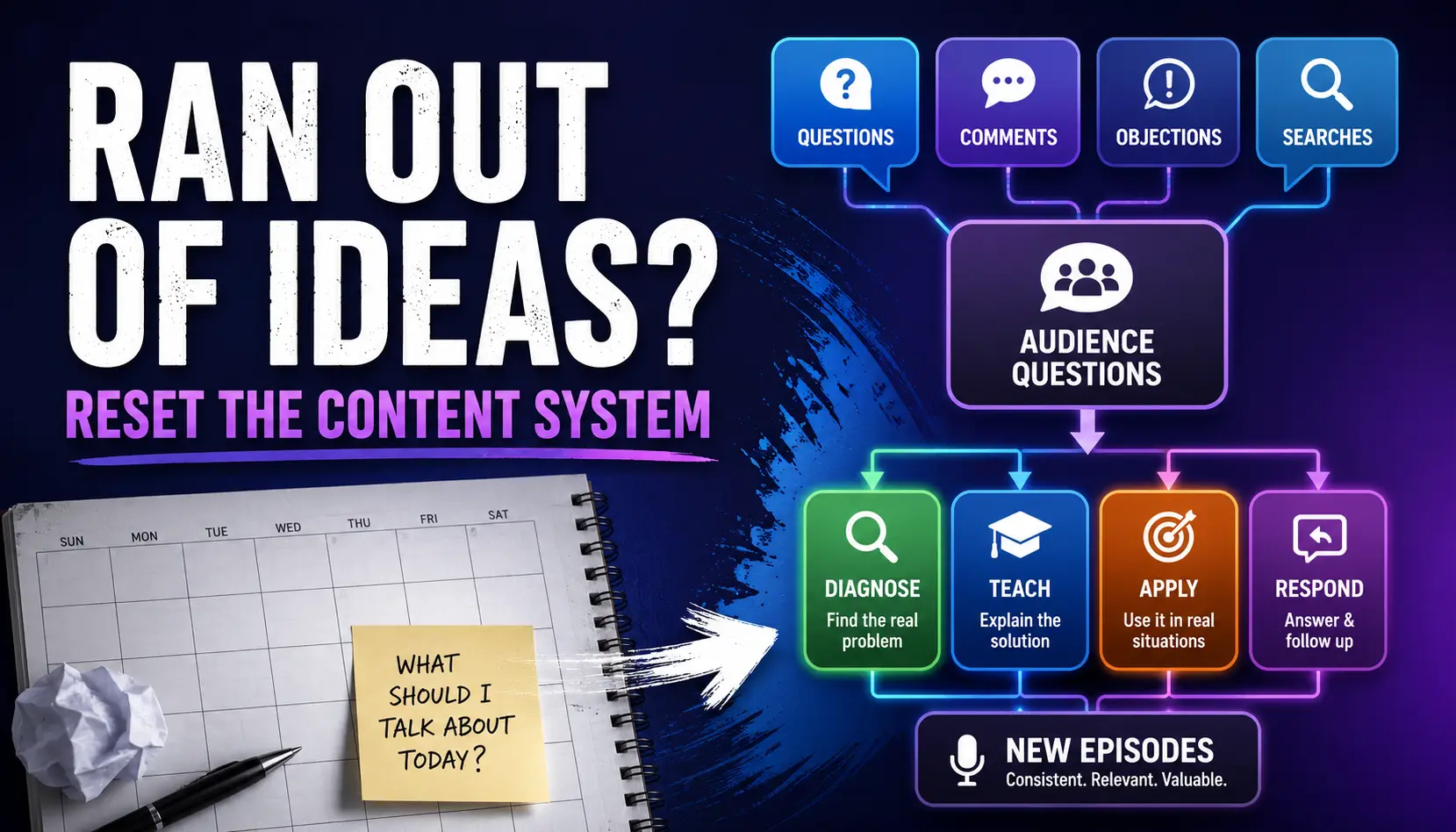
A podcast can survive the launch, the equipment learning curve, the first few awkward recordings, and dozens of weekly episodes—and then suddenly hit a wall.
The calendar goes blank.
Every idea feels like something you’ve already covered.
You open a new document, type three possible episode titles, delete two of them, stare at the third one for a while, and decide maybe this is a good week to reorganize your cables.
I call this the 12-Month Stall.
I don’t mean every podcast runs out of ideas exactly twelve months after launch. It isn’t an industry benchmark. It’s shorthand for a very common stage in a mature show: the original list of obvious topics has been used up, and the content strategy underneath the podcast has nothing new feeding it.
If you’re there now, you probably don’t need another list of 100 podcast topic ideas.
You need to reset the system producing your ideas.
The Podcast That Ran Out of the 1990s
A while back, I was visiting a friend’s recording studio when I noticed a great-looking poster for a podcast about 1990s pop culture.
I asked if they were still recording it there.
Nope.
They had made somewhere around 60 episodes, felt like they had covered everything they could possibly say about the 1990s, and stopped.
That stuck with me because the problem wasn’t really the 1990s.
The 1990s didn’t run out.
Their way of looking at the subject did.
And the same thing happens with business, education, wellness, marketing, music, real estate, nonprofit work, technology, and almost every other podcast category.
You start with the obvious topics.
Then you cover the basics.
Then the FAQs.
Then the myths.
Then a few interviews.
Eventually you start thinking, “I’ve already talked about all of this.”
That’s when the real content strategy has to take over.
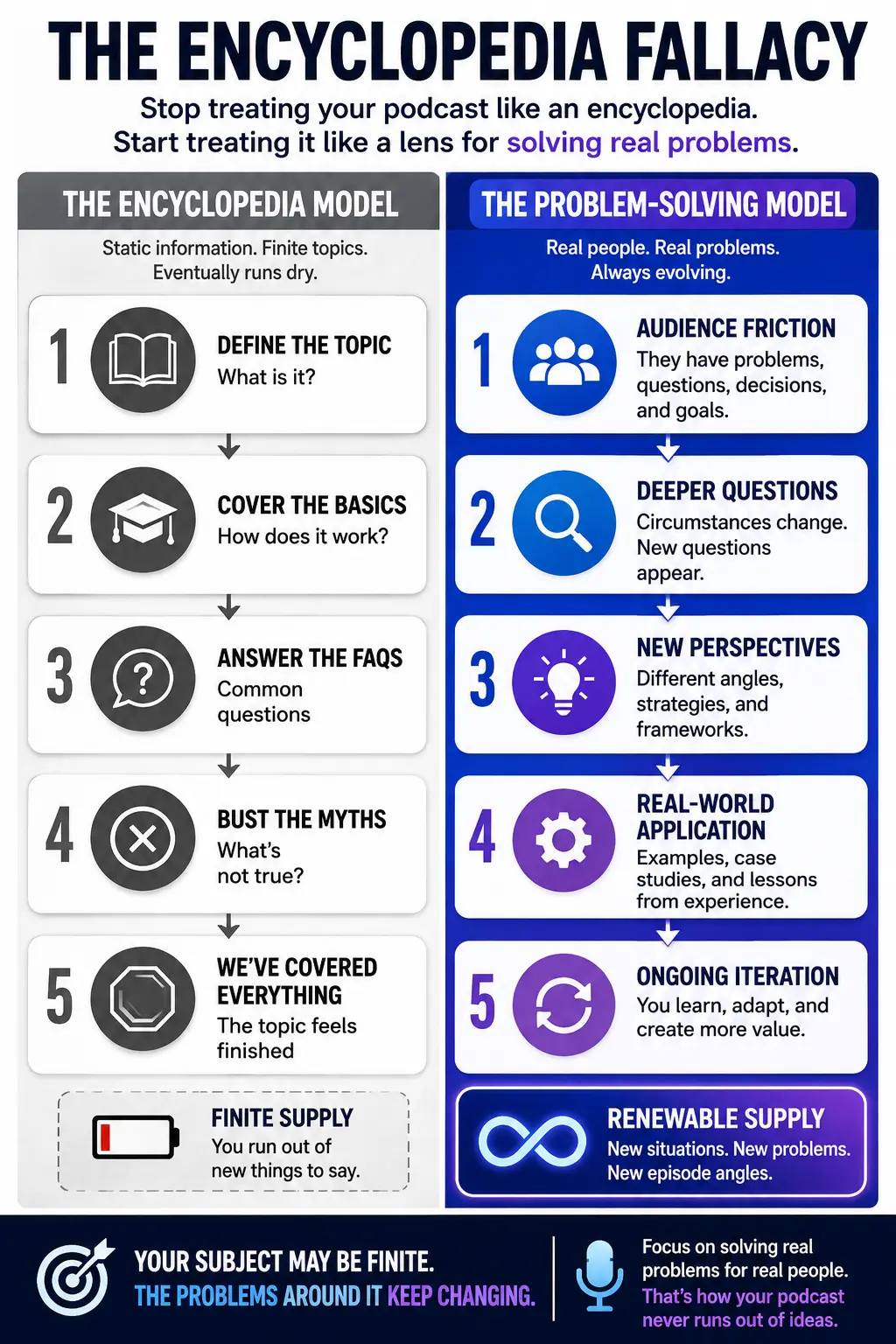
The Encyclopedia Fallacy
I call this problem the Encyclopedia Fallacy.
It happens when you build your podcast as though its job is to document everything there is to know about a subject.
If that’s the model, your topic supply really can feel finite.
Imagine a show about home buying.
You can explain mortgages, inspections, down payments, closing costs, appraisals, offers, and contingencies. Eventually you’ve covered most of the introductory definitions.
But home buyers don’t stop having problems just because you’ve finished defining the terminology.
Their questions change.
The market changes.
Their circumstances change.
New objections appear.
Old advice stops fitting.
Real situations create exceptions.
Your experience produces new examples.
That’s the shift:
Stop treating your podcast like an encyclopedia of your subject. Start treating it like a lens for helping your audience make better decisions.
That gives you a much larger content source.
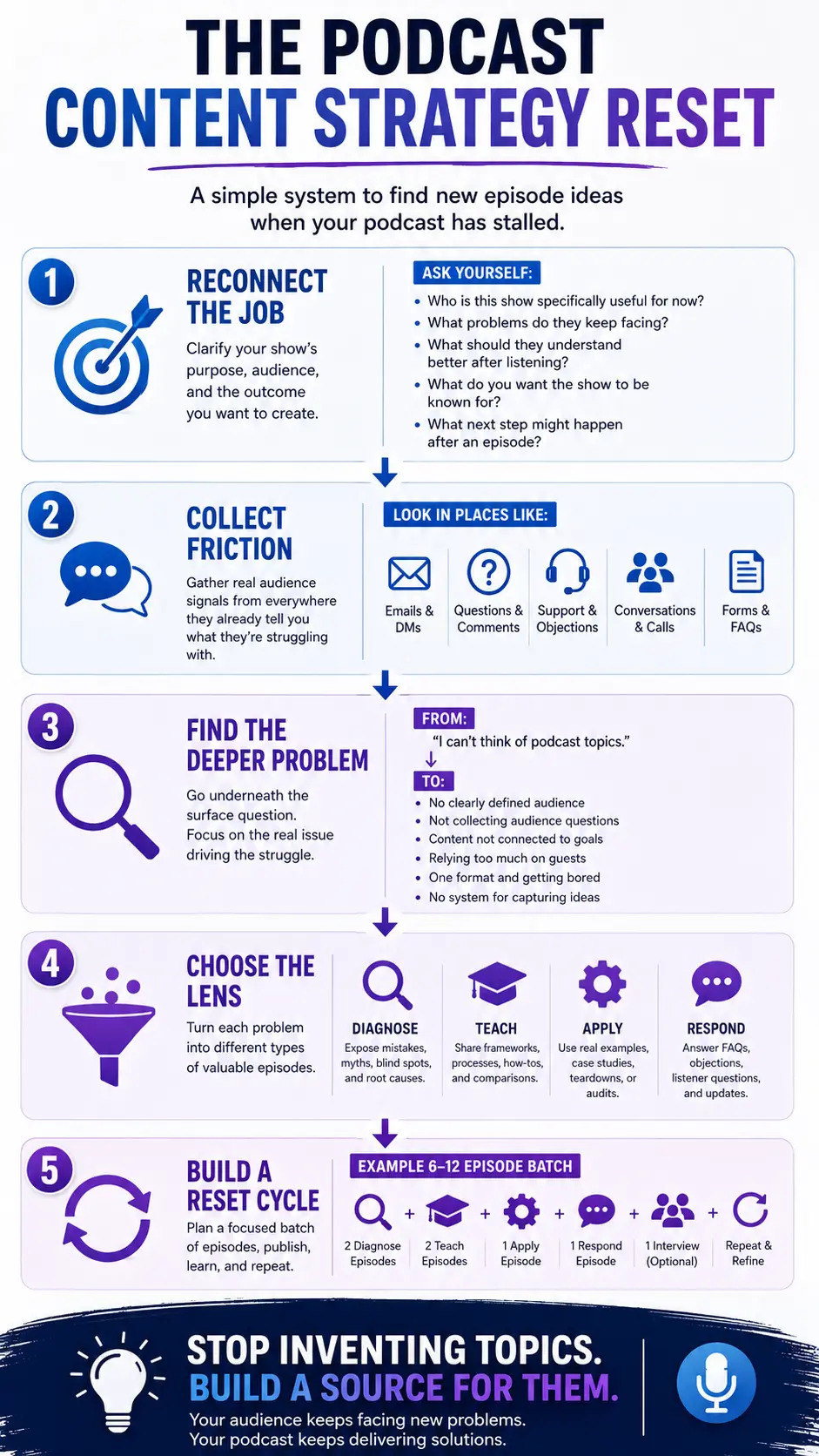
Step 1: Reconnect the Podcast to Its Job
Before brainstorming another topic, answer a more important question:
What is this podcast supposed to help accomplish now?
Your answer may have changed since launch.
Maybe the show originally existed to build awareness, but now it needs to establish your authority around a particular service.
Maybe you’re using it to educate customers.
Maybe it’s helping people evaluate a product.
Maybe you’re building an audience around an educational mission.
Maybe your goal is to turn episodes into a searchable content library.
The answer affects which topics are worth recording.
Ask yourself:
- Who is this show specifically useful for now?
- What recurring problems does that person face?
- What should they understand better after listening?
- What do you want the show to become known for?
- What useful action might happen after an episode?
- Has your audience, offer, organization, or point of view changed since the podcast launched?
If those answers are fuzzy, generating another 50 titles won’t fix much.
You’re just throwing more paint at the wall.
If the show itself needs a deeper reset, revisit the work of defining the podcast concept and foundation before filling another editorial calendar.
Step 2: Build an Outside-In Problem Bank
Once the show’s job is clear, stop trying to invent every episode from scratch.
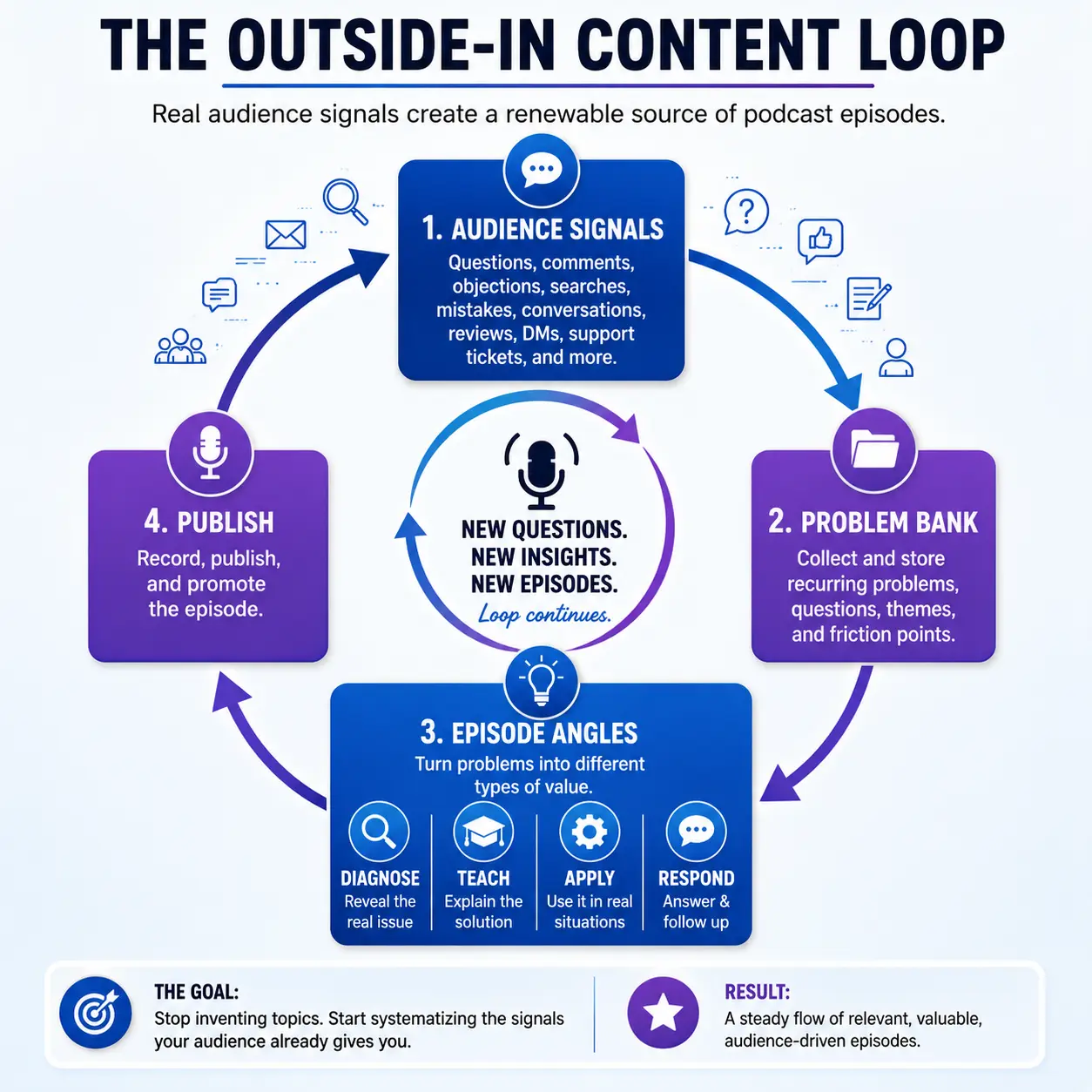
Build what I call an outside-in problem bank.
Instead of asking:
What should I talk about?
Ask:
What is my audience already trying to understand, decide, fix, avoid, or accomplish?
Look for signals in places such as:
- emails;
- customer or client questions;
- comments;
- DMs;
- search queries;
- support questions;
- sales objections;
- intake forms;
- community discussions;
- questions asked during classes or presentations;
- questions guests keep bringing up;
- mistakes you repeatedly see people make;
- old episodes that now deserve an updated answer.
You’re not looking only for fully formed episode titles.
You’re collecting friction.
A question such as “Do I really need video for my podcast?” could produce several different episodes:
- when video actually helps;
- when it adds unnecessary workload;
- what changes when YouTube is part of the plan;
- how to choose between an audio-first and video-first workflow;
- what production problem people accidentally create by adding video too early.
One audience question can contain several legitimate decisions.
That’s how your content supply gets deeper without becoming repetitive.
Step 3: Separate the Symptom From the Real Problem
A good topic often begins with a surface-level question.
A better episode asks what’s underneath it.
Suppose someone says:
“I can’t think of podcast topics anymore.”
That’s the symptom.
Underneath it might be:
- the show has no clearly defined audience;
- every episode starts with a broad industry topic;
- the host isn’t collecting audience questions;
- the content isn’t connected to customer or organizational activity;
- the show relies too heavily on guests;
- the host has one episode format and is getting bored with it;
- there is no pre-production system for capturing and developing ideas.
Each underlying problem creates a different episode.
This is one reason podcast pre-production matters more than simply showing up and hitting record. A repeatable planning process gives useful ideas somewhere to go before they disappear into your Notes app forever.
The basic move is simple:
Surface question → underlying problem → specific decision → episode
That’s a much stronger topic generator than “What haven’t I talked about yet?”
Step 4: Create Recurring Content Lanes
Now organize your problem bank into a few repeatable types of episodes.
You don’t need twenty categories.
Four is usually enough to start.
Diagnose
Help your audience recognize why something isn’t working.
Examples:
- mistakes;
- myths;
- overlooked causes;
- bad assumptions;
- warning signs.
Teach
Show them how something works.
Examples:
- frameworks;
- processes;
- checklists;
- tutorials;
- comparisons;
- decision guides.
Apply
Show the idea working in a real or clearly labeled hypothetical situation.
Examples:
- case studies;
- teardowns;
- audits;
- before-and-after decisions;
- lessons from a project;
- public examples.
Respond
Answer something your audience is actively asking about.
Examples:
- FAQs;
- objections;
- new developments;
- listener questions;
- follow-ups to earlier episodes.
Now one audience problem can generate several genuinely different episodes.
You’re no longer trying to find a brand-new subject every week.
You’re looking at important problems from different useful angles.
Your Format Can Change Without Changing Your Show
Sometimes you haven’t run out of subjects at all.
You’re tired of the way you’re presenting them.
If you’ve recorded 45 interviews in a row, the answer may be a solo teaching episode.
If every episode is a solo tutorial, an expert conversation or case-study breakdown may create a different kind of value.
If every recording is 40 minutes long, a focused 12-minute response to one audience question may feel dramatically easier to produce.
Consistency does not require sameness.
Your podcast can have a recognizable purpose while using multiple episode formats. I break that distinction down further in how to build a multi-format podcast mix without making the show feel random.
Step 5: Build a Reset Cycle Instead of Planning Forever
You do not have to turn your podcast into seasons.
Seasons can be useful. So can breaks. But they are tools, not rules.
Instead, build a short content reset cycle.
Plan six to twelve episodes around the problems you’ve just identified.
For example:
- Two diagnostic episodes.
- Two teaching episodes.
- One audience-question episode.
- One case study or teardown.
- One interview, if the guest brings expertise the audience actually needs.
- One follow-up based on what you learn from the first group.
Before recording each episode, give it one job.
What is this particular episode supposed to help the audience understand or do?
That small decision keeps the calendar from turning into a pile of vaguely related topics.
And if the production side of the show has become part of the problem, build a repeatable process instead of rebuilding everything every week. The automated podcast workflow blueprint is a useful next step for that side of the reset.
Case Studies Can Multiply Your Content Without More Theory
One of the strongest ideas from the original version of this article is worth keeping: when you’ve explained the theory, show the application.
A useful case-study episode can follow a simple structure:
Situation → hidden problem → decision → result or lesson
The example doesn’t need to be a giant success story.
Sometimes the useful lesson is what went wrong.
Sometimes it’s why you decided not to do something.
Sometimes it’s a public example you can analyze without pretending you were involved.
Sometimes it’s a client or customer example you have permission to share.
The important part is that you move from explaining what you believe to showing how you think.
That builds a very different kind of episode.
Try This 30-Minute Podcast Content Reset
If your calendar is empty right now, don’t spend the afternoon brainstorming titles.
Set a timer for 30 minutes.
First 10 minutes: collect friction
Write down every real question, objection, mistake, problem, or decision you’ve encountered recently.
Don’t turn them into titles yet.
Aim for raw material.
Next 10 minutes: sort the problems
Put each item into one of your four content lanes:
- Diagnose
- Teach
- Apply
- Respond
Look for repeated themes.
Those repeated themes are telling you what your audience continues to need.
Next 5 minutes: choose six episodes
Pick the six strongest ideas.
Favor problems that are:
- relevant to the people you want to reach;
- connected to what you know well;
- specific enough for one episode;
- useful even if someone never buys anything from you.
Final 5 minutes: give every episode a job
For each episode, finish this sentence:
After this episode, I want the right listener to understand __________.
Then decide the most relevant next step.
Now you have something much more useful than six random titles.
You have the beginning of a content system.
Need Help Turning the Idea Into a Recordable Episode?
Once you’ve found the right topic, the next challenge is getting it out of your head without scripting every sentence.
The Topic Flow Drill: How to Eliminate Script Reliance and Speak with Natural Authority is available inside the Free Podcasting Pro Tips Vault.
Use it to turn the idea you’ve chosen into a speaking flow you can actually record.
When Running Out of Ideas Is Really a Strategy Warning
Sometimes this process gives you another six months of useful episodes almost immediately.
Other times it exposes a bigger problem.
You collect the audience questions, sort the ideas, and still can’t explain why any of them belong on your show.
That’s important information.
The problem may be upstream from content.
You may need to clarify:
- why the podcast exists;
- who it serves;
- what you want to be known for;
- how episodes connect to the rest of your content;
- what listeners should do after receiving value;
- how the production workload fits the purpose of the show.
That’s where content strategy stops being an editorial-calendar problem and becomes a podcast-system problem.
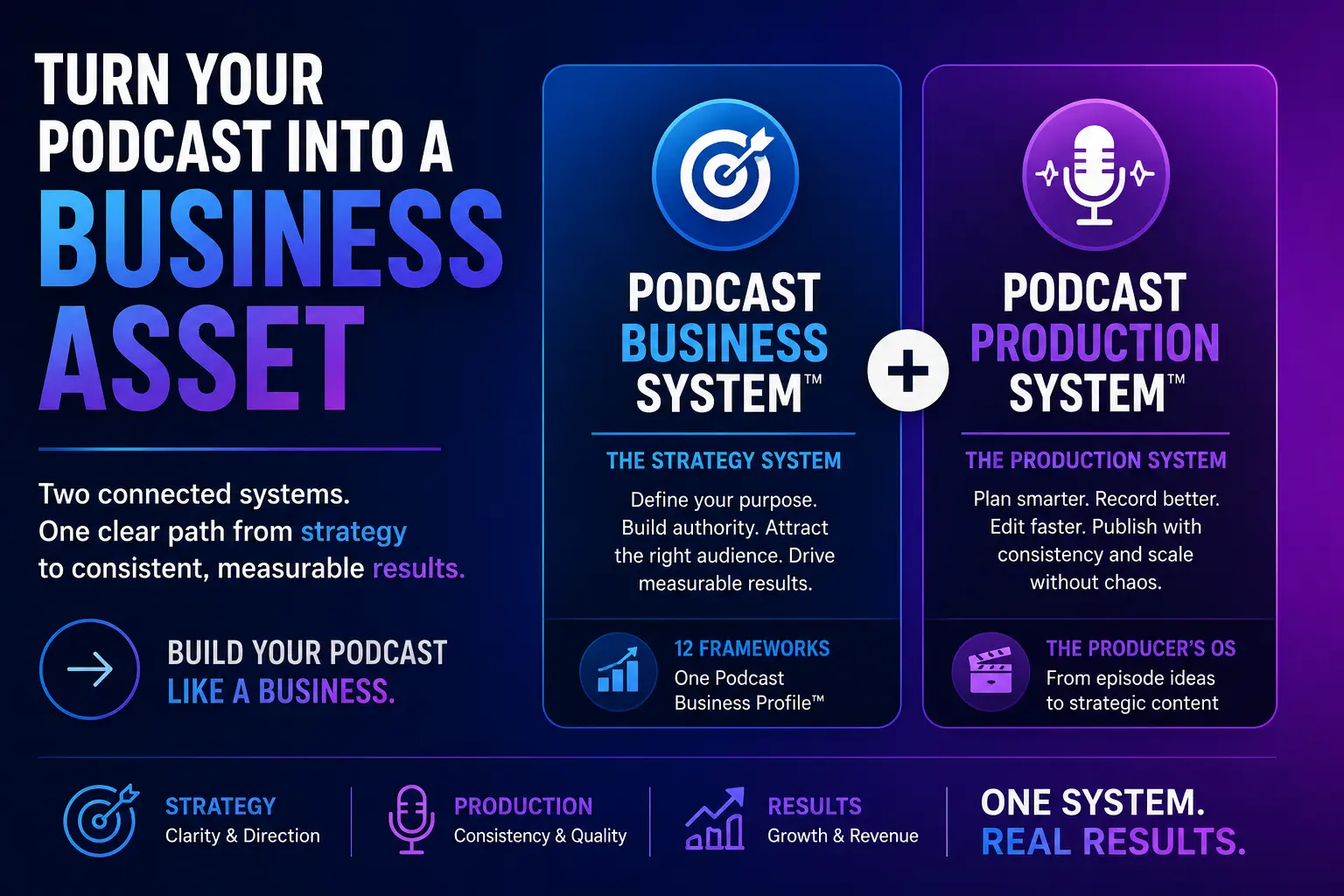
The Podcast Business System + Podcast Production OS is built around connecting those decisions instead of treating content, production, promotion, conversion, and measurement as separate jobs.
The Bottom Line
Running out of obvious podcast topics doesn’t mean you’ve exhausted your subject.
It usually means you’ve exhausted your original way of organizing it.
Don’t solve that by sitting in front of a blank document and demanding that your brain become more creative.
Reconnect the show to its job.
Collect real audience friction.
Look underneath surface questions.
Build recurring content lanes.
Change formats when it helps.
Then plan a short group of episodes and learn from what happens.
Your subject didn’t suddenly become empty.
You just need a better lens for finding the next useful thing to say.