A good podcast mid-roll should not feel like somebody stopped the episode and inserted a commercial.
Whether you’re promoting an outside sponsor, your own product, a free resource, or another relevant next step, the strongest mid-rolls usually have something in common: they make sense in the conversation that is already happening.
That’s the real job.
A mid-roll isn’t automatically good because it’s host-read. It isn’t good because it lasts exactly 60 seconds. And you don’t need to transform into Radio Announcer Travis for a minute and then return to being yourself.
The listener should understand why you’re bringing this up, why it matters to what they were just hearing, and what you want them to do next.
Here’s how to build that kind of mid-roll.
What Is a Podcast Mid-Roll Ad?
A podcast mid-roll is simply an advertisement or promotional message that appears during the main body of an episode.
That’s a placement term.
It doesn’t tell you who reads the ad or how the ad gets into the episode.
A mid-roll could be:
- host-read or voiced by somebody else;
- permanently edited into the episode;
- dynamically inserted;
- an outside sponsorship;
- a promotion for your own business or resource.
That’s why terms like mid-roll, host-read, baked-in, and dynamic ad insertion aren’t interchangeable.
If those terms are starting to sound like alphabet soup, my guide to podcast monetization terms including CPM, CPA, CPL, host-read ads, and DAI breaks the different layers apart.
For this article, we’re concentrating on one question:
What should the host actually say when the episode reaches that mid-roll moment?
The Real Mid-Roll Problem Is the Context Switch
You’ve probably heard this happen.
The host is talking naturally. The conversation has some energy. You’re following the idea.
Then suddenly:
“Today’s episode is brought to you by…”
Different voice. Different rhythm. Different vocabulary.
You can almost hear the Google Doc opening.
Current IAB podcast creative guidance makes a similar point: strong host reads tend to work when they sound like part of the show rather than a commercial interruption, and several contributors recommend giving hosts room to work from natural talking points instead of overloading them with rigid scripted copy.
That doesn’t mean scripts are bad.
A well-written script can sound completely natural. A terrible set of bullet points can still produce a terrible read.
The important thing is maintaining the communication style that earned the listener’s attention in the first place.
For a business podcast, there’s another layer: the offer needs to make sense in the context of the episode.
If you’re teaching somebody how to improve podcast retention and then abruptly pitch an unrelated service, the problem isn’t your delivery.
The problem is fit.
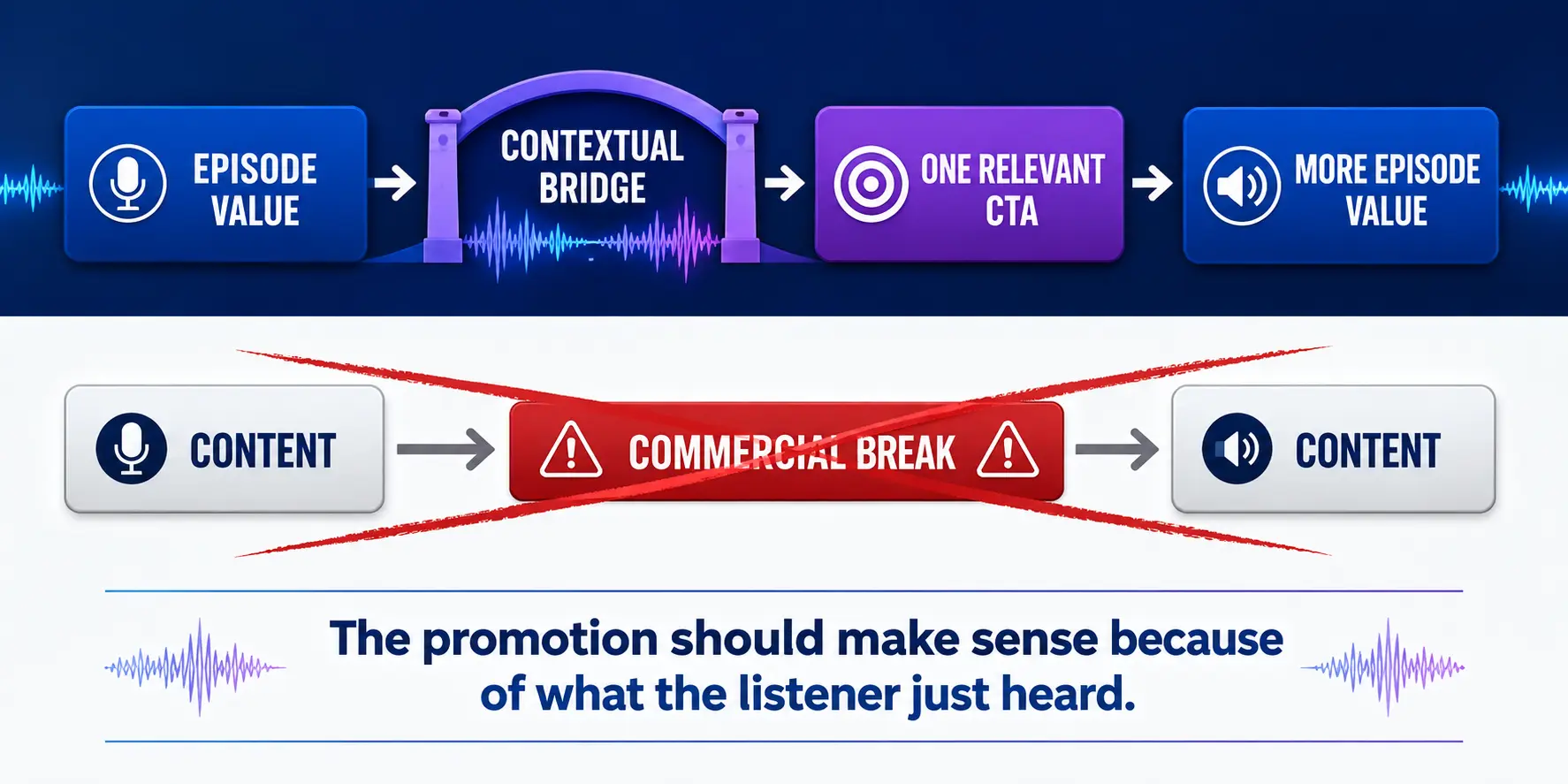
Use This Four-Part Mid-Roll Structure
I like to think about a useful mid-roll as four connected moves:
CONTEXT → PROBLEM → FIT → ACTION
You don’t have to announce the framework to the listener. It’s simply a planning tool that keeps the promotion connected to the lesson.
1. Context: Bridge From the Episode
Start with what the listener was already thinking about.
Instead of:
“Before we continue, I want to tell you about…”
Try something closer to:
“If you’re listening to this and realizing your episodes don’t really have a clear next step yet, this is worth fixing before you record another one.”
You’re still inside the subject.
The listener doesn’t have to mentally leave the episode, process an unrelated commercial, and then come back.
This is especially useful when you’re sponsoring your own podcast with an offer or resource that belongs to your business.
The offer becomes a continuation path rather than a random commercial occupying available airtime.
2. Problem: Name the Specific Friction
Next, identify the problem your resource or offer actually helps solve.
You don’t need to turn this into a late-night infomercial and aggressively “agitate the pain.”
Just make the connection specific.
For example:
“A lot of hosts understand that they need a CTA, but when they get to that spot in the outline they end up improvising five different things: subscribe, follow, review, visit the website, download something…”
That’s recognizable.
And it explains why the next thing you’re about to mention is relevant.
Compare that with:
“Are you struggling to take your podcast to the next level?”
That could lead to practically anything.
Specificity creates the bridge.
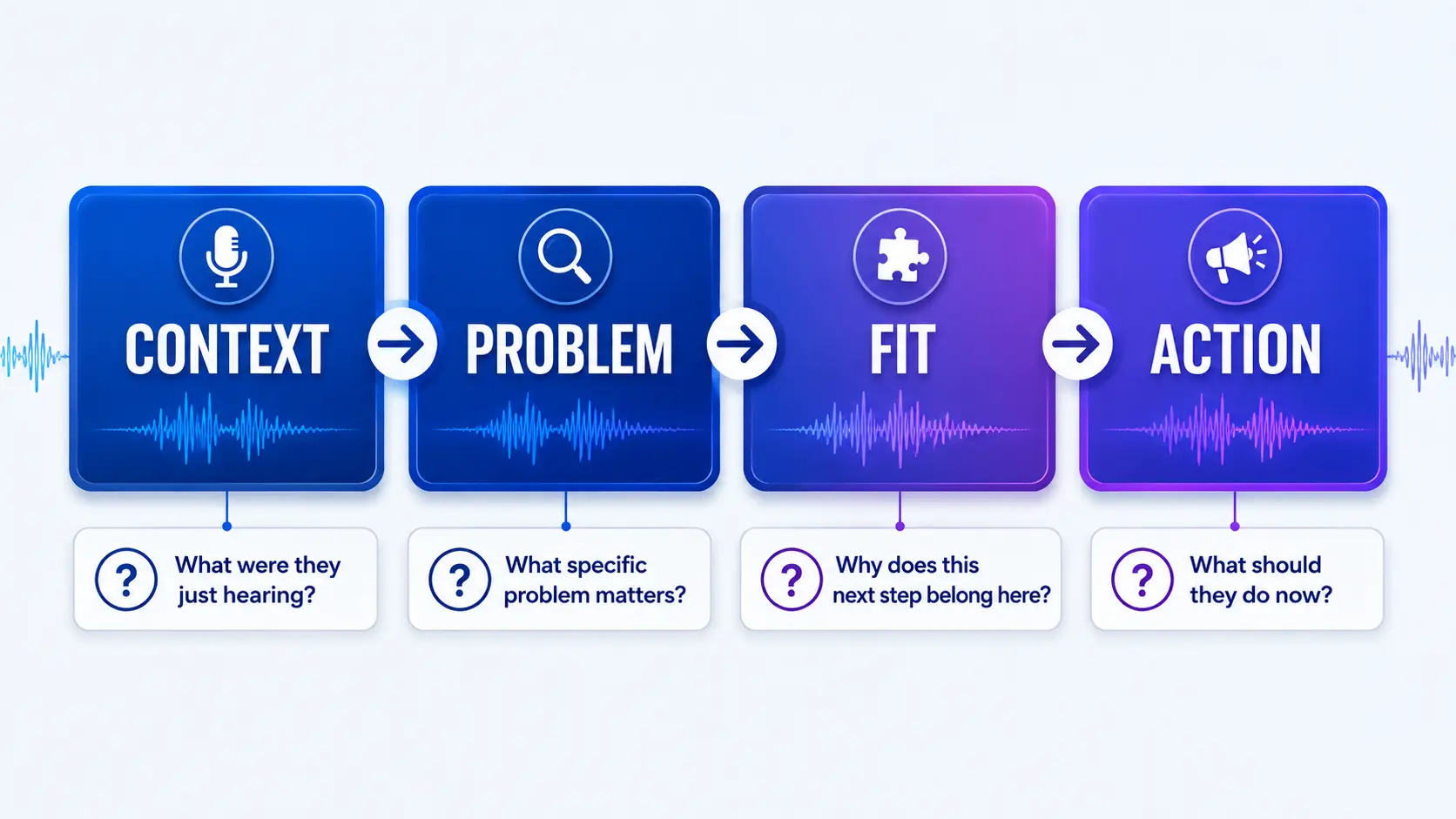
3. Fit: Explain Why This Is the Logical Next Step
Now explain why the thing you’re mentioning helps with the problem.
This is where the old version of this article relied heavily on a dramatic client transformation.
You don’t need one.
Use proof when you genuinely have relevant, verifiable proof. Otherwise, simply explain the fit.
For example:
“That’s exactly why I built the Podcast CTA Swipe File. It gives you CTA structures and a short planning drill so you can decide what you’re asking the listener to do before you hit Record.”
Notice what that does.
It doesn’t promise that the resource will double conversions.
It doesn’t manufacture a client story.
It just answers the listener’s natural question:
Why are you telling me about this?
If you’re working with an outside advertiser, the same principle applies. Explain the useful connection between the sponsor and the audience instead of dumping an entire feature list into the middle of the show.
4. Action: Give the Listener One Clear Direction
Finish with one action.
Not:
Follow me on Instagram.
Subscribe to the channel.
Leave a review.
Join the newsletter.
Download the guide.
Book a call.
Choose the action that matches the job of this episode.
For example:
“If writing the CTA is the part that keeps slowing you down, you can find the Podcast CTA Swipe File at PodcastingProTips.com/tools.”
That’s enough.
Your listener is often driving, exercising, cooking, walking the dog, or doing something other than staring at your beautifully engineered funnel.
Make the instruction easy to remember.
This same Rule of One applies to the finish of an episode. If that’s where you normally direct listeners, see my guide to building a focused podcast conversion outro.
A Mid-Roll Does Not Have to Contain a Story
I would change one of the central ideas in the original article here.
A story can make a mid-roll stronger.
But you don’t need to force a story into every mid-roll.
Sometimes a 25-second contextual explanation is better than a 60-second “micro-story” that obviously exists because somebody told you podcast ads need storytelling.
Use a story when you actually have one that makes the idea clearer.
Use a customer example when it’s true, relevant, approved, and accurately represented.
Use personal experience when you’ve actually had the experience.
Otherwise, explain the problem and the offer like a normal person.
That’s usually a better starting point than trying to manufacture drama around a CTA.
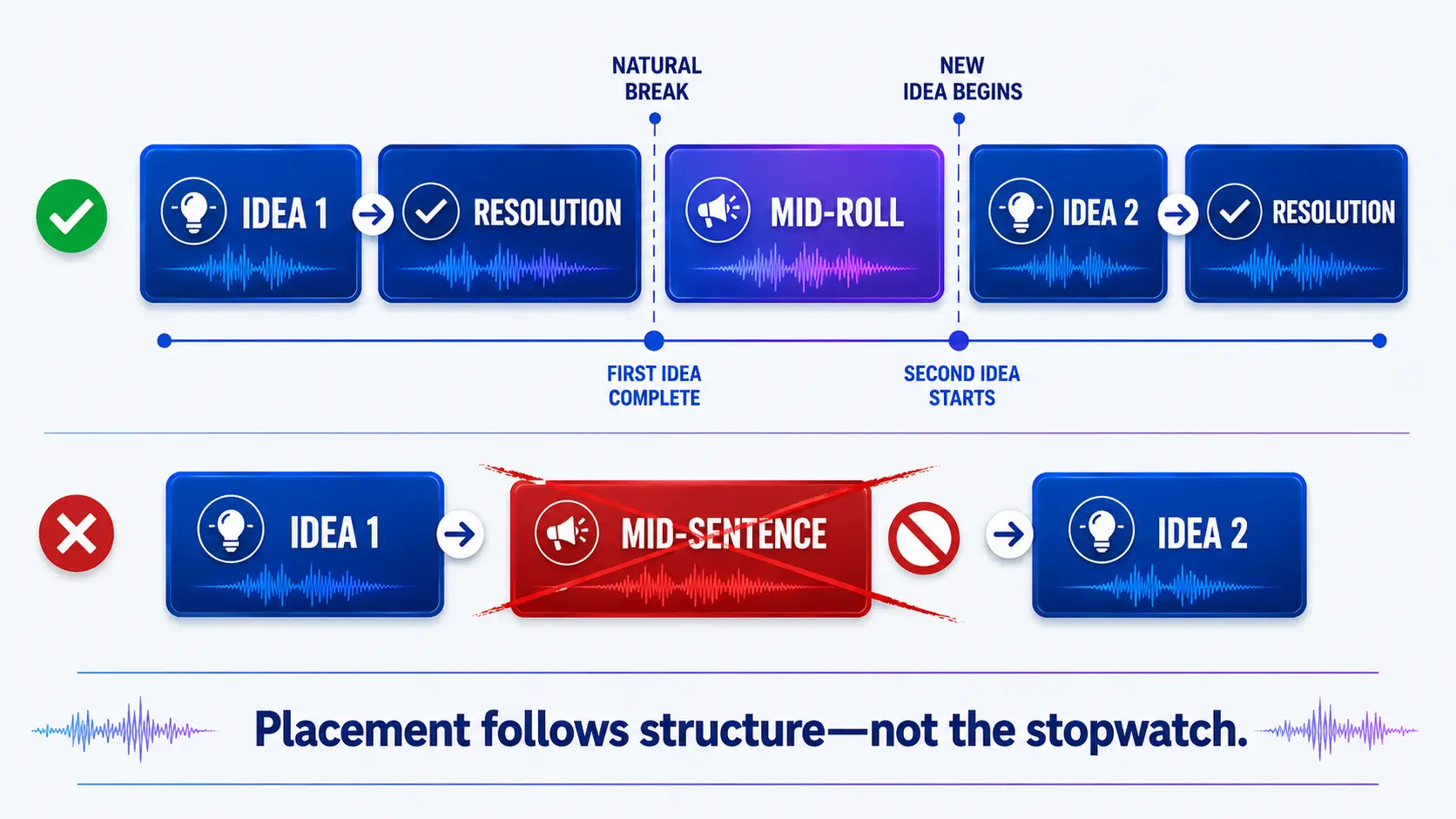
Don’t Automatically Put the Mid-Roll at the Exact Middle
“Mid-roll” does not mean you have to pull out a calculator and drop the CTA at exactly 50% of the runtime.
Look for a natural structural boundary.
Maybe you’ve finished explaining the problem and you’re about to teach the solution.
Maybe an interview has just completed one major topic.
Maybe you’ve reached the end of a story before moving into the practical steps.
That’s a natural place for a short break.
What you want to avoid is this:
“…and that’s why your attribution model needs to separate original source from podcast influ—HEY, LET ME TELL YOU ABOUT THIS GREAT PRODUCT.”
Technically, you’ve created a mid-roll.
Congratulations.
You’ve also run a truck through your sentence.
Placement is a production decision, not just an advertising decision.
And if you’re producing a short 10- or 15-minute solo episode, you may decide you don’t need a mid-roll at all. A focused CTA near the end may create a cleaner listener experience.
The placement should serve the episode, not the other way around.
Should You Put Music Under a Podcast Mid-Roll?
You can, but you don’t have to.
The previous version of this article recommended keeping the music at a fixed number of decibels below the host. I wouldn’t use a universal number like that.
The right balance depends on the voice, music, arrangement, processing, frequency content, and final mix.
The practical rule is simpler:
If the bed makes the words harder to understand, it’s too much.
IAB’s current creative guidance similarly recommends avoiding loud or disruptive music and sound effects and keeping any supporting audio from overpowering the voice.
Sometimes the most natural host-read mid-roll has no music at all.
The transition itself does the work.
Outside Sponsors Need One More Layer: Transparency
If you’re delivering a paid endorsement or you have another material relationship with the company you’re promoting, don’t try to make the sponsorship so “native” that the listener can’t tell there’s a commercial relationship.
Natural does not mean hidden.
The FTC’s current endorsement guidance says endorsements must be honest and not misleading and that material connections affecting how people evaluate an endorsement should be clearly disclosed when that connection would not otherwise be expected.
And don’t claim personal experience with a sponsor’s product if you didn’t have that experience.
There is plenty of room to sound conversational without pretending an advertisement isn’t an advertisement.
Plan the CTA Before You Record the Episode
Here’s where this connects to the larger production system.
The worst time to decide what the listener should do next is when you’ve reached minute 27, the guest has left, you’re staring at the microphone, and somebody says:
“Okay…do the CTA.”
The CTA should come from the episode’s job.
Before recording, you should know:
Who is this episode for?
What problem are we helping them understand or solve?
What is the most relevant next step after they receive that value?
Then the mid-roll becomes much easier to write because you’re not trying to bolt a monetization tactic onto an episode that was never designed to lead anywhere.
That’s the bigger lesson.
A good mid-roll isn’t really an isolated copywriting trick.
It’s one small connection between the episode, the listener’s problem, your offer, and the action you want to measure.
How Do You Know Whether the Mid-Roll Worked?
Don’t judge it by whether everybody in the studio said, “Yeah, that sounded pretty smooth.”
Decide what action you’re trying to create.
Depending on the CTA, that could be:
- a resource download;
- an email signup;
- a tracked website visit;
- a registration;
- an inquiry;
- a product evaluation;
- a purchase.
Then measure the evidence you can actually observe.
A tracked click or resource signup can tell you that somebody responded to the pathway. It doesn’t automatically prove the entire business outcome came from one 30-second mid-roll.
That distinction matters.
If you want to go deeper into separating reach, action, business outcomes, and attribution, see how to measure podcast ROI beyond CPM and downloads.
A Simple Mid-Roll Example
Let’s put the whole structure together.
Imagine the episode is about podcast CTAs.
Context
“If you’ve been listening to this and realizing you haven’t actually decided what your listener should do after each episode, fix that before you worry about making the CTA sound clever.”
Problem
“Most awkward CTAs aren’t really delivery problems. The host gets to the end of the outline and suddenly tries to promote four different things.”
Fit
“That’s why I built the Podcast CTA Swipe File. It gives you ready-to-adapt CTA structures plus a short planning drill that helps you choose the destination before you record.”
Action
“You can find it at PodcastingProTips.com/tools.”
Then continue the episode.
No voice change.
No fake urgency.
No three-minute detour.
And no need to say, “But wait, there’s more.”
The Mid-Roll Checklist
Before you record one, ask:
- Does this offer genuinely fit the subject of the episode?
- Can I bridge into it from something the listener just heard?
- Have I named a specific problem rather than a generic pain point?
- Can I explain why the offer or resource fits without exaggerating?
- Am I giving the listener one primary action?
- Is the placement at a natural transition?
- Does the delivery still sound like me?
- Are any endorsements, relationships, or result claims properly disclosed and supportable?
- Do I know what signal I’ll use to evaluate the CTA?
If you can answer those clearly, you probably don’t need some secret “high-converting ad voice.”
You need a relevant bridge and a clear next step.
Need Help Writing the Actual CTA?
If choosing the words is still slowing you down, the Podcast CTA Swipe File includes CTA scripts for different types of destinations, the Conversion Outro Formula, and a 5-Minute CTA Drill for deciding what to ask the listener to do before you record.
You can find it at:
Turn passive listeners into paying clients
Stop leaving money on the table with vague endings and copy-paste these proven scripts to give your audience a clear path to convert.
Podcast Mid-Roll FAQ
How long should a podcast mid-roll ad be?
There isn’t one mandatory length. Outside advertising campaigns may use defined inventory lengths, but for your own podcast CTA, use enough time to establish context, explain the fit, and give one clear action without dragging the episode off course.
Should a podcast mid-roll be scripted?
It can be. The goal isn’t to eliminate scripts; it’s to eliminate unnatural delivery. A conversational script, hybrid script, or clear set of talking points can all work. Current IAB creative guidance specifically supports natural host delivery and flexible talking points.
Where should I place a mid-roll ad?
Place it at a natural content boundary rather than automatically at the mathematical midpoint of the episode. A completed topic, transition between sections, or shift from problem to solution is usually cleaner than interrupting a thought simply because the timestamp says you’ve reached halfway.