I used to see this all the time when I worked at a podcast production studio.
A smart business owner would walk in about an hour before recording, pull out a sheet of paper, and proudly announce that they had prepared for the interview.
Then I’d look at the page.
Ten generic ChatGPT questions.
“How did you get started?”
“What challenges have you faced?”
“What advice would you give someone just starting out?”
If I had a nickel for every time that happened, I’d have about 85 cents.
The problem wasn’t ChatGPT.
The problem was asking AI to make the editorial decisions that should have been made during podcast pre-production.
If your entire interview plan starts with:
“Give me 10 questions to ask a real estate expert.”
you haven’t really planned an interview.
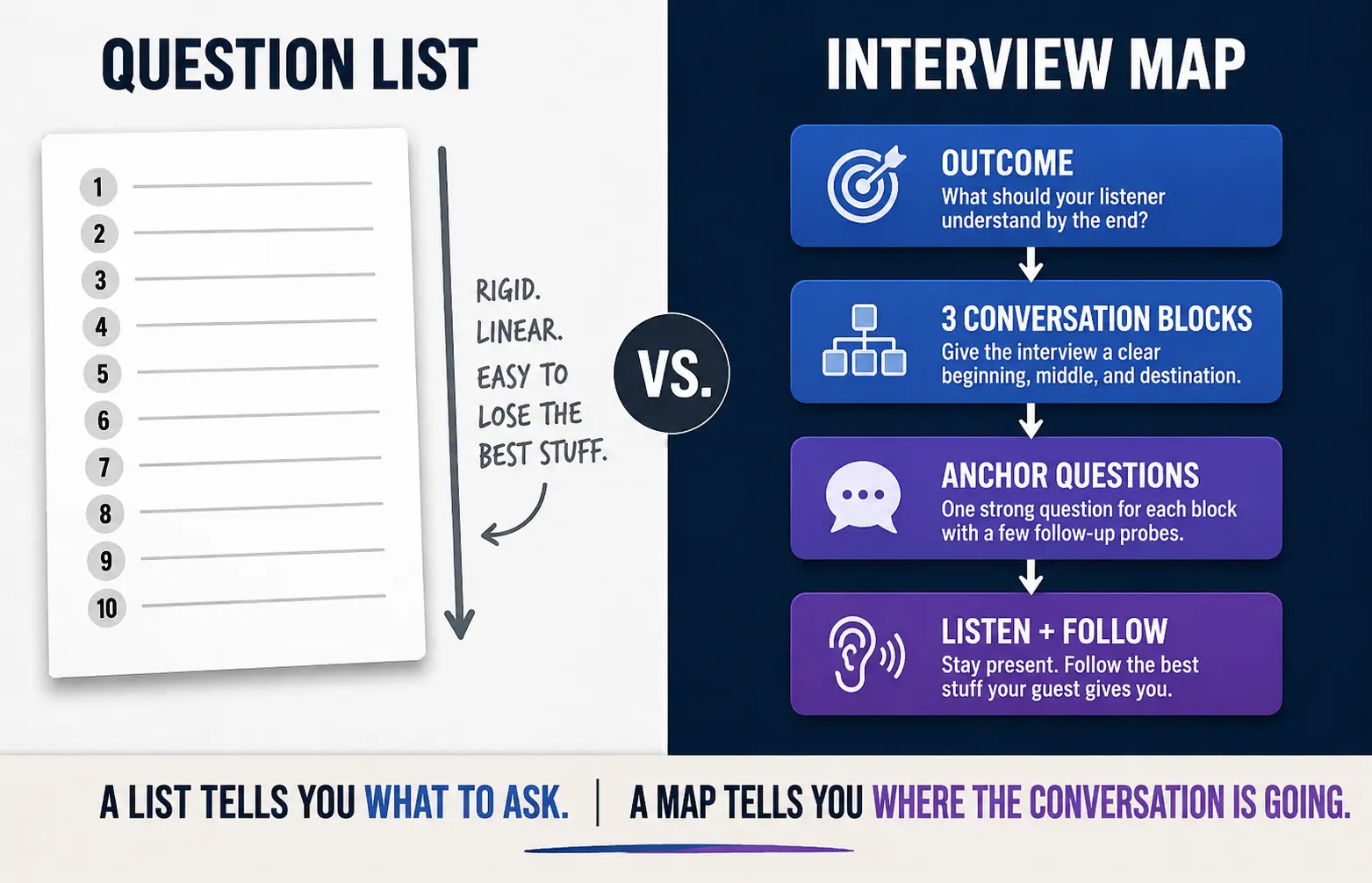
You’ve generated a list.
And those aren’t the same thing.
The Real ChatGPT Interview Trap
ChatGPT can be extremely useful during podcast interview preparation.
It can help you organize research, identify possible angles, compare ideas, develop follow-up questions, spot gaps in your outline, and turn messy notes into something useful.
The trap is expecting it to decide what your conversation should accomplish.
A generic prompt has almost no information about:
- who your audience is;
- why this guest matters to them;
- what your episode is supposed to accomplish;
- what the guest knows that isn’t obvious;
- which opinions are worth challenging;
- which stories you want to uncover;
- what your audience should understand by the end.
So don’t start by asking for questions.
Start by deciding what the interview is for.
Step 1: Give the Interview One Clear Job
Before researching questions, finish this sentence:
By the end of this episode, I want you to understand __________.
That answer becomes your filter.
Suppose you’re interviewing a CPA.
“Talk about taxes” isn’t much of an episode job.
Neither is:
“Learn about our guest and their career.”
A stronger outcome might be:
By the end of this episode, you should understand the three tax mistakes new business owners commonly make before their first profitable year.
Now you have direction.
You know what belongs in the interview and, equally important, what doesn’t.
This is why good podcast pre-production isn’t about scripting every word. It’s about making the important decisions before the red light turns on.
Step 2: Research for Anchors, Not Biography Trivia
You don’t need to memorize your guest’s life story.
You need enough research to find anchors—specific things you can grab onto during the conversation.
Look for:
- an unusual opinion;
- a recent article or social post;
- a project they worked on;
- a mistake they’ve discussed publicly;
- a result they can explain;
- an argument they disagree with;
- a process they’ve developed;
- a major transition in their career;
- something they repeatedly teach.
These give you somewhere useful to start.
Compare these two questions.
Generic:
“What are some common mistakes business owners make with taxes?”
Research anchored:
“You’ve said that one of the biggest mistakes new owners make happens before they even start making real money. What are they doing too early?”
The second question gives the guest something specific to respond to.
It also makes it much harder to fall into the rehearsed answer they’ve given on six other podcasts.
Step 3: Build Three Conversation Blocks Instead of Ten Random Questions
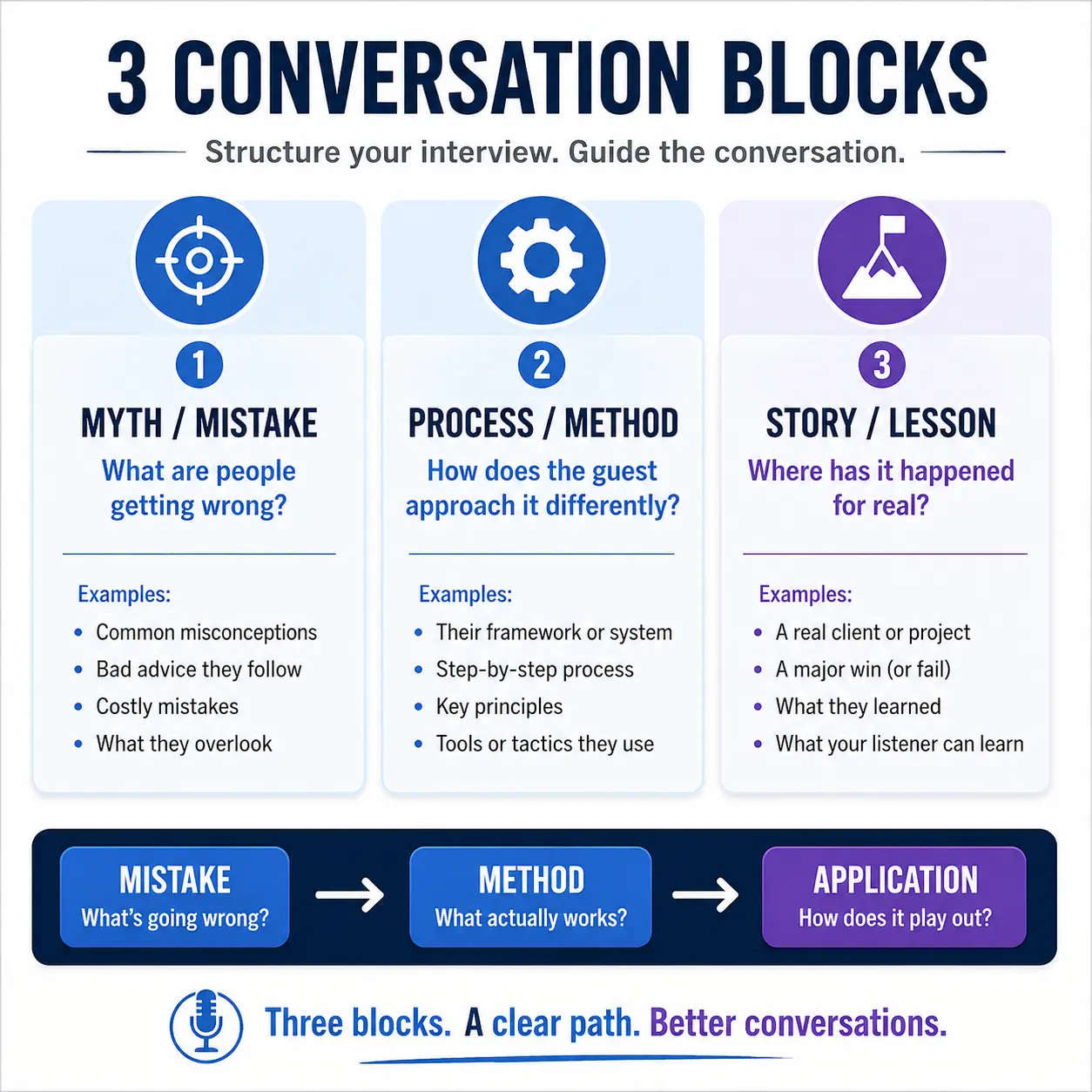
One of the easiest ways to simplify interview preparation is to organize the episode around three major conversation blocks.
A useful structure is:
1. Myth or Mistake
What does your audience misunderstand?
What does the guest see people doing incorrectly?
2. Process or Method
What does the guest actually do differently?
How does their approach work?
3. Story or Lesson
Where has this played out in real life?
What happened?
What can your listener learn from it?
Now you have a path:
MISTAKE → METHOD → REAL-WORLD APPLICATION
That is much easier to host than a page containing Questions 1 through 14.
It also gives the interview somewhere to go.
Step 4: Write Anchor Questions, Not a Script
You still need questions.
You just don’t need to write every possible sentence you’re going to say.
For each major block, prepare one anchor question.
Then give yourself one or two optional follow-ups.
For example:
Block: Mistake
Anchor question:
“What do most podcasters misunderstand about preparing for an interview?”
Possible follow-ups:
- “Why does that happen?”
- “What does that sound like in an actual recording?”
Block: Method
Anchor question:
“How do you prepare differently?”
Possible follow-ups:
- “Walk me through that.”
- “What do you decide before you write the first question?”
Block: Story
Anchor question:
“Can you think of an interview where that preparation completely changed the conversation?”
Possible follow-ups:
- “What happened?”
- “What would have happened if you had stayed with the original questions?”
That’s enough structure to keep the interview moving without turning you into someone reading cue cards.
Step 5: Use ChatGPT as the Research Assistant
This is where AI becomes useful.
Instead of:
Give me 10 questions for my guest.
give ChatGPT the decisions you’ve already made.
For example:
I’m preparing a podcast interview for [AUDIENCE].
The guest is [GUEST].
The episode’s main outcome is: By the end of this episode, the audience should understand [OUTCOME].
Do not start by giving me a generic list of interview questions.
Help me identify:
- Three useful conversation blocks.
- Relevant tensions, mistakes, disagreements, processes, or stories worth exploring.
- Two or three specific research anchors for each block based on the material I provide.
- One anchor question for each block.
- Up to two optional follow-up probes for each anchor question.
- Any question that sounds generic or likely to produce a rehearsed answer.
- Any factual claim that should be verified before recording.
Then give it your guest’s bio, notes, articles, transcript excerpts, website copy, posts, or other relevant material.
If current information matters, you can also have ChatGPT search for recent sources and use those findings as research inputs rather than simply asking it to invent questions.
The difference is important.
You’re still producing the interview.
AI is helping you process the research.
Step 6: Stop Looking at Your Prep Once the Good Stuff Starts
There is a strange way to ruin an interview after doing excellent preparation:
Follow your preparation too closely.
Your guest says something unexpected.
There’s a pause.
Their tone changes.
They mention a mistake you’ve never heard them discuss.
And instead of following it, you look down and think:
“Okay…Question 6.”
That’s the passive-listening trap in podcast interviews.
Your plan is supposed to give you confidence to listen—not give you an excuse to stop listening.
When something better appears, follow it.
Ask:
- “Wait. What happened there?”
- “Why?”
- “Can you give me an example?”
- “What do you mean by that?”
- “What changed?”
- “Back up for a second—how did you figure that out?”
Curiosity is part of good interview preparation because your outline should leave enough room for an actual human conversation. That’s also why I think of authenticity, passion, and curiosity as things your podcast structure should protect, not edit out.
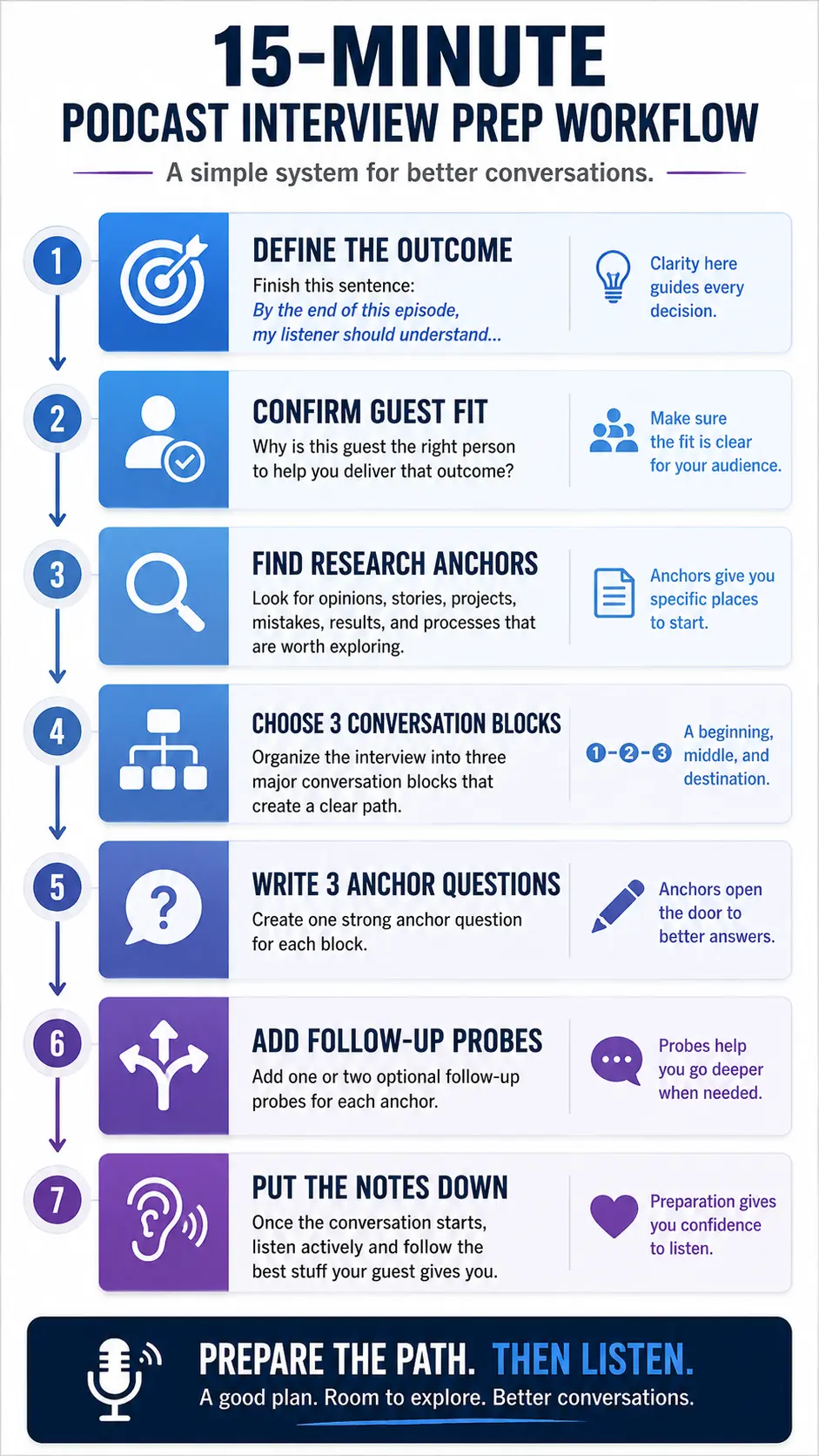
A 15-Minute Podcast Interview Preparation Workflow
You do not need three hours and a 12-page dossier for every guest.
For many interviews, a focused preparation session can look like this:
- Define the episode outcome.
What should your listener understand when the episode is over? - Confirm why this guest fits.
What can this person specifically contribute to that outcome? - Find your research anchors.
Identify a few opinions, stories, examples, processes, or experiences worth exploring. - Choose three conversation blocks.
Give the episode a beginning, middle, and destination. - Write one anchor question for each block.
Don’t script the entire conversation. - Add a few follow-up probes.
Keep them available if the conversation needs help. - Put the notes down and listen.
Once the guest starts giving you something better, follow the conversation.
That’s preparation.
A list of ten generic questions is just paperwork.
Before You Hit Record
Run this quick check:
- Do I know what this episode is supposed to accomplish?
- Do I know why this guest is right for that topic?
- Have I found something beyond their standard biography?
- Can I describe my three major conversation blocks?
- Do I have one strong anchor question for each?
- Do I have a few follow-up probes available?
- Am I prepared to abandon a question if the guest gives me something better?
- Does the episode lead somewhere useful for my listener?
If you can answer yes to those questions, you’re prepared.
Not over-scripted.
Not winging it.
Prepared.
Want the Complete Interview Prep System?
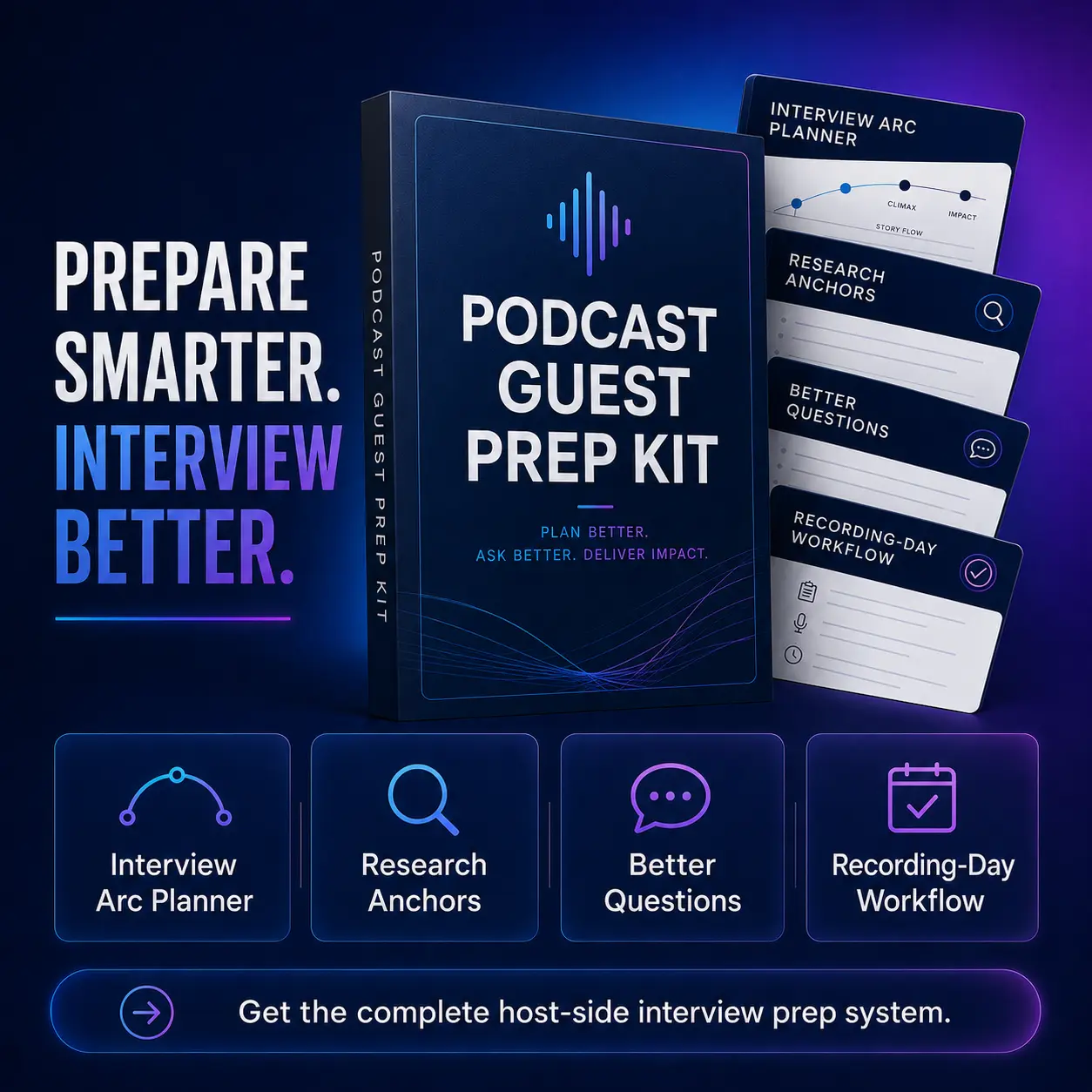
If you want to turn this into a repeatable workflow, the Podcast Guest Prep Kit gives you the complete host-side system: guest relevance and format tools, an Interview Arc Planner, research anchors, Macro Tension Blocks, active-listening prompts, question rewrites, Ramble Rescue scripts, guest communication templates, recording-day tools, and AI prompts.
Get the Podcast Guest Prep Kit →
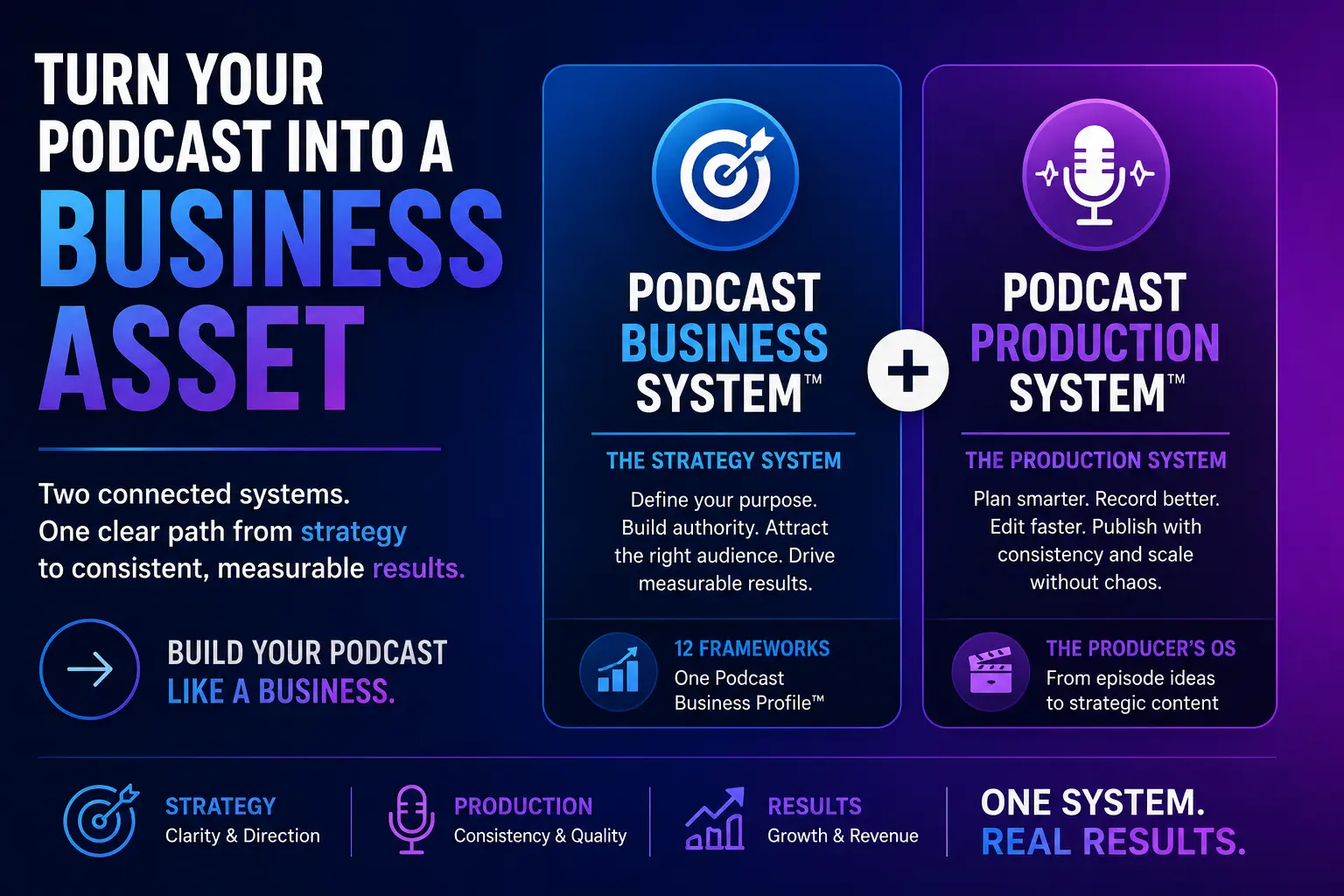
And remember: even excellent interview preparation sits downstream from the larger decisions about what your podcast is supposed to accomplish. If your topics, guests, content, CTAs, and business goals aren’t connected, that’s the broader problem the Podcast Business System is designed to solve.
Podcast Interview Preparation FAQ
Can you use ChatGPT to prepare for a podcast interview?
Yes. The best use is to let ChatGPT help research, organize, compare, and develop your interview plan after you’ve defined the audience, episode outcome, and guest angle. Don’t expect a generic request for “10 questions” to make those decisions for you.
How many podcast interview questions should you prepare?
There isn’t a magic number. For a focused interview, a few strong anchor questions supported by optional follow-ups are often more useful than a long rigid list. Your goal is to create enough structure to guide the conversation while leaving room to listen.
What should you research before interviewing a podcast guest?
Look beyond the standard biography. Find specific opinions, stories, projects, processes, mistakes, disagreements, recent work, and examples connected to the episode’s actual purpose.