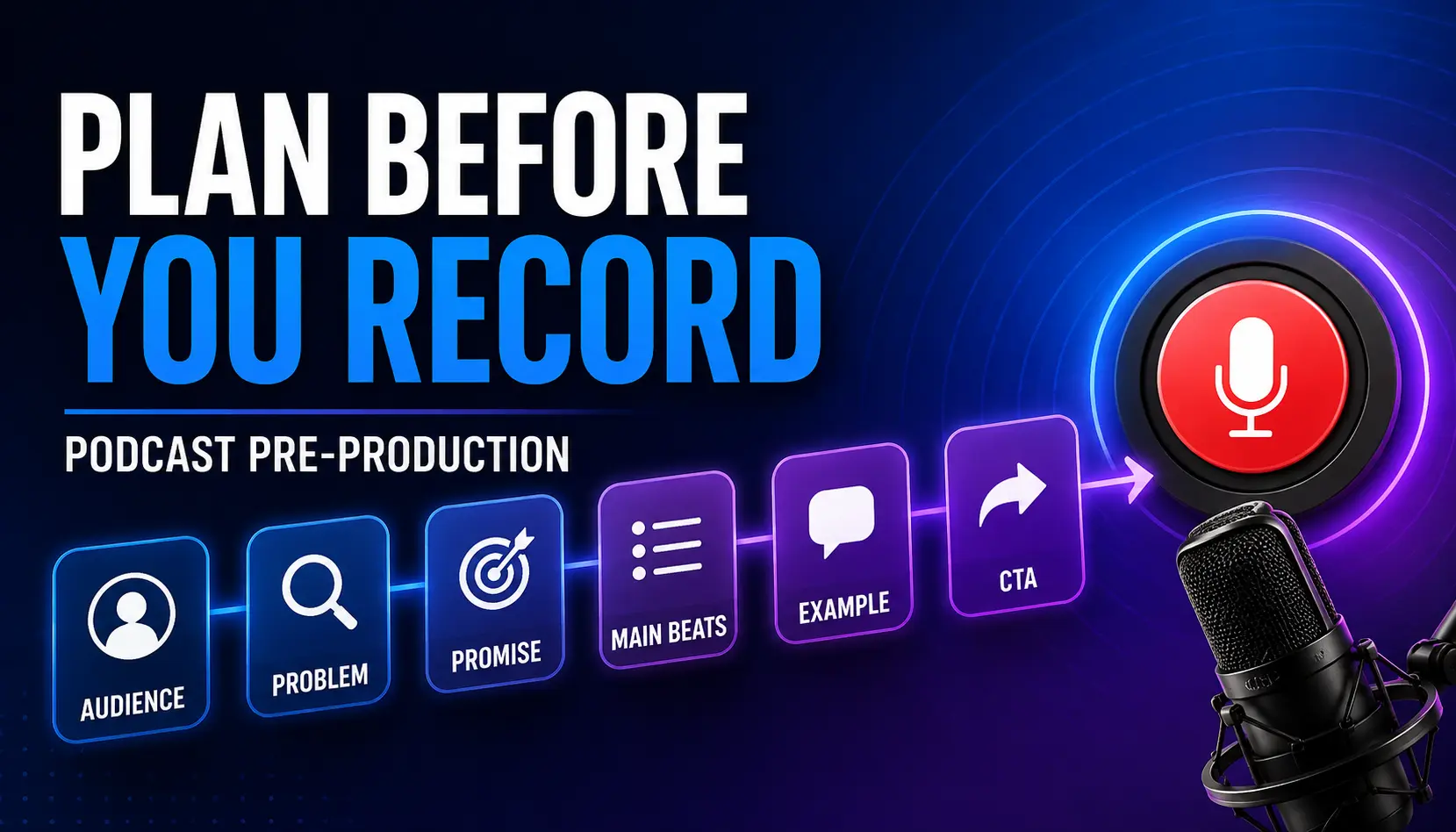
You do not need to script every word of a podcast episode before you record it.
But you should know what the episode is supposed to do.
That is the simplest way to think about podcast pre-production.
Podcast pre-production is the planning you do before the microphones and cameras start recording. It is where you decide who the episode is for, what problem it will address, what the listener should take away, how the conversation will move, and what should happen when the episode ends.
Without that work, you are not really planning an episode. You are showing up with a topic and hoping something useful happens.
Sometimes it does.
Sometimes you spend 60 minutes throwing paint at the wall and hand your editor a very expensive abstract painting.
What Is Podcast Pre-Production?
Podcast pre-production is everything you decide and prepare before recording.
Depending on the episode, that can include:
- the audience or listener problem;
- the job of the episode;
- the main promise or takeaway;
- the episode format;
- the opening hook;
- the main talking points or interview arc;
- examples, stories, or proof;
- the primary call-to-action;
- guest research and questions;
- recording assets and technical preparation.
The goal is not to eliminate spontaneity.
The goal is to give the spontaneity somewhere useful to go.
A strong outline should work like a map. You know where you are starting, where you need to end up, and the major stops along the way. You can still take a side road when something interesting happens.
If the entire show itself still lacks a clear audience, purpose, or promise, episode planning will only take you so far. Start by defining your podcast concept and the foundation of the show before worrying about individual episodes.
Why Winging a Podcast Episode Creates Problems
Some experienced hosts can sit down, talk for an hour, and make it look effortless.
What you do not always see is the structure underneath the conversation.
They know the subject. They understand their audience. They recognize when a conversation is wandering. They know how to return to the point. They have developed instincts through repetition.
Simply copying the visible part—two microphones and a conversation—does not give you those instincts.
I have seen this go wrong in the studio.
I once worked with a successful real-estate professional who was completely comfortable talking about his business. Knowledge was not the problem. Confidence was not the problem.
The episodes still never came out.
The recordings wandered through so many disconnected ideas that there was no clear episode underneath them. There was no central takeaway and no reasonable editing decision that could manufacture one afterward.
That is an important distinction.
Editing can tighten an episode.
Editing can remove repetition.
Editing can clean up mistakes.
Editing cannot reliably invent the point you never decided to make.
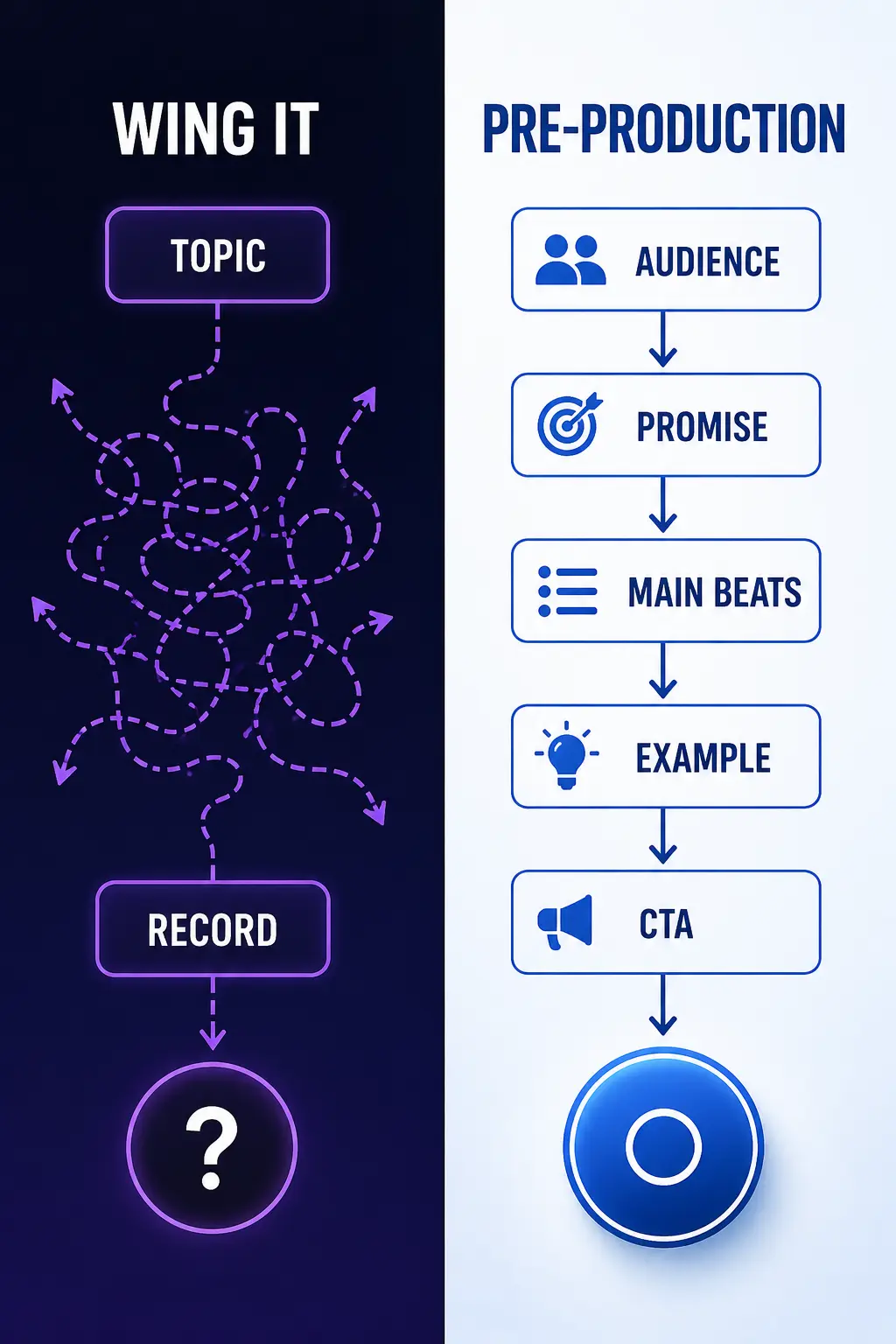
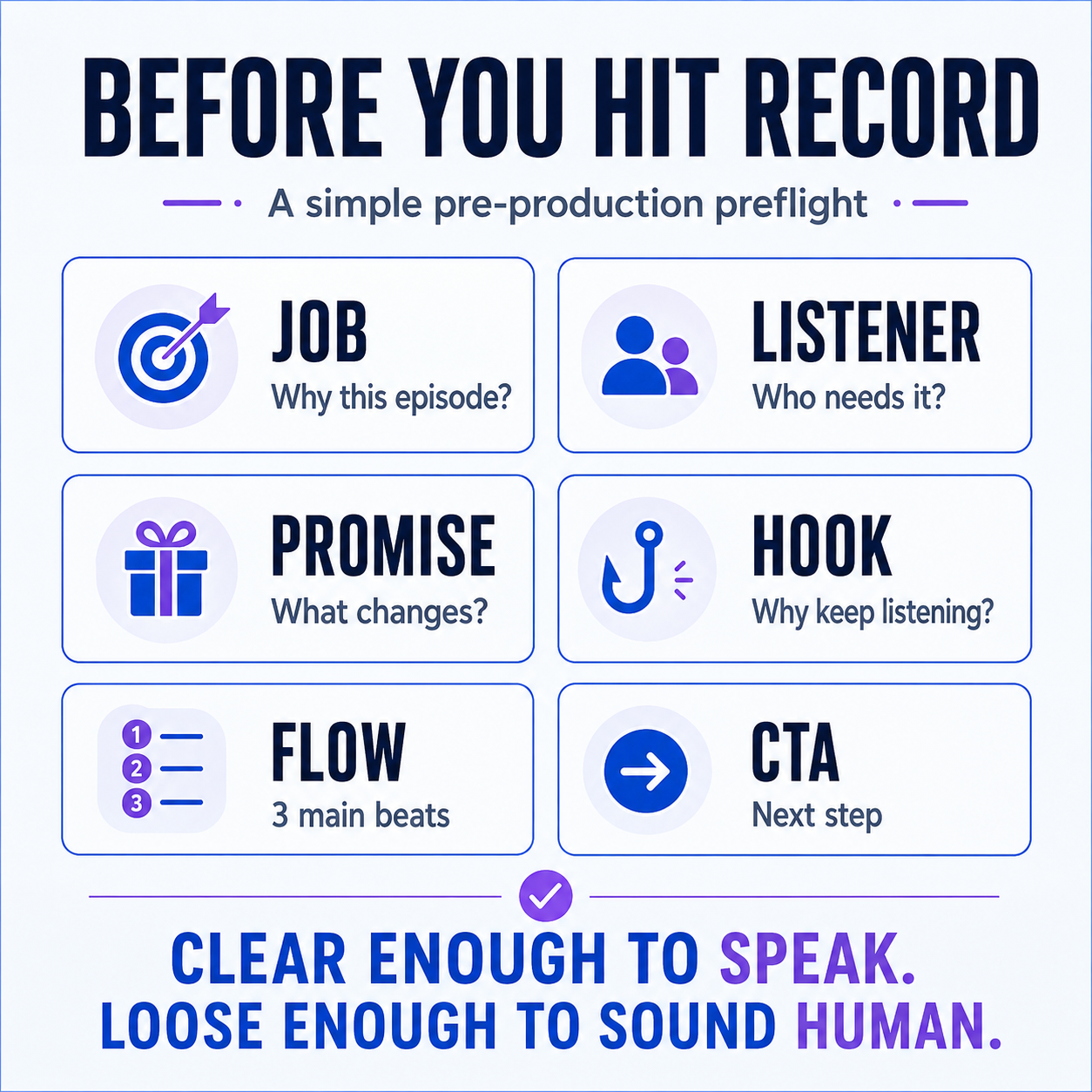
The 8 Things to Plan Before You Record
You do not need a 14-page production document for every podcast episode.
For most shows, answering eight questions gives you enough structure to walk into the recording with direction.
1. What Is the Job of This Episode?
Start here.
Why are you making this particular episode?
Maybe you want to:
- answer a common audience question;
- teach a process;
- correct a misconception;
- demonstrate your expertise;
- help someone make a decision;
- share a useful story;
- prepare a potential customer for a next step;
- interview someone who brings relevant expertise.
“Talk about marketing” is not much of an episode job.
“Help a local business owner understand why more podcast downloads may not fix a weak conversion path” is much clearer.
A topic tells you what you are talking about.
A job tells you why the episode exists.
2. Who Is This Episode Specifically For?
You do not have to redesign your entire audience for every episode.
You do need to know which part of that audience needs this particular conversation.
Imagine one person encountering the problem.
What are they trying to understand?
What are they currently doing?
Where are they stuck?
What would make this episode useful to them right now?
That one decision will improve your examples, your language, your hook, and the amount of explanation you need.
3. What Is the One Main Promise?
What should someone understand, decide, avoid, or be able to do after listening?
Keep this focused.
If your outline contains six completely different promises, you probably have six episodes.
For this article, for example, the promise is simple:
You should be able to plan a focused podcast episode before recording without writing a rigid word-for-word script.
Everything else supports that.
4. What Format Best Fits the Job?
Do not automatically default to an interview because you have a guest available.
Do not automatically record a solo episode because it is easier to schedule.
Choose the format that serves the idea.
A solo teaching episode works well when you need to explain your own thinking.
An interview works when the guest brings expertise, experience, evidence, or perspective that materially improves the episode.
A case study works when the example itself carries the lesson.
A tactical episode works when the audience needs a process.
A misconception or pattern-interrupt episode works when you need to challenge the way someone currently thinks about a problem.
Format follows purpose.
5. How Will You Open the Episode?
Your first line does not need to sound like a movie trailer.
It does need to create relevance.
Before recording, know how you are going to get into the subject.
That could be:
- the problem;
- a consequence;
- a recognizable situation;
- a mistake;
- a surprising distinction;
- a direct promise;
- a useful question.
What you want to avoid is spending the beginning of the episode warming yourself up while the listener waits for the episode to start.
If your opening routinely takes too long to reach the useful part, see my guide to fixing the traditional 60-second podcast intro.
6. What Are the Main Beats?
Now build the path.
For a straightforward teaching episode, this might be:
- Problem
- Why it matters
- Point one
- Point two
- Point three
- Example
- Takeaway
- CTA
Those labels are not sacred.
The principle is.
You want enough structure that you can look at the outline and immediately know where you are in the episode.
I prefer bullet points and speaking maps for a lot of podcast material because they create direction without forcing you to read paragraphs into a microphone.
Your outline should help you speak.
It should not make you sound like you are reading an article.
7. What Example, Story, or Proof Will Make the Point Real?
This is one of the easiest things to forget when you plan an episode.
You map the teaching points but leave out the part that makes the lesson concrete.
Before recording, identify at least one useful example.
It could be:
- a client situation you are allowed to discuss;
- something you observed;
- a personal experience;
- a hypothetical example;
- a before-and-after comparison;
- a simple analogy.
You do not need a dramatic story in every episode.
You need enough context that the listener can see what the idea looks like outside your outline.
8. What Should the Listener Do Next?
Choose the CTA before you record.
Do not wait until the final 30 seconds and suddenly remember that the episode is supposed to lead somewhere.
Your CTA might be:
- use a template;
- download a resource;
- listen to a related episode;
- join your email list;
- visit a product page;
- book a conversation;
- apply the lesson themselves.
The strongest next step usually continues the problem the episode just helped solve.
That makes the CTA part of the episode instead of a commercial stapled onto the end.
Interview Pre-Production Needs a Different Kind of Planning
A guest interview needs preparation, but that does not mean writing 27 questions and reading them in order.
Start with the reason the guest belongs in the episode.
Ask:
- Why this guest?
- Why this topic?
- Why will my audience care?
- What should the audience understand by the end?
- What are the few major areas we need to explore?
- What stories or examples would make those areas useful?
Then prepare a small number of anchor questions and keep additional prompts available as backup.
The outline gives you direction.
Your listening determines where the conversation goes next.
That distinction is important enough that I cover it separately in how to prepare for a podcast interview without letting ChatGPT write a generic question list.
Podcast Pre-Production Is Not the Same as Writing a Full Script
This is where some hosts overcorrect.
They ramble through one episode, hate the result, and decide they need to write every word of the next one.
Now the episode is organized—but it sounds like someone reading an employee handbook.
You have several preparation options.
A speaking map gives you the key points and lets you explain them naturally.
A hybrid script gives you precise wording for the hook, important explanations, transitions, CTA, or close while leaving the teaching sections looser.
A full script makes sense when wording needs to be exact.
Use the lightest level of preparation that allows you to speak clearly and confidently.
That is usually enough.
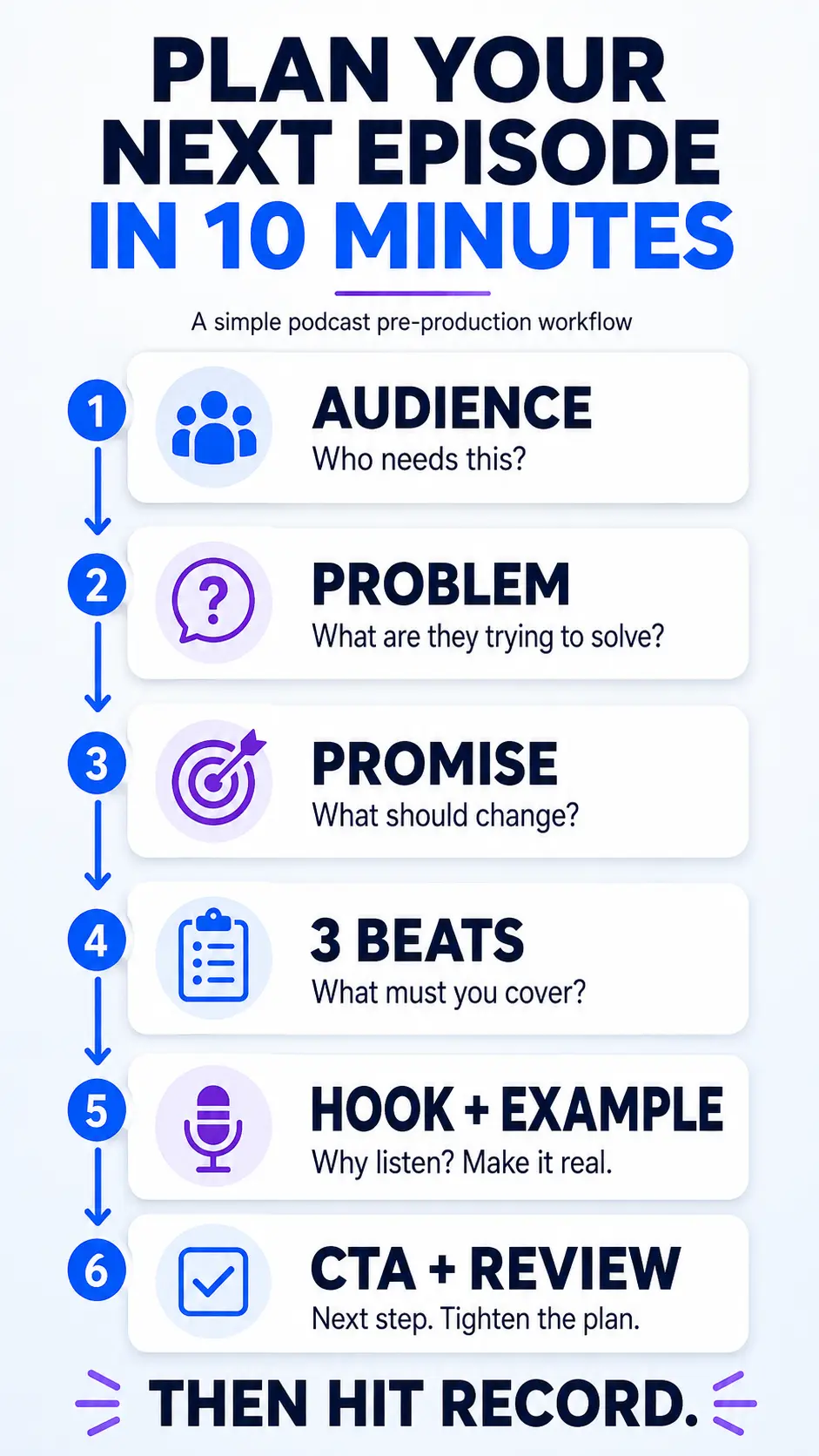
A 10-Minute Podcast Pre-Production Plan
Once you have done this a few times, pre-production does not need to become a giant homework assignment.
Here is a simple pre-flight you can run before a straightforward episode:
Minute 1: Audience
Who is this for?
Minute 2: Problem
What specific question, problem, mistake, or situation are you addressing?
Minute 3: Promise
What should the listener understand or be able to do afterward?
Minutes 4–6: Main Beats
Write the three main ideas you need to cover.
Minute 7: Hook
Write the opening idea or first line.
Minute 8: Example
Choose one example, story, or comparison.
Minute 9: CTA
Decide the one next step.
Minute 10: Review
Look at the plan as a whole.
Does everything support the same episode?
If not, trim it before you hit Record.
Ten useful minutes before the recording can be a much better investment than trying to discover the episode inside the editing timeline later.
Good Pre-Production Makes Everything Downstream Easier
The recording is only one part of a podcast episode.
Afterward, someone may still need to:
- edit it;
- choose a title;
- create chapters;
- write the description or show notes;
- identify clips;
- create social content;
- write an email;
- connect the episode to the right CTA.
When the episode already has a defined audience, problem, promise, structure, and next step, those decisions have a starting point.
That is the larger production lesson.
Pre-production should not be an isolated checklist.
It should feed the rest of the workflow.
If every episode requires you to reinvent the process from scratch, turn the steps that work into a repeatable system. My automated podcast workflow blueprint goes deeper into building that kind of repeatable production process.
Stop Starting Every Episode From a Blank Page
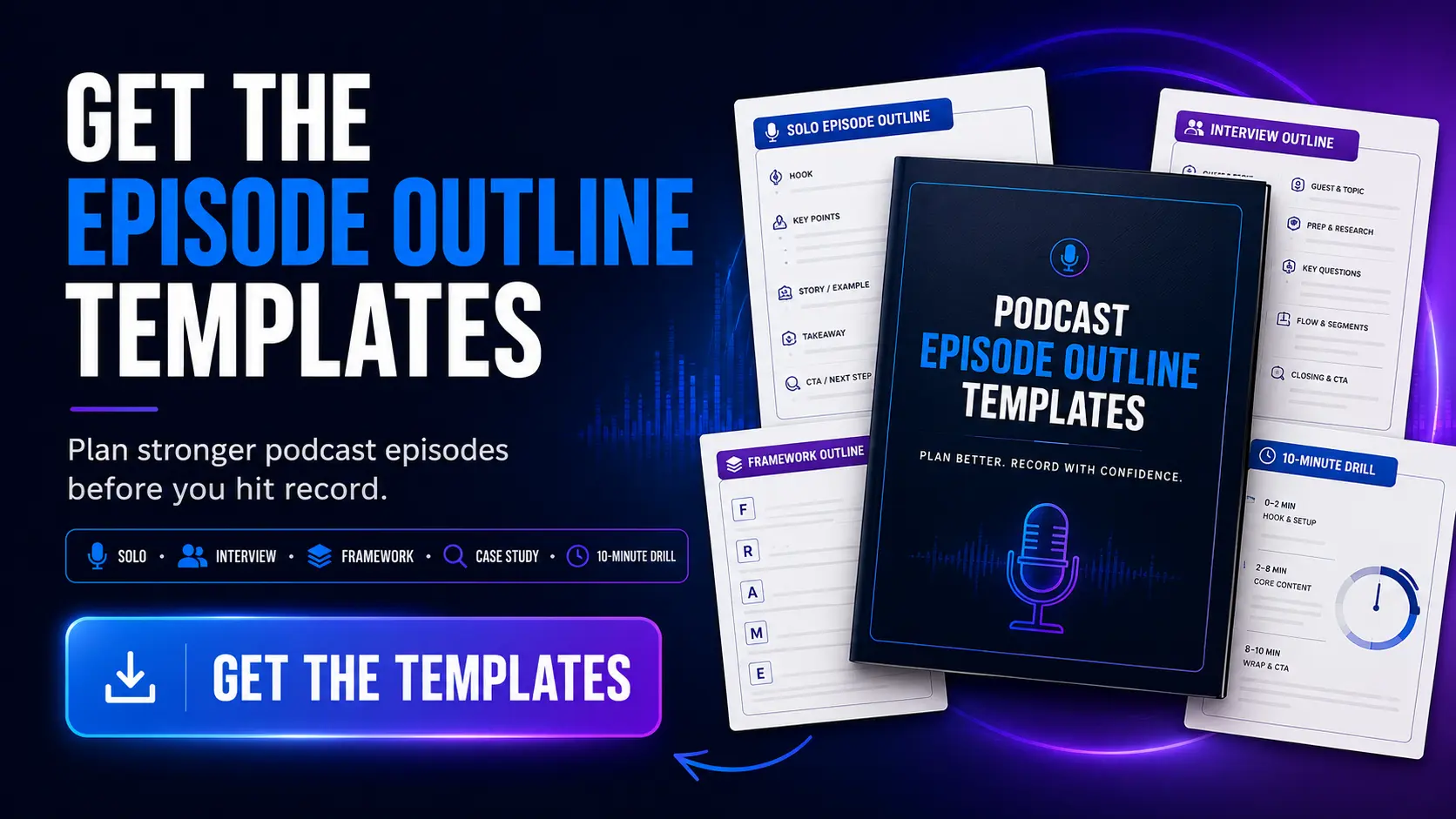
If the hardest part of pre-production is turning the idea in your head into a usable recording map, that is exactly what the Podcast Episode Outline Templates are built to help with.
They include adaptable structures for solo teaching episodes, interviews, tactical framework episodes, pattern-interrupt episodes, case studies, and reverse-repurposing episodes, plus a 10-minute outline drill.
Get the Podcast Episode Outline Templates on the Podcasting Pro Tools page and map your next episode before you hit Record.
A little planning is not what makes a podcast stiff.
Usually, it is what gives you enough confidence to stop worrying about where you are going and start having the conversation.
Podcast Pre-Production FAQ
How much pre-production does a podcast episode need?
There is no universal amount. A simple solo teaching episode may only need a short speaking map. A researched interview, technical episode, narrative show, or highly produced video episode may require considerably more preparation. Plan enough to know the audience, purpose, promise, flow, example, and next step.
Should I fully script a podcast episode?
Not necessarily. Many episodes work better from an outline or speaking map. Use a full script when exact wording matters or when scripting genuinely helps your delivery. Do not assume more words on the planning page automatically create a better recording.
What should I prepare before a podcast interview?
Know why the guest is relevant, what the audience should learn, the major conversation blocks, your anchor questions, useful research points, potential examples or stories, and the final takeaway. Leave room to follow strong answers instead of reading a question list mechanically.
Is the episode title part of pre-production?
You should normally have a working title or angle before recording because it can help clarify the episode’s promise. The final publishable title can change after recording once you know exactly what the finished episode delivers.