Dynamic ad insertion used to feel like something built for giant podcast networks with ad-ops departments and enterprise publishing contracts.
That is no longer the case.
If you run an independent podcast, a company show, or a podcast that supports your business, Transistor, Captivate, and RedCircle all give you practical ways to change promotional audio without permanently baking every offer into every episode.
The important question is no longer just, “Does this host have dynamic ads?”
It is:
What do you actually want your dynamic inventory to do?
There is a big difference between running sponsor inventory, promoting your own product, swapping a seasonal CTA, cross-promoting another show, and keeping five years of old episodes commercially relevant.
So before you move your entire podcast because somebody showed you a shiny DAI dashboard, here is what the technology actually does—and how these three platforms compare.
What Is Podcast Dynamic Ad Insertion?
Dynamic ad insertion, usually shortened to DAI, lets your podcast host place replaceable audio into designated positions in a published episode instead of permanently editing that audio into the master episode file.
Those positions can commonly include:
- pre-roll;
- mid-roll;
- post-roll.
And despite the name, the inserted audio does not have to be an “ad.”
You might dynamically insert:
- a sponsor message;
- your own product promotion;
- an event announcement;
- a new lead magnet;
- a current CTA;
- another podcast promo;
- a seasonal offer;
- updated intro or outro content.
RedCircle, for example, specifically supports ads, cross-promotions, announcements, intros, outros, and other custom audio through its Dynamic Insertion system. Captivate describes AMIE as a broader dynamic content engine rather than simply an advertising tool. Transistor similarly allows ads, announcements, and other audio to be managed through campaigns.
That distinction matters for a business podcast.
You do not need a paid sponsor before DAI becomes useful.
Sometimes the most valuable inventory in your show is the inventory you use to promote your own next step.
Why DAI Is Especially Useful for Business Podcasts
Imagine you publish an episode today and permanently record this into the outro:
“Registration for my September workshop closes Friday.”
Great in August.
Pretty ridiculous when someone discovers the episode next March.
That is the baked-in problem.
The actual teaching in your episode might stay useful for years while the promotional message around it expires in a few weeks.
With dynamic insertion, you can keep the main episode evergreen while changing the promotional layer around it.
That can turn an old back catalog into active inventory instead of a time capsule.
This becomes especially useful for four jobs.
1. Promoting Your Own Business
A business podcast does not have to sell its available inventory to another company.
You can use that space to promote your own:
- product;
- service;
- newsletter;
- free resource;
- event;
- consultation;
- next episode.
That is essentially self-sponsoring your podcast.
If you want to go deeper into that model, see my guide to using your own business as the sponsor of your podcast.
2. Running Time-Sensitive Campaigns
A campaign might run for three weeks instead of three years.
When it ends, remove it.
The episode itself stays intact.
Transistor supports scheduled campaign start and end dates, while Captivate’s dynamic content tools and RedCircle’s insertion system are designed to let publishers change content without permanently rebuilding the original episode.
3. Updating Your Back Catalog
This is where DAI gets much more interesting.
Suppose you have 75 evergreen episodes still receiving downloads.
Without dynamic insertion, you could have 75 old CTAs pointing people toward outdated destinations.
With the right hosting setup, you can change the promotional audio across many episodes without manually opening 75 editing sessions.
That is a production advantage, but it is also a business advantage.
Old episodes can continue directing listeners toward something relevant today.
4. Selling or Automating Ad Inventory
DAI can also do what its name suggests: advertising.
Depending on the platform, that might include direct sponsor campaigns, dynamically delivered host-read spots, programmatic inventory, or marketplace opportunities.
RedCircle leans particularly heavily into this model through the RedCircle Ad Platform, while Captivate has expanded its own advertising and marketplace capabilities around AMIE.
But monetization is only one use case.
Do not confuse the technology with the business model.
Transistor vs. Captivate vs. RedCircle
Here is the practical comparison.
| Platform | Strongest fit | Dynamic capabilities | Standout feature |
|---|---|---|---|
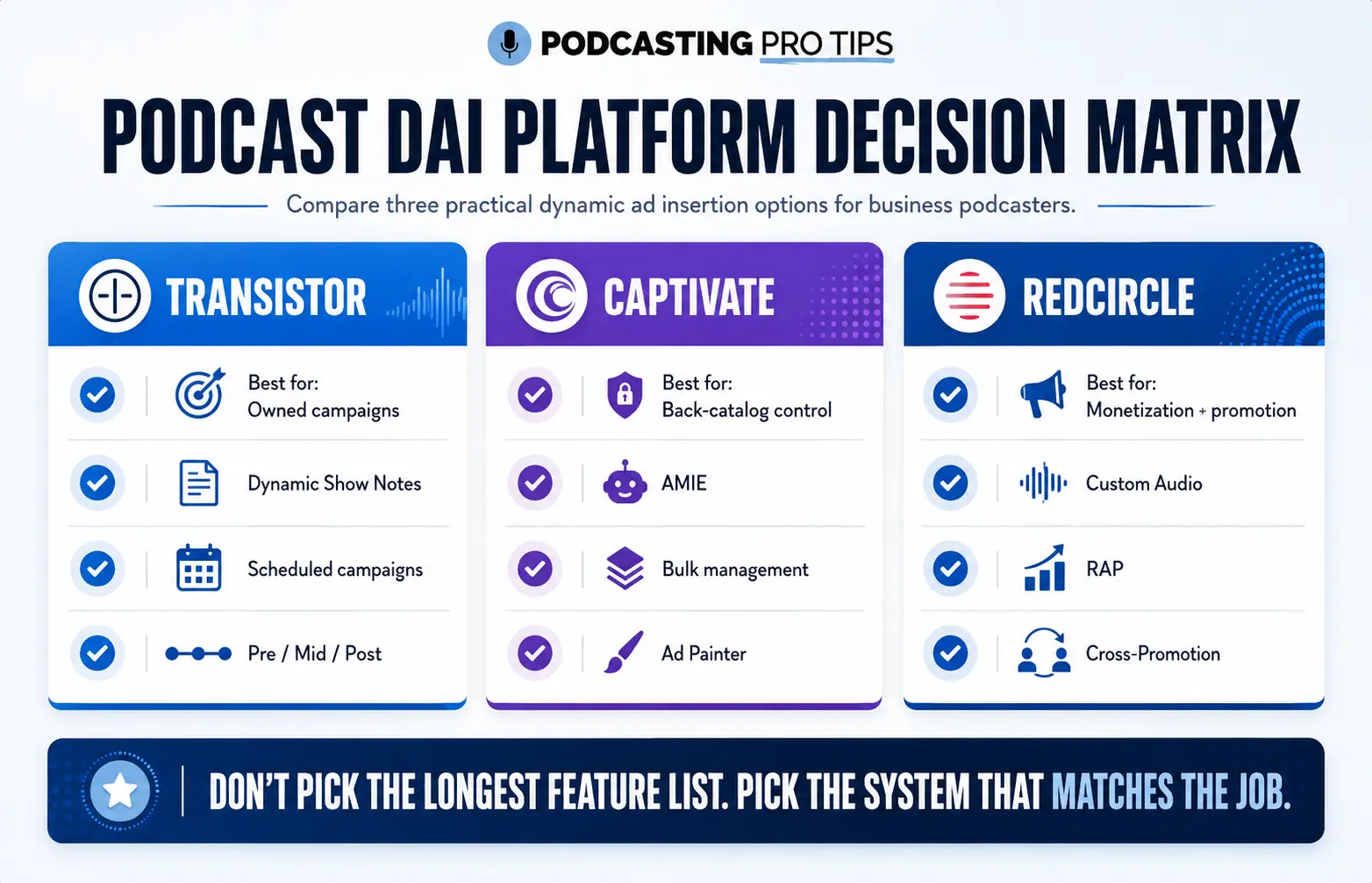
| Transistor | Businesses and multi-show publishers wanting simple campaign control | Pre-, mid-, post-roll campaigns, scheduling, Dynamic Show Notes | Audio campaign and related show-note content can be managed together |
| Captivate | Independent podcasters wanting deep back-catalog control | AMIE pre-, mid-, post-roll, bulk editing, campaign tools | Ad Painter can replace old baked-in sections without manually re-editing each master |
| RedCircle | Podcasters combining house promotions with advertising and cross-promotion | Pre-, mid-, post-roll insertion, custom audio, Audio Blocks, RAP, cross-promotion | Strong combination of owned promotions and monetized inventory |
Platform features and plans were verified against official documentation in August 2026 and can change. Always check the current plan before moving a show.
Transistor: Best for Clean, Straightforward Campaign Management
Transistor is probably the easiest of these three to understand if your main goal is:
“I want to run my own campaigns across my podcast without building an ad-operations department.”
Its Campaigns system supports dynamic audio at the beginning, middle, and end of episodes. You can also create mid-roll insertion points at specific timestamps.
The feature I especially like for a business show is Dynamic Show Notes.
You may have a temporary audio promotion telling people to visit a particular page.
The obvious production problem is that changing the audio while leaving an expired link sitting in the episode description is not much of an improvement.
Transistor lets dynamic audio campaigns include dynamic notes, and its Professional plan currently includes both dynamic ads and Dynamic Show Notes. The Professional tier is $49/month as of August 2026.
That makes Transistor a particularly clean fit when you run your own:
- launches;
- lead magnets;
- events;
- internal promotions;
- product campaigns.
It does not supply the sponsors for you. Transistor provides the insertion infrastructure rather than an advertising marketplace.
That can actually be an advantage if what you want is control rather than an ad network.
Captivate: Best for Advanced Back-Catalog Control
Captivate’s system is called AMIE — Audio Monetization and Insertion Engine.
The basic dynamic insertion functionality is available across Captivate’s plans, which currently start at $19 per month when paid monthly. Captivate says its plans include dynamic content insertion with AMIE.
You can manage pre-roll, mid-roll, and post-roll content and apply changes to individual episodes or use bulk editing tools across a larger catalog.
But the feature that makes Captivate especially interesting is Ad Painter.
Imagine you migrated a show with an old sponsor or promotional segment physically baked into the original audio.
Normally, cleaning that up means finding the original session, editing the episode again, exporting again, and replacing the file.
Not exactly how most people want to spend Tuesday afternoon.
Ad Painter lets you identify that old section and replace it with current dynamic content instead. Captivate’s current documentation describes the tool as a way to overlay old baked-in sections with new audio.
For a large evergreen catalog, that can be a serious operational advantage.
Captivate is therefore the platform I would examine closely when the question is not simply:
“How do I insert an ad?”
but:
“How do I regain control over years of already-published audio?”
RedCircle: Best for Combining Promotions, Cross-Promotion, and Monetization
RedCircle takes a slightly different approach because Dynamic Insertion sits inside a larger monetization and growth system.
Its Dynamic Insertion architecture uses Insertion Points and Audio Blocks.
An Insertion Point determines where replaceable audio can play.
An Audio Block determines what audio is assigned there.
Those insertion points can be pre-roll, mid-roll, or post-roll. RedCircle also allows Audio Blocks to be assigned across multiple episodes, which makes catalog-wide changes much easier.
You can use the system for your own custom promotions and even off-platform ad campaigns. RedCircle’s current documentation says Growth-plan members and above receive full Dynamic Insertion access, including custom dynamic campaigns.
Then you have the other side of RedCircle:
- its advertising platform;
- programmatic advertising;
- host-read campaign infrastructure;
- cross-promotion marketplace.
Programmatic ads can be dynamically placed in pre-, mid-, or post-roll positions when a show is participating in RAP.
That makes RedCircle particularly worth comparing if you want your inventory to do double duty:
use some slots for your own business while leaving others available for monetization or cross-promotion.
How Dynamic Ad Insertion Actually Reaches Apple Podcasts and Spotify
This is an area where DAI often gets explained badly.
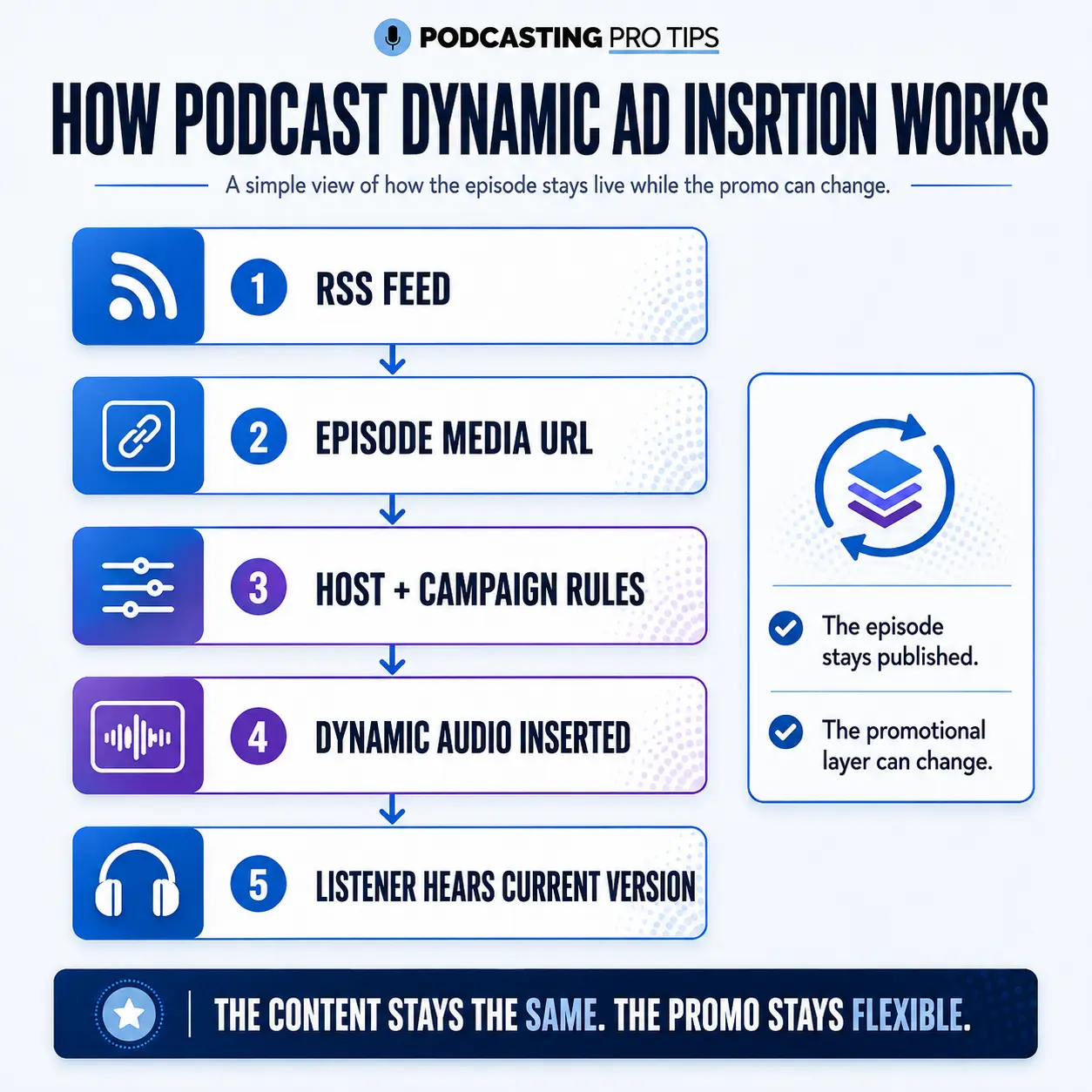
Your podcast’s RSS feed contains an <enclosure> URL for each episode. That URL identifies the location of the episode’s media file. Apple explicitly requires that enclosure URL as part of an RSS-distributed episode.
So you are not publishing a completely new Apple Podcasts episode every time you switch a promotion.
Conceptually, the process looks like this:
Podcast feed → episode media URL → hosting/ad system → current dynamic audio configuration → listener
Your host or ad system manages what belongs in the available insertion points.
The listener still experiences the result as a normal podcast episode.
The important production point is this:
Changing the campaign does not mean rebuilding the entire distribution relationship with Apple Podcasts or Spotify.
You are changing what your hosting infrastructure delivers through the existing episode.
That is one of the reasons the back catalog can remain useful.
The Producer’s Execution Step: Keep the Master Clean
This is the part I would decide before you ever log into the dynamic-ad dashboard.
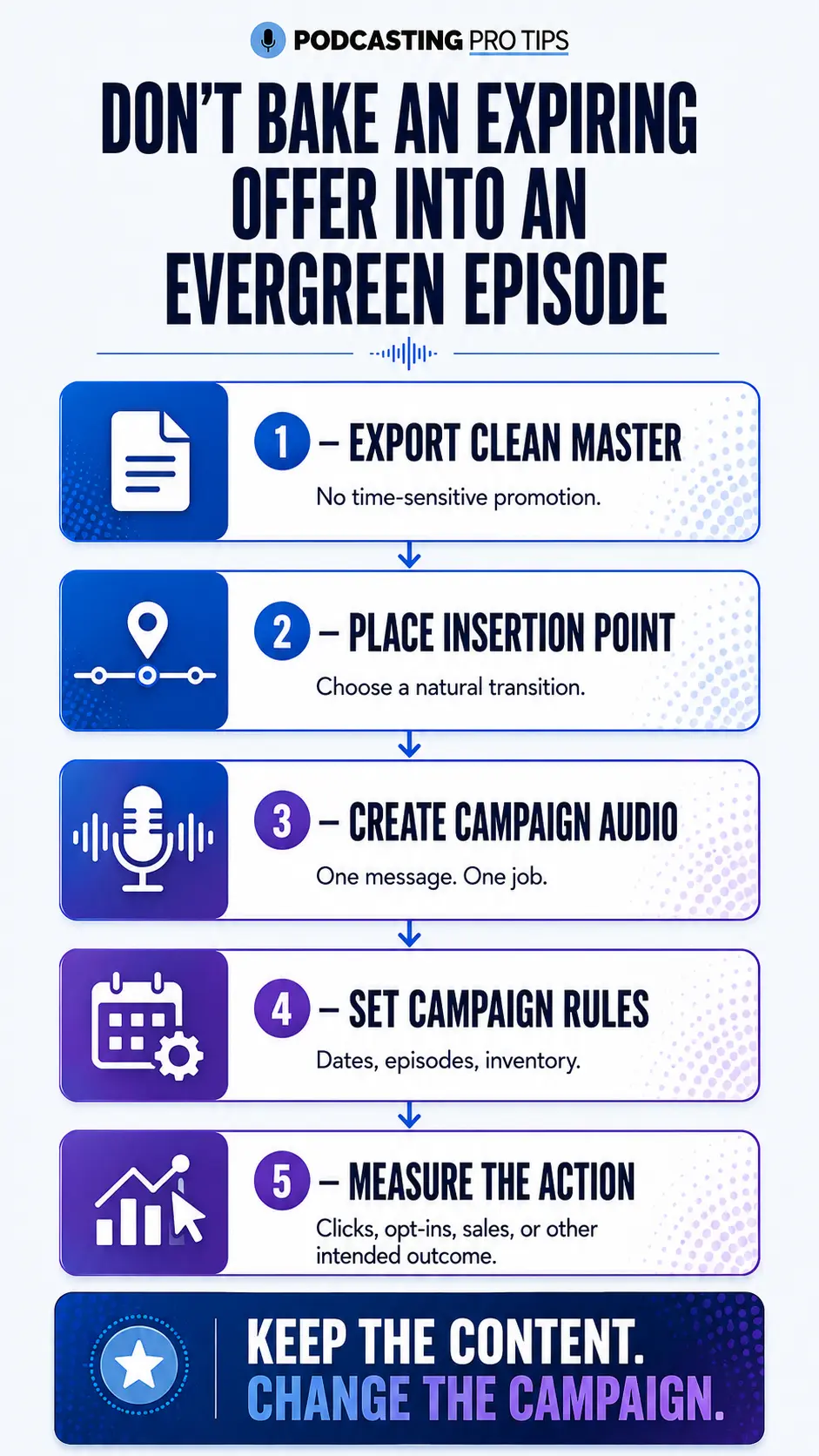
If a promotion expires, do not automatically bake it permanently into the master episode.
Instead:
- Export the evergreen episode content cleanly.
- Decide where an insertion point actually belongs.
- Create the promotional audio separately.
- Assign that audio to the appropriate campaign or slot.
- Give the campaign an end condition.
- Replace or remove the promotion when its job is finished.
The technology is downstream of the decision.
If you do not know what the promotion is supposed to accomplish, dynamic insertion just gives you a more sophisticated way to rotate random CTAs.
And that is still random.
Do Not Let the Ad Slot Wreck the Episode
DAI solves a distribution problem. It does not automatically solve a production problem.
A badly placed mid-roll is still a badly placed mid-roll.
If your dynamic audio suddenly appears halfway through an unfinished sentence, comes in dramatically louder than the episode, or has no relationship to what the listener was hearing, the fact that it was inserted dynamically will not make it feel professional.
A few simple production rules help:
- place mid-roll markers at natural structural breaks;
- match the perceived loudness of the surrounding episode;
- give the transition enough room to breathe;
- keep the promotion focused;
- return the listener cleanly to the episode.
For more on level consistency, see my breakdown of podcast loudness standards and LUFS.
And if the promotion is actually your primary CTA, the wording matters too. My guide to building a podcast outro around one clear next action goes deeper into that part.
How to Choose the Right DAI Platform
Do not choose a hosting platform based on a screenshot of its ad dashboard.
Start with the job.
Ask these questions.
Do I mainly want to run my own promotions?
Look closely at Transistor.
Its Campaigns plus Dynamic Show Notes make it particularly clean for owned promotions and time-sensitive business campaigns.
Do I have a large back catalog that needs cleanup or frequent changes?
Look closely at Captivate.
AMIE’s bulk tools and Ad Painter make catalog maintenance one of its clearest strengths.
Do I want dynamic promotions plus an advertising and cross-promotion system?
Look closely at RedCircle.
Its Dynamic Insertion system is closely connected to RAP and its cross-promotion infrastructure.
Do I need enterprise ad operations?
Then this three-platform comparison may no longer be your full shortlist.
Megaphone remains positioned by Spotify toward professional and enterprise publishers, and there are other enterprise-level systems worth evaluating when sophisticated ad operations become the primary requirement.
For most independent business shows, however, start by figuring out the workflow you actually need before paying for complexity you will never use.
The Number I Would Not Ignore: What Happens After the Ad?
Dynamic insertion can tell you where and when you ran a promotion.
That does not automatically tell you whether the promotion did anything useful.
If your dynamic message says:
“Download the guide.”
then the interesting question is not only how many downloads heard the message.
It is:
How many people downloaded the guide?
If the campaign directs people toward a product:
How many qualified visitors or purchases can you responsibly connect to that campaign?
That is where campaign naming, unique URLs, UTM parameters, opt-ins, conversion tracking, and attribution become much more useful than simply knowing the ad technically ran.
If you are measuring a podcast primarily through CPM and raw downloads, read Beyond CPM: Redefining Podcast ROI next.
The DAI system controls the inventory.
Your measurement system tells you whether using that inventory was worthwhile.
Dynamic Inventory Still Needs a Good CTA
There is one final trap here.
Podcasters discover DAI and immediately start thinking about all the promotions they can rotate.
New lead magnet.
New product.
Newsletter.
YouTube.
Consultation.
Event.
Review request.
Easy there.
Dynamic inventory gives you flexibility. It does not eliminate choice overload.
Every campaign should still have a clear job and one primary action.
If writing that promotion is the part that slows you down, the Podcast CTA Swipe File includes ready-to-adapt scripts plus the Conversion Outro Formula and the 5-Minute CTA Drill. It is available in the Podcasting Pro Tools Library.
The goal is not to fill every available insertion point.
The goal is to use the right insertion point to move the right listener toward a relevant next step.
Frequently Asked Questions About Podcast Dynamic Ad Insertion
Does dynamic ad insertion work on Apple Podcasts and Spotify?
Yes, when your podcast host supports DAI, the dynamic audio is handled through the hosted episode media rather than requiring you to manually create a new Apple Podcasts or Spotify episode every time the campaign changes. RSS-distributed episodes use an enclosure URL that points to the hosted media.
Can I use dynamic ad insertion without having sponsors?
Yes. Dynamic insertion can be used for your own products, lead magnets, announcements, events, cross-promotions, intros, outros, and other replaceable audio—not only paid advertising.
Can dynamic insertion change an old podcast episode?
It can change or add audio at configured insertion locations without requiring you to permanently bake the new promotion into the original master. The exact workflow varies by host. Captivate also offers Ad Painter for replacing sections of previously baked-in audio.
Which podcast host is best for dynamic ad insertion?
There is no universal winner. Transistor is particularly clean for owned campaigns and Dynamic Show Notes, Captivate is strong for back-catalog management and AMIE tools, and RedCircle combines Dynamic Insertion with advertising and cross-promotion infrastructure. Choose based on the job you need the inventory to perform rather than the longest feature list.
Your Dynamic Ad Slot Still Needs the Right Message
Dynamic insertion makes it easy to change what your listeners hear. But the technology cannot decide what you should ask them to do next.
The Podcast CTA Swipe File gives you ready-to-adapt CTA scripts, the Conversion Outro Formula, and a quick planning drill to help you choose one clear next step before you record the promotion.
Get the Podcast CTA Swipe File →