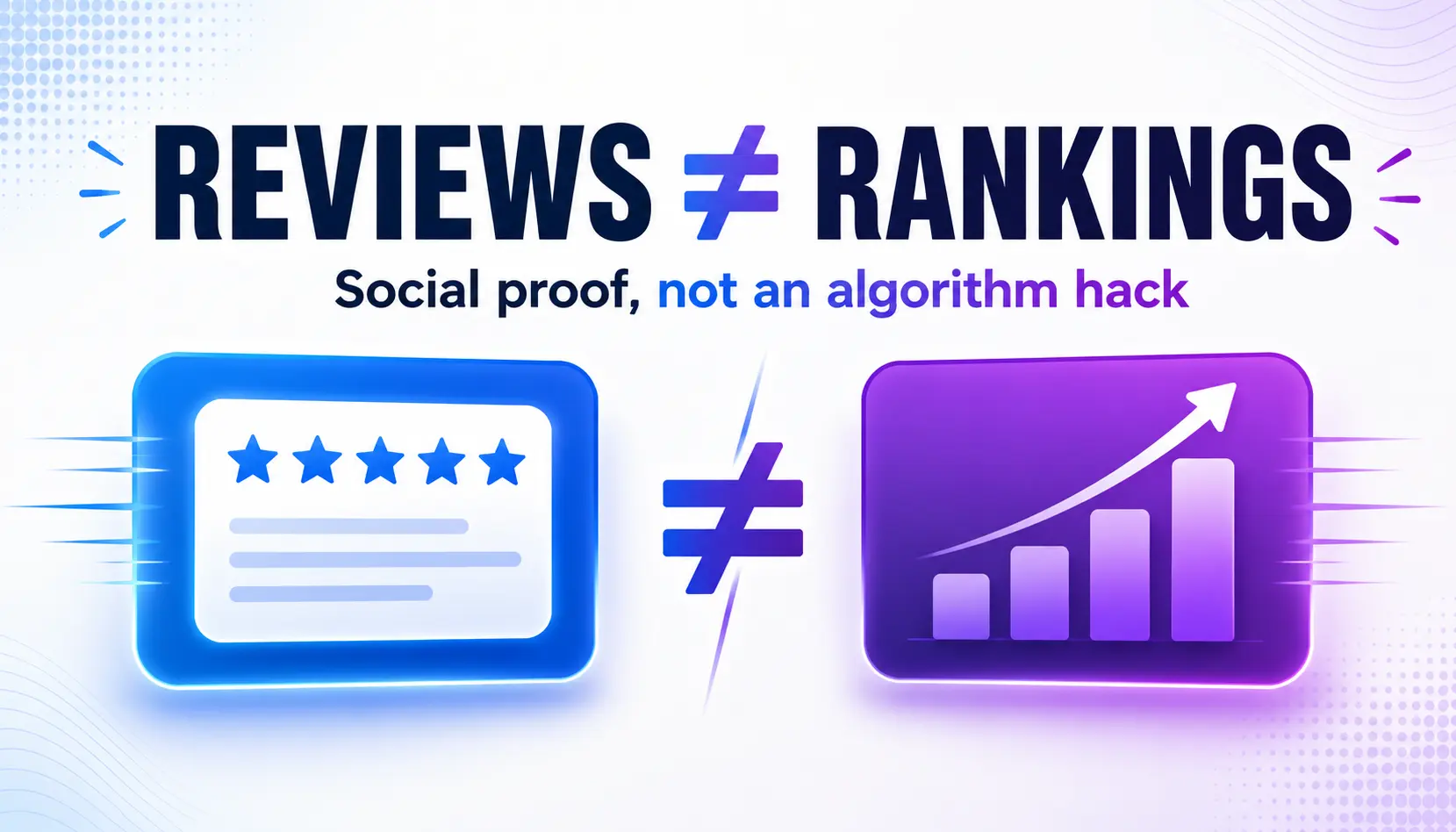
Podcast reviews can help a show look credible to potential listeners, but you should not treat them as a magic ranking button.
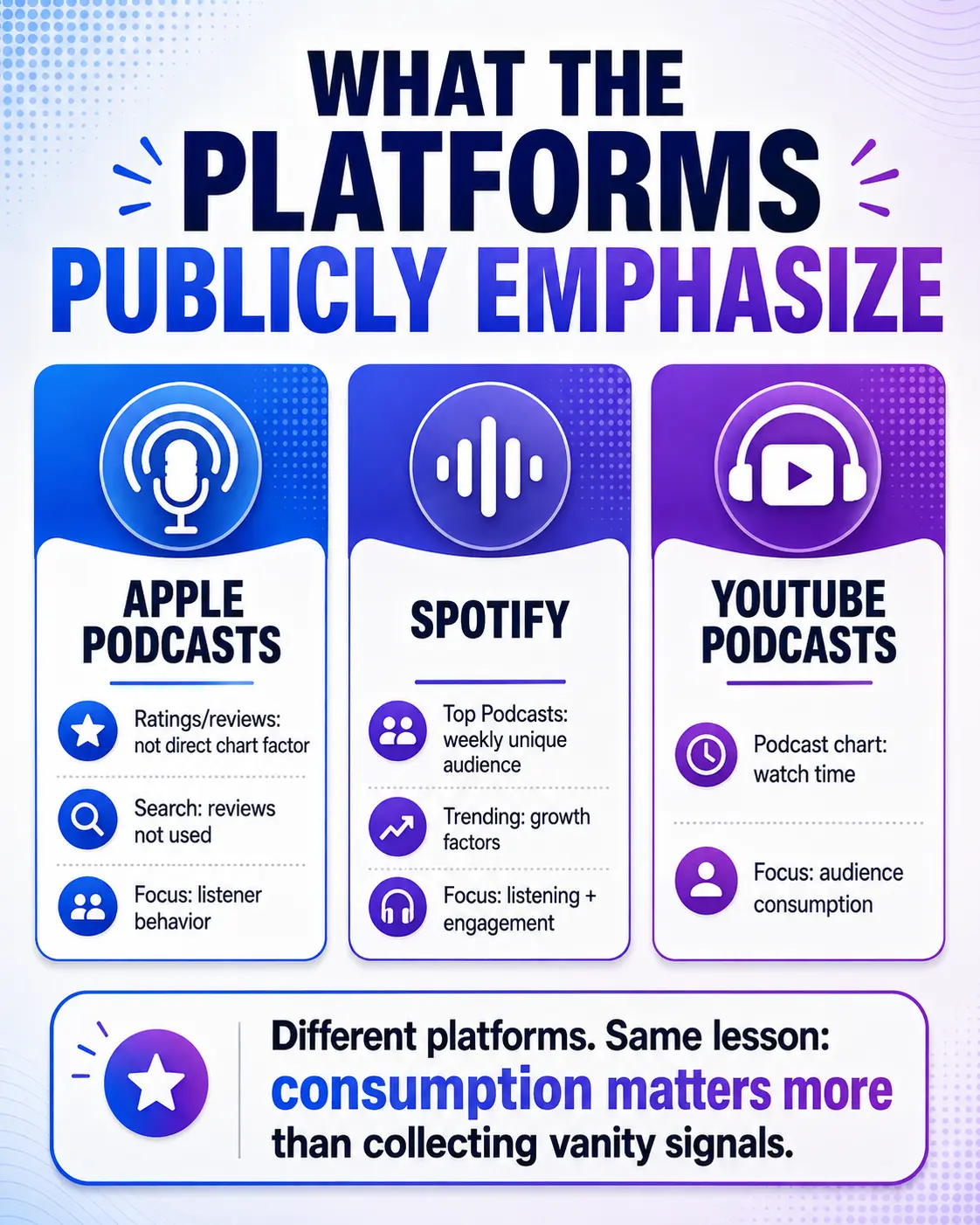
Apple is especially clear about this. Ratings, reviews, and shares are not factored into the algorithm that determines Apple Podcasts Top Shows or Trending Episodes, and Apple also says they are not factored into Apple Podcasts Search.
That doesn’t make reviews worthless.
It means reviews and rankings are doing different jobs.
And once you understand that distinction, you can stop burning your podcast outro asking everyone for five stars because somebody told you that 100 reviews would unlock the algorithm.
The Podcast Review Myth
You’ve probably heard some version of this advice:
“Get 50 reviews.”
“Get 100 reviews in the first few weeks.”
“Ask everyone you know to rate the show so Apple starts pushing it.”
The exact number changes depending on who is giving the advice.
The evidence behind it is much harder to find.
There is no published Apple Podcasts rule saying your show needs a specific number of reviews before it receives greater distribution. More importantly, Apple’s own documentation says ratings and reviews aren’t direct inputs into its Top Shows, Trending Episodes, or Search rankings.
So if you’re begging for reviews because you think you’re feeding an Apple ranking formula, you’re optimizing for the wrong thing.
Reviews can still be useful.
Just not for the reason the myth claims.
Do Apple Podcast Reviews Affect Rankings?
Apple says no: ratings, reviews, and shares are not factored directly into the algorithm that determines its Top Shows or Trending Episodes charts.
There’s an important bit of nuance here.
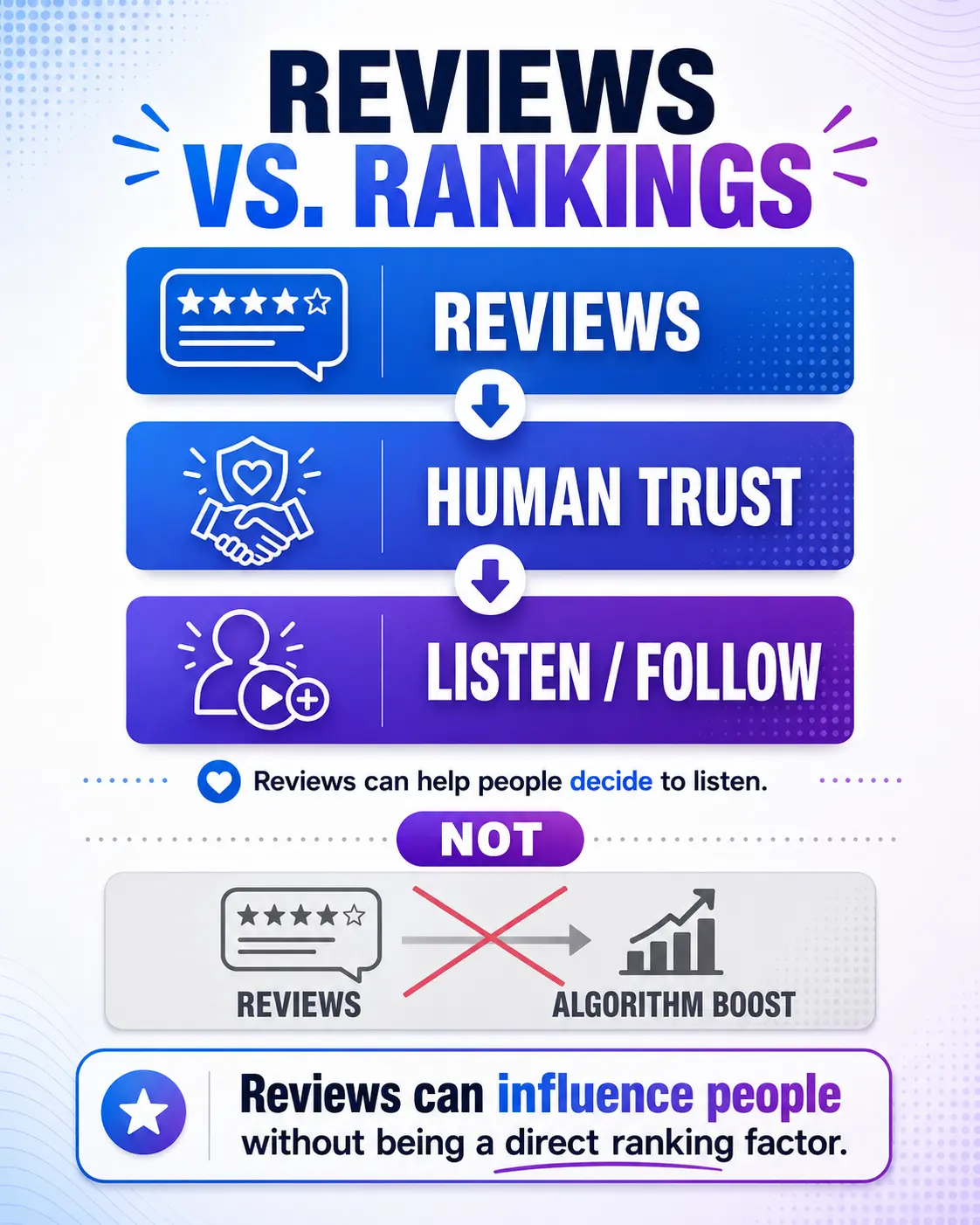
Apple says ratings, reviews, and shares can help indicate a show’s newness, popularity, and quality to people. Someone may see strong ratings, decide the show looks worth trying, listen to an episode, and follow it.
Those listener actions can matter even though the review itself isn’t the chart input.
Think of it this way:
REVIEW → HUMAN TRUST → LISTEN / FOLLOW → POSSIBLE PLATFORM SIGNAL
That is very different from:
REVIEW → ALGORITHM BOOST
The first path makes sense.
The second is the myth.
Reviews Don’t Boost Apple Podcasts Search Either
This is another place where podcast advice gets messy.
Written reviews may contain lots of words related to your topic, but Apple says ratings, reviews, and shares are not factored into Apple Podcasts Search results.
So asking listeners to stuff keywords into reviews isn’t an Apple Podcasts SEO strategy.
If you want stronger search visibility, work on the parts of your podcast you actually control: clear show positioning, useful episode topics, descriptive titles, accurate metadata, and content that earns real listener interest.
What Actually Matters on Apple Podcasts?
Apple doesn’t publish every detail of its proprietary systems, so anyone claiming to know the complete Apple Podcasts algorithm should be treated carefully.
What Apple does tell us publicly is useful.
Apple says its charts reflect the most popular shows and episodes in a market, and that ratings, reviews, and shares are not direct ranking factors for Top Shows or Trending Episodes. Apple also notes that following and listening behavior can influence chart performance indirectly.
That gives you a much more useful priority:
Create something people actually choose to listen to and continue listening to.
A review from somebody who barely listened is nice decoration.
A listener who finds the show relevant enough to follow it and keeps coming back is much more meaningful.
What About Spotify Podcast Ratings?
Spotify’s current public chart documentation puts the emphasis on audience and listening behavior rather than review volume.
Spotify says its Top Podcasts chart ranks shows using weekly unique audience. Trending Podcasts uses a combination of growth factors, and Spotify describes its charts overall as being based on listening behavior and engagement. Spotify specifically encourages creators to get fans to follow and listen.
That doesn’t mean ratings have no value on Spotify.
It means you shouldn’t invent a ranking benefit Spotify hasn’t claimed.
Spotify has also expanded its creator-listener interaction tools, including episode comments and polls. Those features can be useful for actual audience feedback and conversation, which is a different job than collecting stars simply to make a number go up.
YouTube Makes the Difference Even Clearer
If your podcast is also on YouTube, the idea that a five-star review count is the center of podcast discovery becomes even harder to defend.
YouTube’s Weekly Top Podcast Shows chart is based on total watch time in the relevant market.
YouTube’s broader recommendation guidance also emphasizes viewer behavior and personalization signals such as viewing history, search history, subscriptions, and likes.
That changes the practical question.
Instead of asking:
“How do I get more ratings?”
Ask:
“Are people choosing this content, staying with it, and wanting more of it?”
That’s a much tougher question.
It’s also a much more useful one.
So Are Podcast Reviews Worth Getting?
Yes—when you understand their job.
A good podcast review can provide social proof.
Imagine someone discovers one of your episodes through Google, YouTube, LinkedIn, a recommendation, or another piece of content.
They’ve never heard of you.
They look at the show.
Strong ratings and thoughtful listener comments can reduce some of the uncertainty around trying it.
That’s human behavior, not an algorithm hack.
A detailed review might also tell you something useful about the show itself.
A listener may tell you:
- which episodes helped them;
- which ideas stuck with them;
- why they continue listening;
- what they think the show is about;
- how they describe the value to somebody else.
That is far more interesting to me than watching the review counter move from 82 to 83.
One is audience intelligence.
The other is a number.
When Should You Ask for a Podcast Review?
Ask when a listener has actually received enough value to have something meaningful to say.
That usually means a loyal listener, subscriber, customer, student, community member, colleague, or someone who has specifically told you the podcast helped them.
You don’t need to interrogate them.
And you definitely don’t need to hand them a paragraph of keywords you want copied into Apple Podcasts.
A simple request is enough:
“If the show has been useful to you, I’d appreciate an honest rating or review. Tell people what you’ve found useful about it.”
Now the request has a legitimate job.
You’re collecting authentic listener proof rather than trying to manufacture a ranking signal.
Should You Ask for Reviews in Every Podcast Outro?
Usually, no.
Your outro is valuable space.
If someone just spent 20 or 30 minutes learning how to solve a problem, the most useful next step should normally continue that journey.
Maybe that’s another episode.
Maybe it’s a guide.
Maybe it’s a worksheet.
Maybe it’s joining your email list.
Maybe it’s looking at the product or service you just spent the episode helping them understand.
Asking for a review instead can interrupt that path.
This is why I prefer thinking of the outro as a conversion decision rather than a list of podcast housekeeping chores.
Your listener doesn’t need:
“Subscribe, review, follow me everywhere, visit the website, join the newsletter, share this episode and tell a friend.”
That’s not a CTA.
That’s a grocery list.
A stronger outro gives the listener one primary decision.
If collecting reviews happens to be the most useful decision at that moment, fine.
Most of the time, it won’t be.
For a deeper breakdown, see Podcast Outro Call to Action: How to Give Listeners One Clear Next Step.
What Should You Ask Listeners to Do Instead?
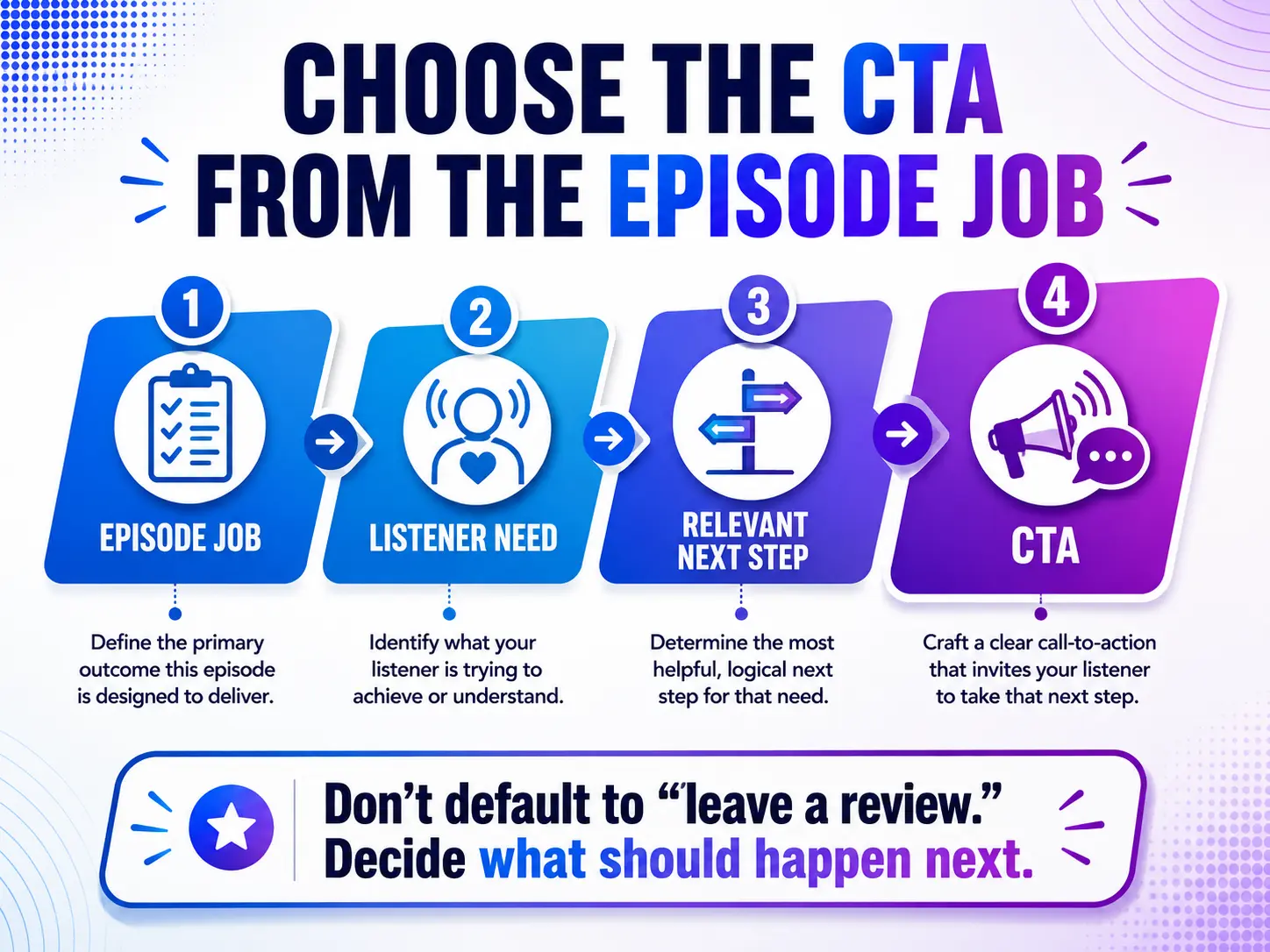
Start with the job of the episode.
If the episode solves a specific problem, ask what the logical next step is after the listener understands that problem.
For example:
If you taught them how to structure an episode, an episode-planning resource may make sense.
If you explained a retention problem, the next step might be a retention audit.
If you helped them understand their podcast isn’t producing meaningful business results, the next step may be diagnosing the bigger system behind the show.
This is also why I don’t like building CTAs at the last minute.
The next step should come from the job of the content.
EPISODE JOB → LISTENER NEED → RELEVANT NEXT STEP → CTA
The CTA isn’t something you bolt onto the episode five seconds before you record the outro.
It should finish the path the episode already created.
Reviews Are One Signal. Your Podcast Needs a System.
The bigger lesson here has very little to do with stars.
Podcasting gets messy when isolated tactics start pretending to be strategies.
Get more reviews.
Post more clips.
Book bigger guests.
Buy another microphone.
Publish more often.
Run ads.
Try YouTube.
None of those ideas is automatically bad.
The problem is doing them without knowing what job they’re supposed to perform.
A business-minded podcast needs connected decisions around the audience, episode purpose, production, content, discovery, conversion, and measurement.
Otherwise you can spend months improving numbers that never mattered very much to the thing you were actually trying to accomplish.
That’s the real podcast review myth.
The problem isn’t that reviews have no value.
The problem is expecting one small audience signal to do the work of an entire podcast system.
Want Better Calls to Action?
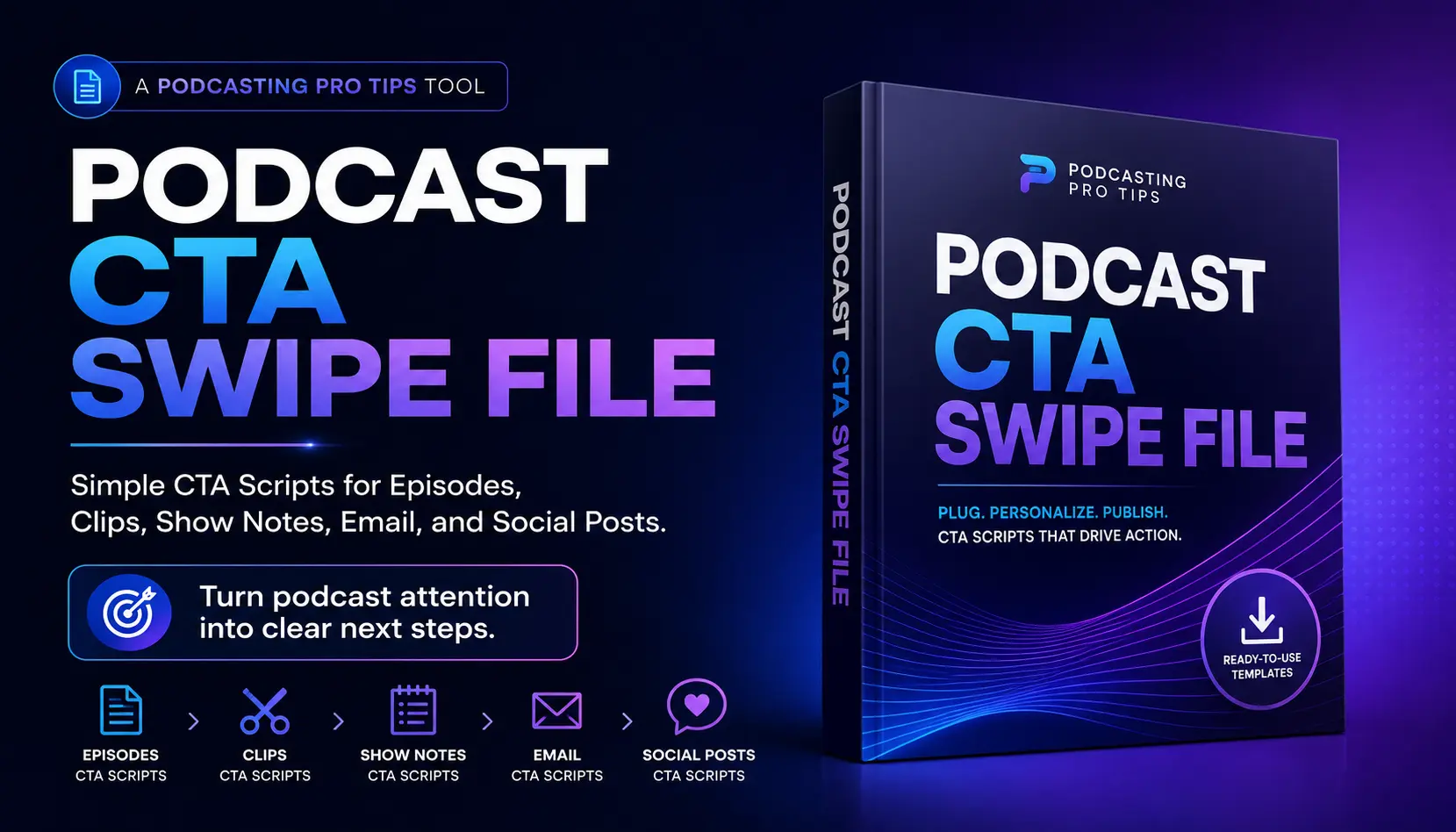
If you’ve been ending every episode with a pile of asks because you’re not sure what the listener should do next, the Podcast CTA Swipe File includes practical scripts and the Conversion Outro Formula for choosing and wording one clear next step.
You can find it in the Podcasting Pro Tools Library.
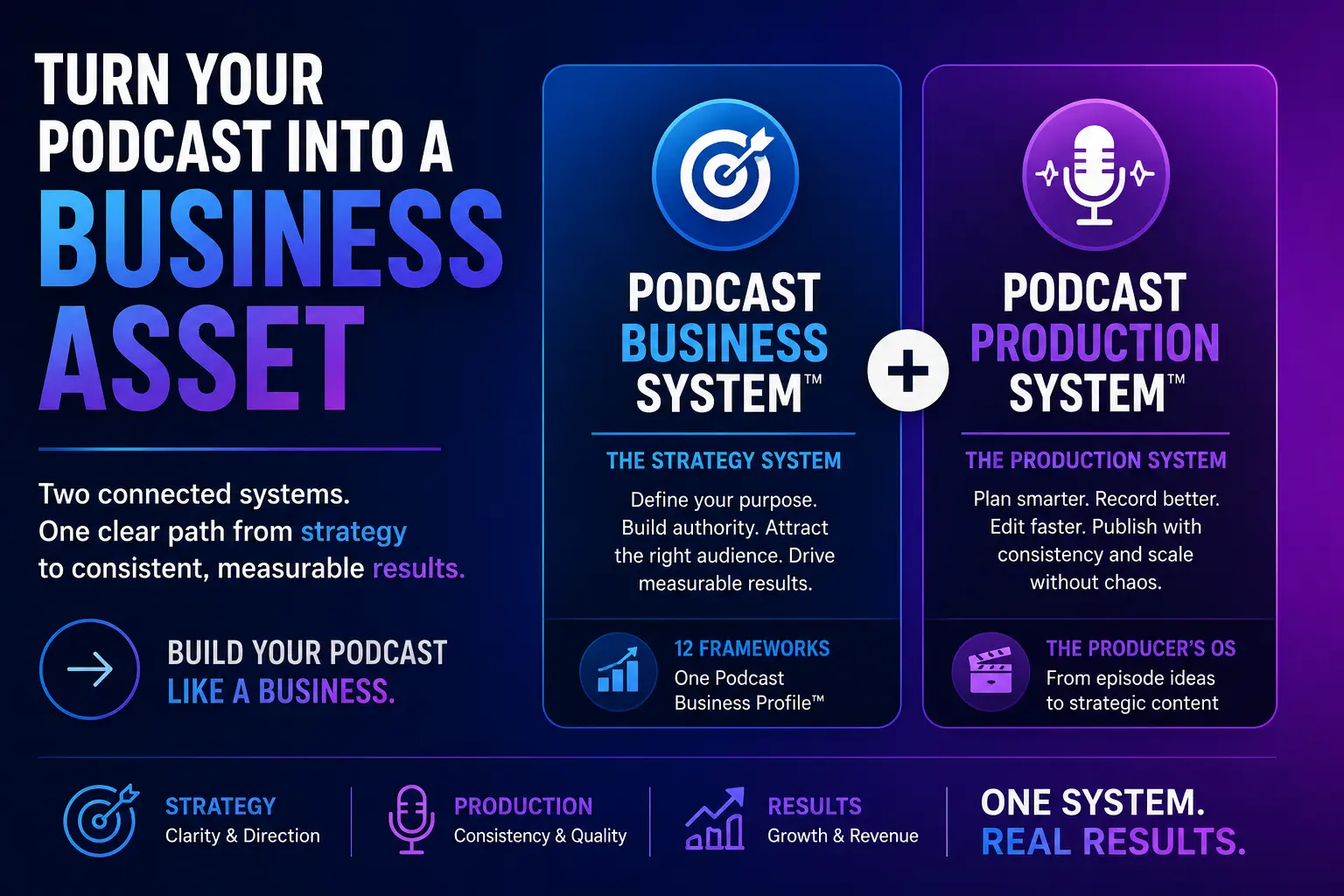
And if the bigger problem is that your episodes, content, CTAs, measurement, and business goals aren’t connected in the first place, the Podcast Business System + Podcast Production OS is the complete system for building those decisions together.
Turn Your Podcast Into a Business Asset
Build the Strategy. Run the Production.
The Podcast Business System™ + Podcast Production OS™ connect your strategy, content, production, conversion, ROI, and measurement so your podcast operates as one purposeful system—not a collection of disconnected tactics.
Podcast Review FAQ
Do Apple Podcast reviews help your podcast rank higher?
Apple says ratings and reviews are not directly factored into its Top Shows or Trending Episodes rankings. They can still influence human listeners who decide whether to try or follow your show.
Do podcast reviews improve Apple Podcasts SEO?
Apple says ratings, reviews, and shares are not factored into Apple Podcasts Search results. Focus on clear positioning, relevant episode topics, titles, metadata, and listener behavior instead.
Should I still ask listeners to leave podcast reviews?
Yes, when social proof or listener feedback is the goal. Just don’t sacrifice a more relevant listener action because you think reviews are an automatic algorithm boost.
How many podcast reviews do I need?
There is no official Apple threshold saying you need 50, 100, or another specific number of reviews to unlock rankings. Treat fixed review-count formulas skeptically unless the platform itself documents them.