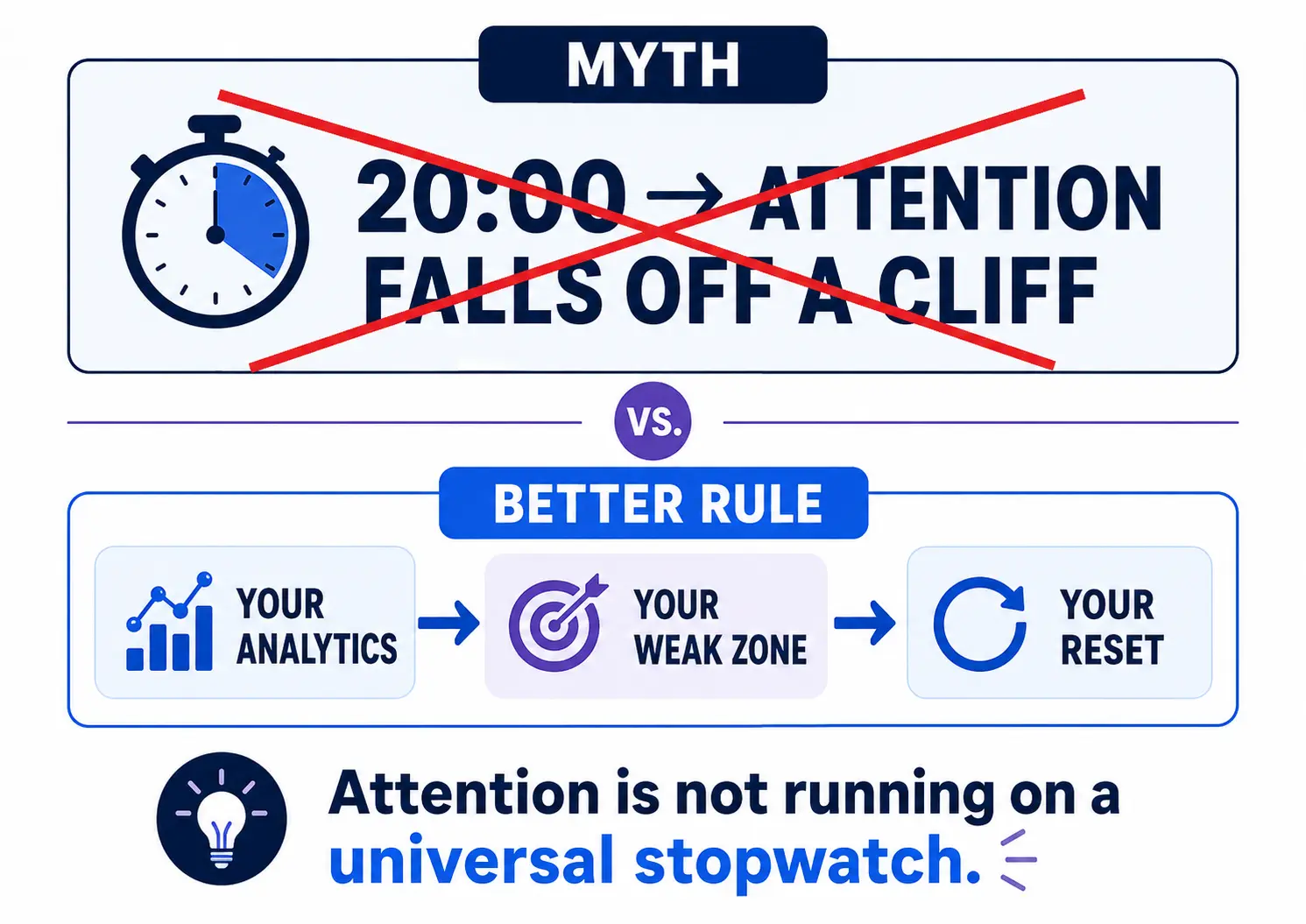
Yes, listeners can drift during the middle of a podcast. But no, there is not a universal biological alarm clock that goes off at 20 minutes and tells everyone’s brain, “That’s enough podcasting for today.”
The better way to improve podcast listener retention is to stop designing around an arbitrary timestamp and start looking at what actually happens inside the episode.
Where does the conversation stop moving? Where does the explanation become repetitive? Where does the listener lose the map? And where would a deliberate structural reset make the next section easier to follow?
That is the real mid-episode retention problem.
Is There Really a 20-Minute Podcast Attention Slump?
There is no good evidence for a universal 20-minute podcast attention limit.
Research into sustained attention does show that attention can become less consistent as time on task increases. People wander. They get distracted. They miss things. But attempts to turn that into a neat rule—“humans can only pay attention for 10 minutes,” “15 minutes,” or “20 minutes”—oversimplify what the research actually shows.
The old version of this article also pointed to TED’s traditional 18-minute talk length as proof of the rule. That sounds convincing until you look a little closer. TED itself says ideal length varies by format, with some talks much shorter and some interviews or dialogues running longer. An editorial format is not the same thing as a neurological cutoff.
So if your retention graph starts falling around minute 19, pay attention to it.
Just don’t assume minute 19 is the cause.
Why Podcast Listeners Actually Drift
Mid-episode attention usually weakens because something about the listening experience has stopped progressing.
A few common causes show up again and again:
- The host keeps explaining the same idea without adding anything new.
- A guest gives a long answer and the original question disappears somewhere along the way.
- The episode moves from one point to another without telling the listener why the new section matters.
- A dense technical section goes too long without an example or application.
- An ad or promotional break ends, but nobody brings the listener back into the conversation.
- Every section uses the same pace, tone, sentence length, and type of information.
- The listener simply loses track of where they are in the argument.
This is why I think of podcast retention as attention design.
You are not trying to hypnotize somebody into listening for another 17 minutes.
You are helping them keep track of the idea.
The Podcast Retention Rescue approach uses the same principle: attention problems are often structure problems. A strong episode guides the listener through a sequence instead of assuming they will stay completely focused from beginning to end.
The Re-Engagement Framework
When the middle of an episode starts to flatten, use four moves:
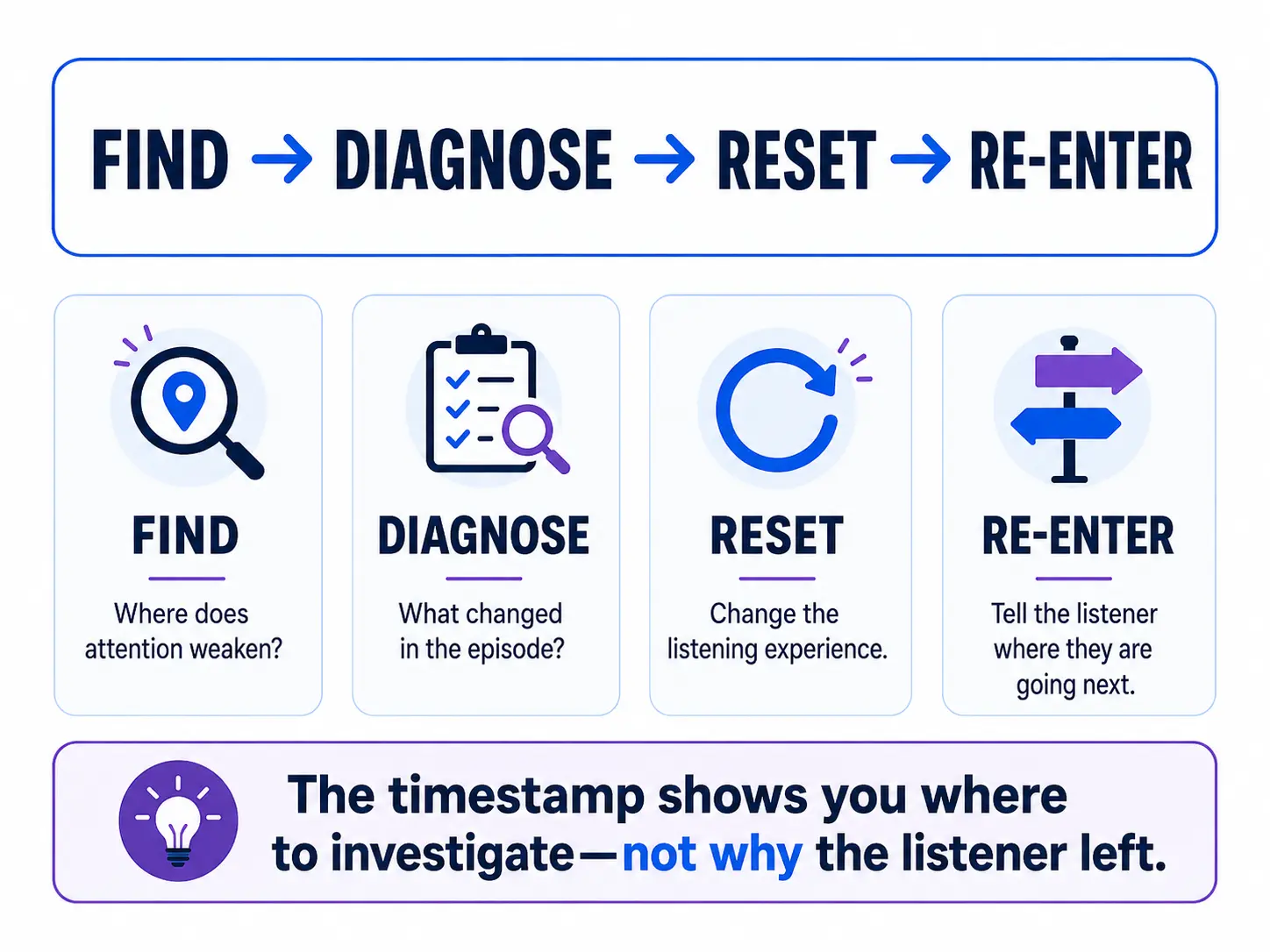
Find → Diagnose → Reset → Re-Enter
1. Find the Actual Weak Zone
Start with your own episode.
Do not automatically put a transition at 18:00 because somebody on the internet said attention dies there.
Look at the data you actually have.
Spotify for Creators currently provides episode completion and consumption metrics, along with tools for comparing episode performance. Spotify has also documented episode drop-off data for identifying segments where listeners stop listening or watching. Apple Podcasts provides metrics including average consumption and engaged listeners.
Then compare several episodes.
You are looking for a pattern, not one ugly little line on one Tuesday.
2. Diagnose What Changed
Once you find a weak zone, listen to the episode again.
Ask what the listener was experiencing immediately before the decline.
Was the host repeating a point?
Did the conversation become abstract?
Did a guest start rambling?
Did you move into a long explanation with no example?
Did an ad break interrupt the thread?
Did the episode simply stop creating new movement?
The timestamp tells you where to investigate.
It does not tell you why the problem happened.
That distinction matters.
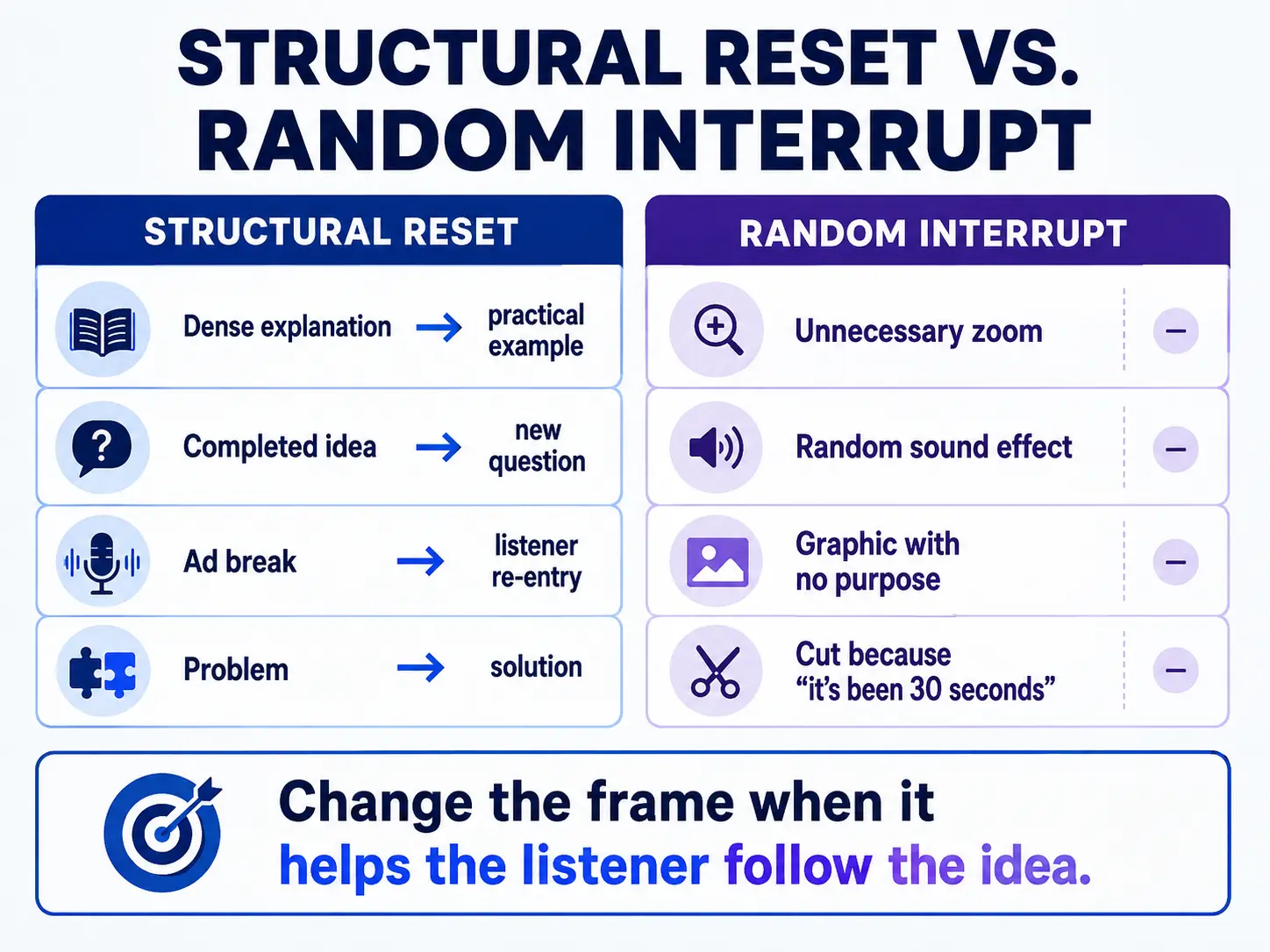
3. Add a Structural Reset
A reset changes how the listener is processing the material.
It does not need to be loud.
It does not need an air horn, a spinning logo, three camera punches, and a bass drop. Your podcast is not a monster-truck commercial.
A useful reset might be:
Move from explanation to example.
“You’ve heard the theory. Let me show you what this looks like in an actual episode.”
Move from problem to solution.
“So that’s why the middle starts feeling flat. Now let’s fix it.”
Summarize and preview.
“We’ve handled the opening and the first section. The next part is where most hosts lose the thread.”
Ask a new question.
“But what happens when the content is good and people still leave?”
Redirect a guest.
“Let me stop you there, because you just said something I think the listener needs to hear again.”
Use a short sonic or visual transition.
A music sting, chapter card, graphic, camera change, or pause can help signal that one section has ended and another has begun.
The key is that the change should support the idea.
For video podcasts specifically, I go deeper into the difference between useful pattern interrupts and random editing.
4. Re-Enter the Listener Into the Conversation
A structural change works better when you also tell the listener where they are.
This is the part a lot of hosts miss.
They add a music sting.
Then they immediately resume talking.
The listener hears that something changed, but not necessarily why.
Give them a re-entry line.
For example:
“Here’s where all of this becomes practical.”
Or:
“We’ve looked at why this happens. Now I want to give you three ways to fix it before your next recording.”
Or:
“If you missed the last couple of minutes, this is the part to come back for.”
That tiny bit of orientation can do more useful work than another flashy edit.
Put the Reset at a Structural Boundary, Not a Timestamp
The best place for a mid-episode reset is usually where one meaningful part of the episode ends and another begins.
That might happen at minute 8.
It might happen at minute 21.
In a 35-minute interview, you may have several natural boundaries.
A good reset can appear:
- after a difficult explanation;
- after resolving one question;
- before introducing a new problem;
- after an ad or promotional break;
- between two interview blocks;
- before a case study or practical example;
- when shifting from diagnosis into application.
This is why podcast pre-production matters. If you know the major sections before you record, you can build movement into the episode instead of trying to manufacture it later in the edit.
A Story Can Be a Great Reset—But It Needs a Job
One of the strongest ideas from the original article is the move from abstract teaching into a real example.
Keep that.
Just use it intentionally.
Suppose you have spent eight minutes explaining a complicated marketing process.
Instead of adding another explanation of the same concept, you could say:
“Let me pull this out of theory for a second. Imagine a local business owner who has been publishing every week but cannot tell which episodes are actually producing inquiries.”
Now the listener has something concrete to follow.
The story changes the mode of attention because the listener is no longer processing only abstract explanation. They are applying the idea to a situation.
But the story still has to move the lesson forward.
A random anecdote is just a detour wearing a nicer shirt.
Do Not Confuse Re-Engagement With Constant Stimulation
Once podcasters hear “pattern interrupt,” things can get a little out of hand.
Zoom.
Sound effect.
Caption.
Punch-in.
B-roll.
Back to the host.
Another zoom.
Eventually the viewer is wondering whether the editor is being paid by the cut.
You do not need constant movement.
In fact, too many changes can make an episode harder to follow.
Use a reset when it improves one of three things:
Clarity: the listener understands the idea better.
Orientation: the listener understands where the episode is going.
Energy: the new section genuinely benefits from a different pace or presentation.
If the change does none of those things, you probably do not need it.
Use Your Analytics as a Feedback Loop
The goal is not to find the perfect retention trick.
The goal is controlled improvement.
Try this:
- Review three to five comparable episodes.
- Find sections where attention appears to weaken.
- Listen to what was happening immediately before those points.
- Look for a repeated structural problem.
- Change one thing in the next episode.
- Compare the result with similar episodes.
Do not redesign your entire show because one episode had a strange graph.
And do not assume every downward slope means something went wrong. Some attrition is normal. People arrive at work. The dog needs to go out. A phone rings. Life is undefeated.
Look for repeatable patterns you can actually influence.
That is a much better production habit than blindly placing a music sting at minute 18.
Fix Retention Before You Hit Record
One last point: retention is not only a post-production problem.
Editing can tighten an episode. Music can create boundaries. Graphics can help a video viewer follow a section.
But the strongest retention decisions often happen earlier.
Before recording, know:
- the listener problem;
- the episode promise;
- the major sections;
- where the idea changes direction;
- where an example belongs;
- where the listener may need a reset;
- what payoff you are building toward;
- what the listener should do next.
If your opening is the weak point, start with a stronger podcast hook and show intro structure.
And if listeners stay through the teaching but your ending suddenly turns into a disconnected pitch, make sure the podcast outro and CTA continue the same listener journey.
Retention is easier when the whole episode has a path.
Frequently Asked Questions
Is 20 minutes too long for a podcast?
No. There is no universal rule that podcast attention collapses at 20 minutes. Episode length should fit the content, format, audience, and job of the episode. Use your own consumption and retention data rather than an arbitrary cutoff.
Should I add a pattern interrupt every 10 or 20 minutes?
Not automatically. Use a pattern interrupt when the episode reaches a meaningful transition, the listener needs re-orientation, or a different presentation style makes the next idea easier to understand.
Does adding music improve podcast retention?
Music can help mark a transition or create a recognizable section boundary, but it does not guarantee better retention. The structural reason for the transition matters more than the sound effect itself.
Should I shorten my podcast if listeners drop off in the middle?
Maybe, but do not shorten it automatically. First determine what was happening where people left. A 40-minute episode with clear progression may hold attention better than a repetitive 20-minute episode.
Build the Reset Into the Episode
If your episodes open strongly but lose direction in the middle, the answer probably is not another random editing trick.
Find where the episode becomes harder to follow. Diagnose the reason. Change the structure. Then give the listener a clear way back into the conversation.
That is the point of re-engagement.
If you want a repeatable way to audit those weak areas, the Podcast Retention Rescue Kit includes the seven-part Retention Arc plus tools for slow openings, flat middles, listener re-entry, and structural resets. The goal is not to make every episode hyperactive. It is to help you find the biggest attention leak and fix that first.