Podcast downloads matter.
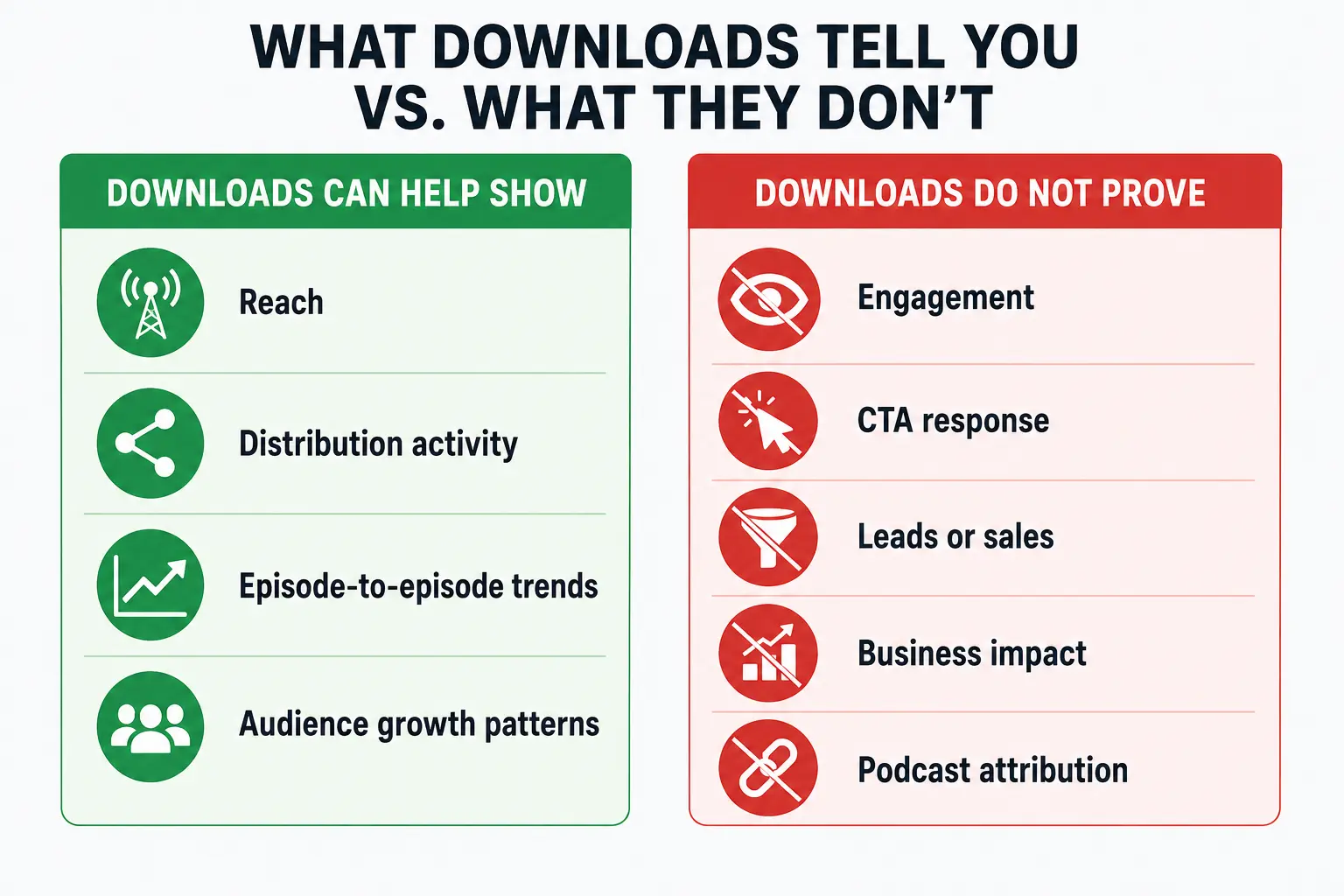
They can help you understand whether your episodes are getting distributed and whether the potential audience for your show is growing.
But a download count cannot tell you, by itself, whether people actually stayed with the episode, took the next step you wanted them to take, or created any meaningful value for your business.
That is where podcasters get into trouble.
The problem isn’t tracking downloads.
The problem is asking one metric to answer questions it was never designed to answer.
Are Podcast Downloads a Vanity Metric?
Podcast downloads become a vanity metric when the number is treated as proof that the podcast is succeeding without connecting it to the actual job of the show.
There is nothing inherently useless about a download.
Podcast measurement standards exist specifically to make download and audience reporting more consistent, and podcast platforms provide increasingly detailed audience and engagement information alongside those numbers.
The distinction is simple:
Downloads measure activity. They don’t automatically measure impact.
If your podcast exists primarily to sell advertising against audience reach, downloads may be extremely important.
If your show exists to educate customers, build authority, generate inquiries, support a product, grow an email audience, strengthen relationships, or influence sales, you need additional evidence.
Otherwise you’re looking at one number and trying to make it tell the whole story.
What Podcast Downloads Can Actually Tell You
Downloads can help you answer questions about the reach and distribution of your show.
For example:
- Is the audience generally growing or shrinking?
- Which episodes generate more initial activity?
- Are older episodes continuing to attract listeners?
- Did a promotion appear to increase distribution?
- Are certain subjects consistently attracting more interest?
Those are useful questions.
If one episode consistently reaches twice as many people as another, I want to know why.
But I don’t automatically conclude that the episode with more downloads was twice as valuable.
That’s a different question.
What Downloads Cannot Tell You
Suppose one of your episodes gets 1,000 downloads.
Great.
Now what?
Did the right people download it?
Did they listen for thirty seconds or thirty minutes?
Did they understand your point?
Did anyone visit your website?
Did someone download the resource you mentioned?
Did a prospective client listen before contacting you?
Did an existing customer use the episode to better understand your product?
Did the recording produce six other useful pieces of content?
Did the episode influence a purchase three weeks later?
Your download count doesn’t answer those questions.
That is why a business-minded podcaster needs to look beyond a single dashboard number.
Use Four Levels of Podcast Measurement
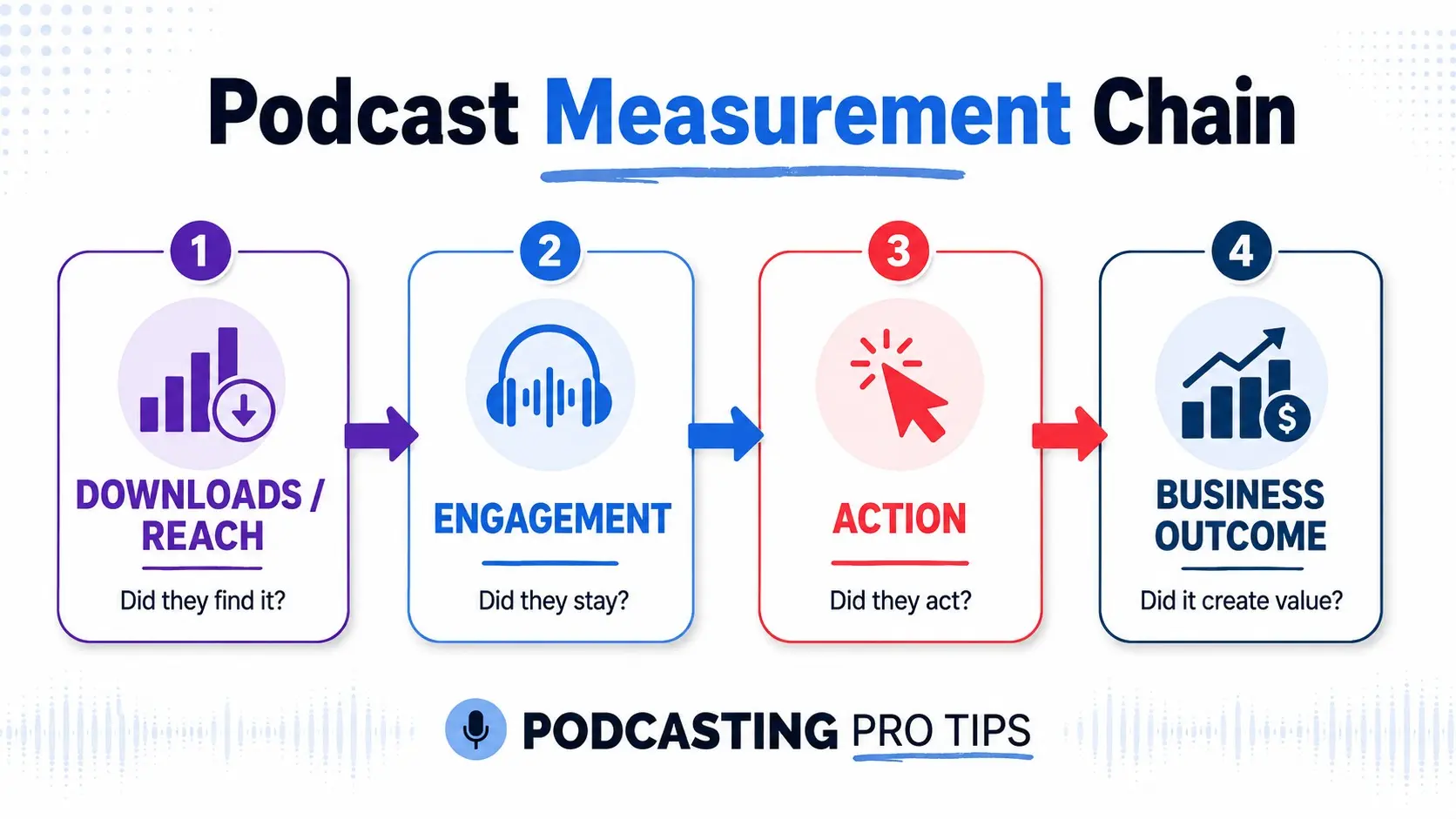
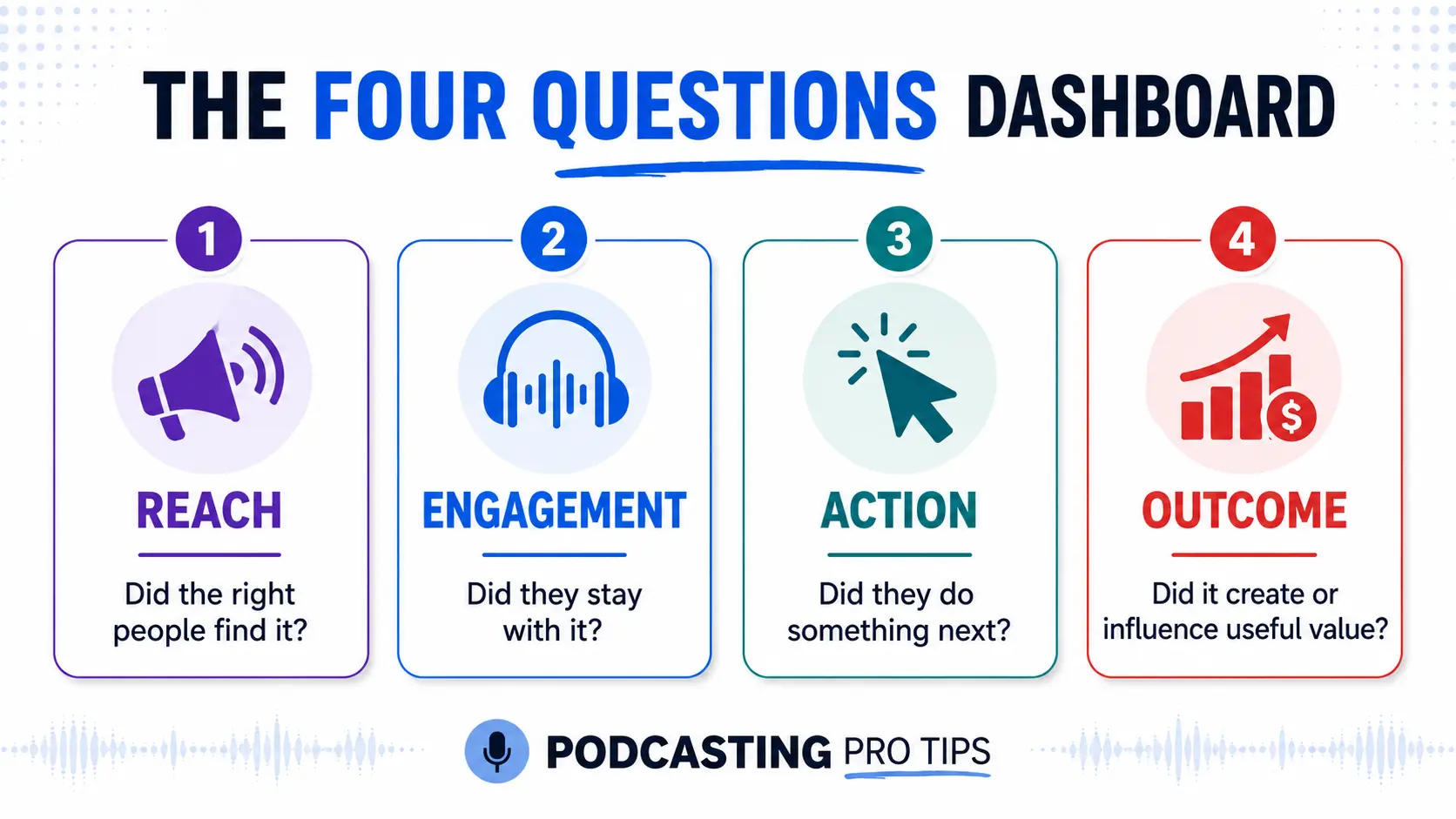
A practical way to evaluate a podcast is to separate measurement into four levels.
1. Reach: Did People Find the Episode?
This is where downloads belong.
Depending on your platforms and hosting setup, useful reach indicators might include downloads, listeners, audience, followers, plays, impressions, or discovery data.
The purpose of this layer is simple:
Did the content reach people?
Reach matters because nothing else happens if nobody encounters the show.
But reach is the beginning of the measurement chain, not the end.
2. Engagement: Did They Actually Consume It?
Once people find the episode, the next question is whether they stay.
Apple Podcasts, for example, reports listeners, engaged listeners, time listened, and average consumption separately from basic plays. Spotify provides consumption time, completion information, and returning-audience data in addition to its broader audience metrics.
You don’t need to obsess over every graph.
You’re looking for evidence that the episode actually held attention long enough to do its job.
If an episode produces plenty of initial activity but people consistently abandon it during the opening, that tells you something very different from a simple download count.
And that is a production problem you can actually work on.
3. Action: Did the Listener Do Anything Next?
This is where podcast measurement starts connecting to the rest of your business or organization.
What action was the episode supposed to encourage?
Maybe it was:
- downloading a guide;
- joining your email list;
- registering for a class;
- visiting a product page;
- booking an appointment;
- sending an inquiry;
- watching another episode;
- requesting more information.
Not every episode needs to sell something.
But an episode should normally have a job.
If there is a logical next action, track it.
This is also why your podcast CTA matters. Sending a listener in five different directions makes measurement unnecessarily difficult. A clearer approach is to design one relevant podcast call to action around what the listener should reasonably do next.
4. Business Outcome: Did the Podcast Create Useful Value?
This is the question download reporting cannot answer on its own.
For a business-focused show, useful outcomes might include:
- qualified inquiries;
- registrations or bookings;
- product evaluation;
- sales conversations;
- direct sales;
- assisted sales;
- customer education;
- email-list growth;
- referrals;
- stronger professional relationships;
- reusable content;
- documented expertise or authority.
The important word here is might.
You shouldn’t automatically give the podcast credit for every business result that occurs after somebody listened.
That is attribution.
And attribution requires evidence.
You need some way to distinguish where the person originally came from from whether the podcast later influenced their decision.
That could include tracked links, signup-source questions, thank-you-page questions, CRM notes, or simply asking someone:
“Did the podcast or a specific episode influence your decision to sign up, purchase, or reach out?”
Now you are collecting evidence instead of guessing.
A Small Podcast Can Still Be Doing a Big Job
Imagine an educator who uses a podcast to support paid workshops.
This is hypothetical.
An episode produces 250 downloads.
That number alone doesn’t look spectacular.
But suppose the host can also see that listeners stayed with the episode, several people downloaded the companion resource, some joined the email list, and a few eventually registered for a workshop after indicating that the podcast influenced the decision.
The useful story isn’t:
“We got 250 downloads.”
It isn’t even:
“The podcast generated every workshop sale.”
The better conclusion is:
“The episode reached an audience, held attention, produced measurable actions, and there is evidence that the podcast influenced some downstream outcomes.”
That is a much more defensible way to talk about podcast performance.
And it gives you something you can improve.
Your Podcast Metrics Should Match the Job of the Show
This is the part many podcasters skip.
They start measuring the podcast before clearly deciding what the podcast is supposed to accomplish.
If you haven’t defined the job, almost any number can look important.
One week you’re celebrating downloads.
The next week it’s YouTube views.
Then followers.
Then clips.
Then impressions.
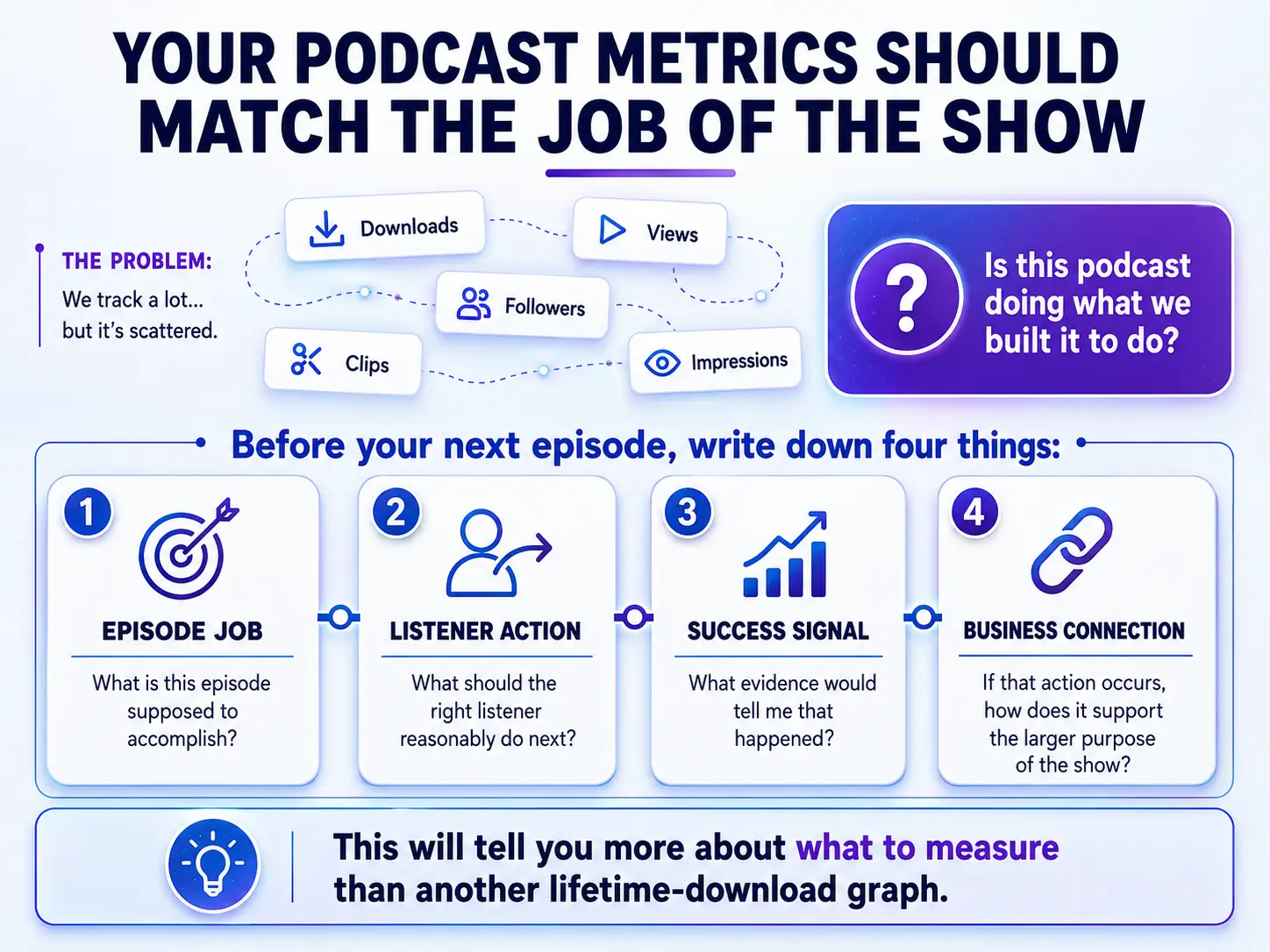
Pretty soon you’ve got fifteen dashboards open and still can’t answer the basic question:
Is this podcast doing what we built it to do?
Before your next episode, write down four things:
- Episode job: What is this episode supposed to accomplish?
- Listener action: What should the right listener reasonably do next?
- Success signal: What evidence would tell me that happened?
- Business connection: If that action occurs, how does it support the larger purpose of the show?
That little exercise will tell you more about what to measure than staring at another lifetime-download graph.
And if the show itself still doesn’t have a clearly defined job, start upstream. Defining your podcast concept and foundation gives the rest of your measurement something to attach to.
When Downloads Really Do Matter
None of this means you should ignore downloads.
If your business model depends on advertising inventory, audience scale matters.
If you’re testing distribution, promotion, search discovery, or episode subjects, reach data matters.
If your downloads suddenly collapse, you probably want to know why.
The mistake is not caring about downloads.
The mistake is promoting downloads from one useful metric to the definition of podcast success.
For a business podcast, those are two completely different things.
Stop Asking “How Many Downloads Did We Get?”
Ask a better sequence of questions:
Did the right people find it?
Did they stay with it?
Did they take the intended next step?
Did that activity create or influence something useful?
Downloads help answer the first question.
Your podcast measurement system should help you answer the rest.
Build the Business System Behind the Metrics
If you’re looking at your analytics and realizing you don’t actually know what the podcast is supposed to accomplish, what action listeners should take, or how you’ll recognize business impact, the problem probably isn’t your analytics software.
Those decisions belong upstream.
The Podcast Business System + Podcast Production OS connects the strategy, content, production, conversion, ROI, and attribution decisions behind the show so you’re not trying to build the measurement system after the episodes are already published.