Pitching yourself as a podcast guest isn’t really about convincing a host that you’re interesting.
It’s about showing them that you could help create an episode their audience would actually want to hear.
That’s an important distinction.
A host may receive pitches from authors, coaches, founders, creators, publicists, consultants, and people who apparently became a “thought leader” sometime between breakfast and lunch. Most of those pitches start with the person being pitched:
Here’s who I am. Here’s what I accomplished. Here’s my company. Here’s my book.
The host is thinking about something different:
Would this make a good episode for my listeners?
A strong podcast guest pitch answers that question quickly.
Before You Pitch, Find the Right Podcasts
Don’t start by building the biggest possible list of podcasts.
Start by finding shows where your expertise overlaps with something the audience already cares about.
Look at:
- who the show appears to serve;
- the topics it regularly covers;
- its recent episodes;
- the type of guests it books;
- the interview format;
- whether your proposed subject has already been covered repeatedly;
- whether you can contribute something meaningfully different.
Audience fit matters more than simply finding the largest show.
If you host your own podcast, this is also where your podcast positioning matters. You should already be able to explain who your show serves, what problem you help with, and why someone should care.
If that’s still fuzzy, start with my guide to defining your podcast concept and audience.
Don’t Make Download Counts Your Only Filter
A smaller, well-matched show can sometimes be more useful to your business than a much broader podcast.
The useful question isn’t simply:
How many people listen?
It’s:
Are these the people I actually want to reach, and is there a sensible next step if the conversation connects with them?
That next step might be listening to your podcast, downloading a useful resource, joining your email list, exploring your work, following you, or simply remembering you as someone who knows what they’re talking about.
That’s one reason I don’t like treating podcast downloads as the entire scoreboard. Download numbers are useful, but they’re not the same thing as business value.
The Most Important Shift: Pitch the Episode, Not Your Résumé
Your credentials matter.
But they’re supporting evidence. They’re not the episode.
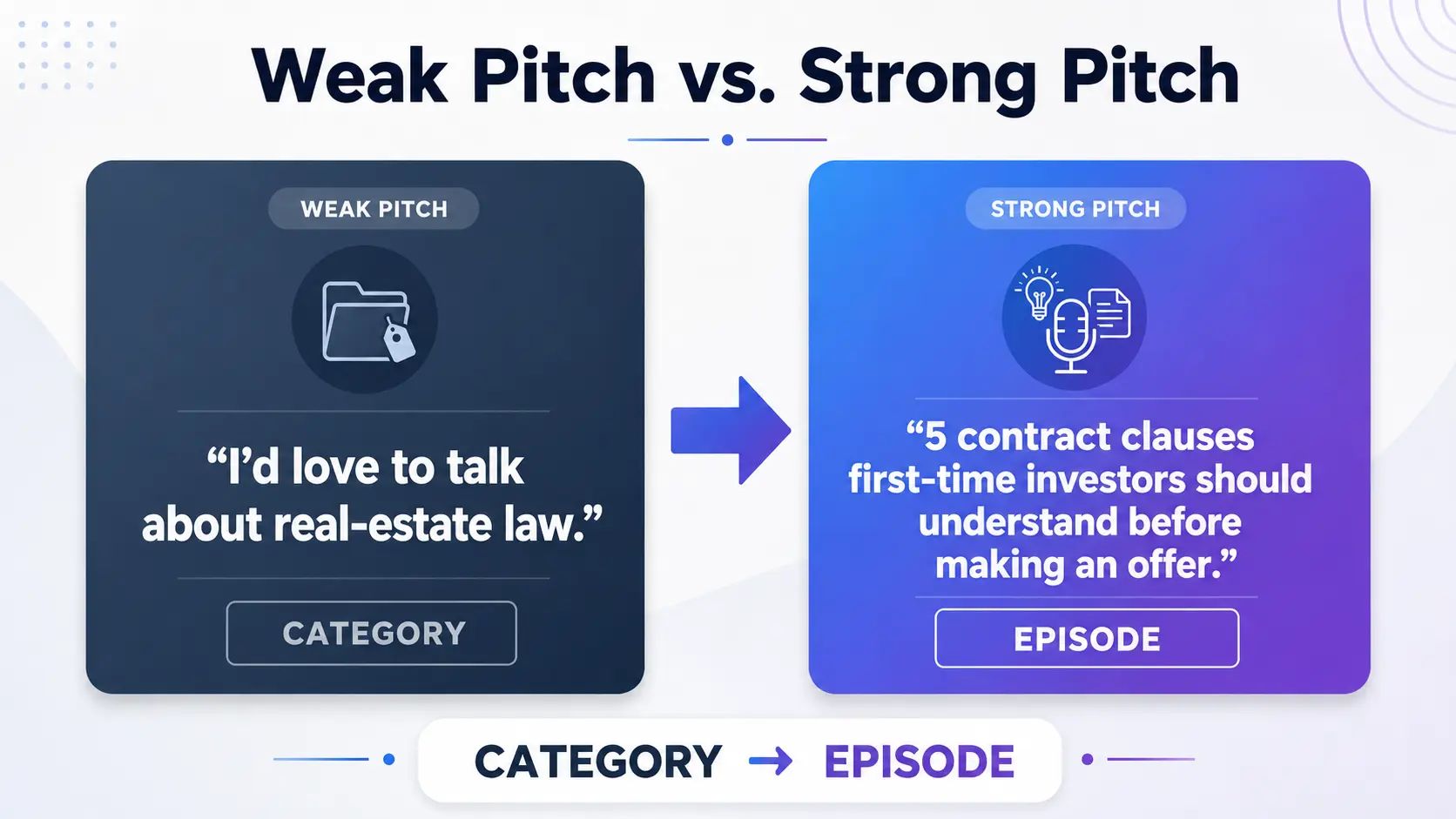
Instead of writing:
I’m an entrepreneur, keynote speaker, bestselling author, consultant and founder of XYZ Company…
Start thinking:
What conversation could I help this host create that fits what their listeners already care about?
That’s a much stronger starting point.
For example, imagine you’re a real-estate attorney pitching a podcast for first-time property investors.
“I’m an experienced real-estate attorney” establishes credibility.
But this is the potential episode:
Five contract clauses first-time investors often overlook before they close on a property.
Now the host can picture the conversation.
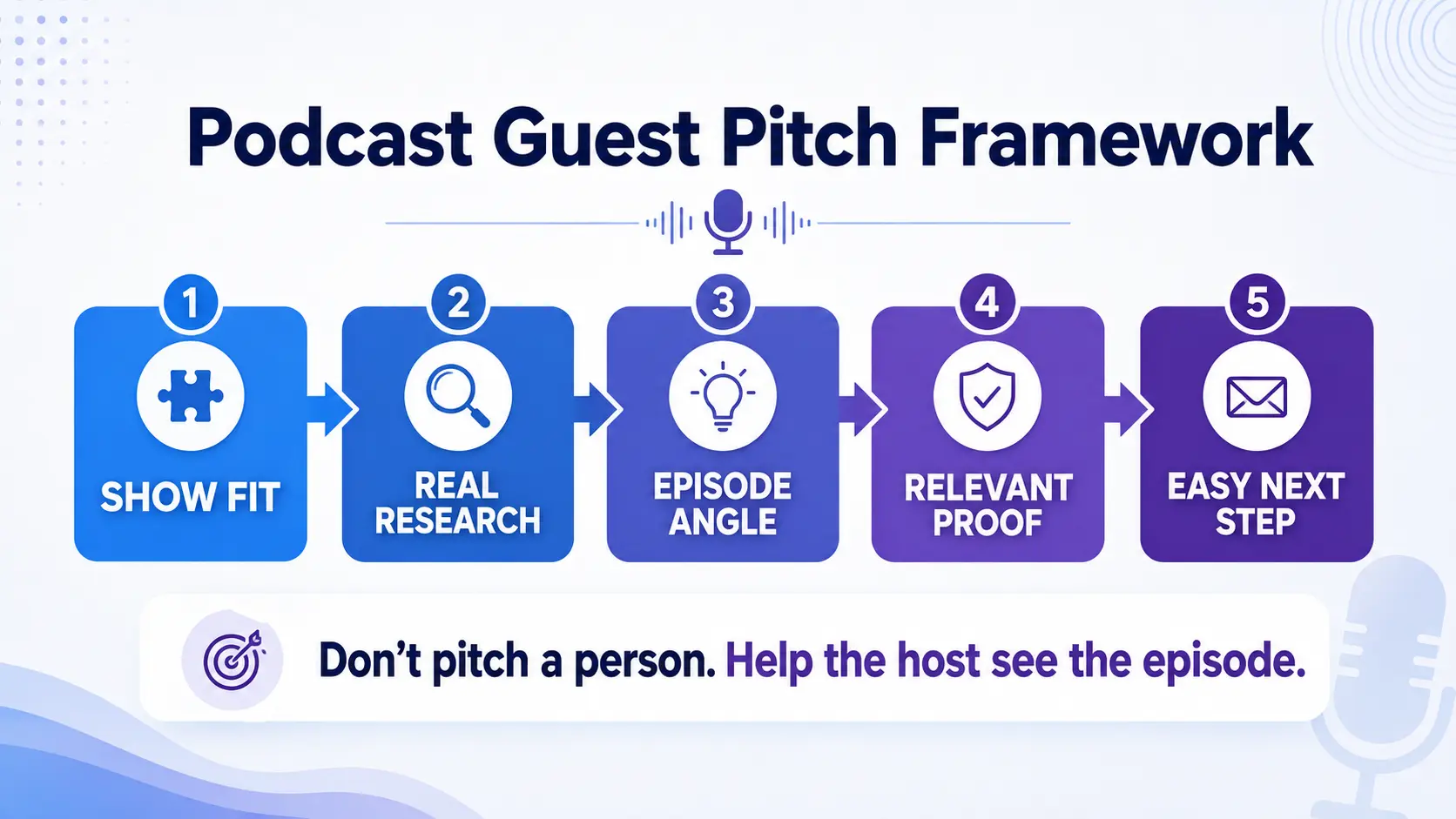
How to Write a Podcast Guest Pitch in 5 Steps
1. Show That You Actually Know the Podcast
You don’t need to write a love letter.
Just prove that this isn’t the same email being sprayed across 300 podcast inboxes.
Reference a relevant episode, recurring subject, interview, or idea.
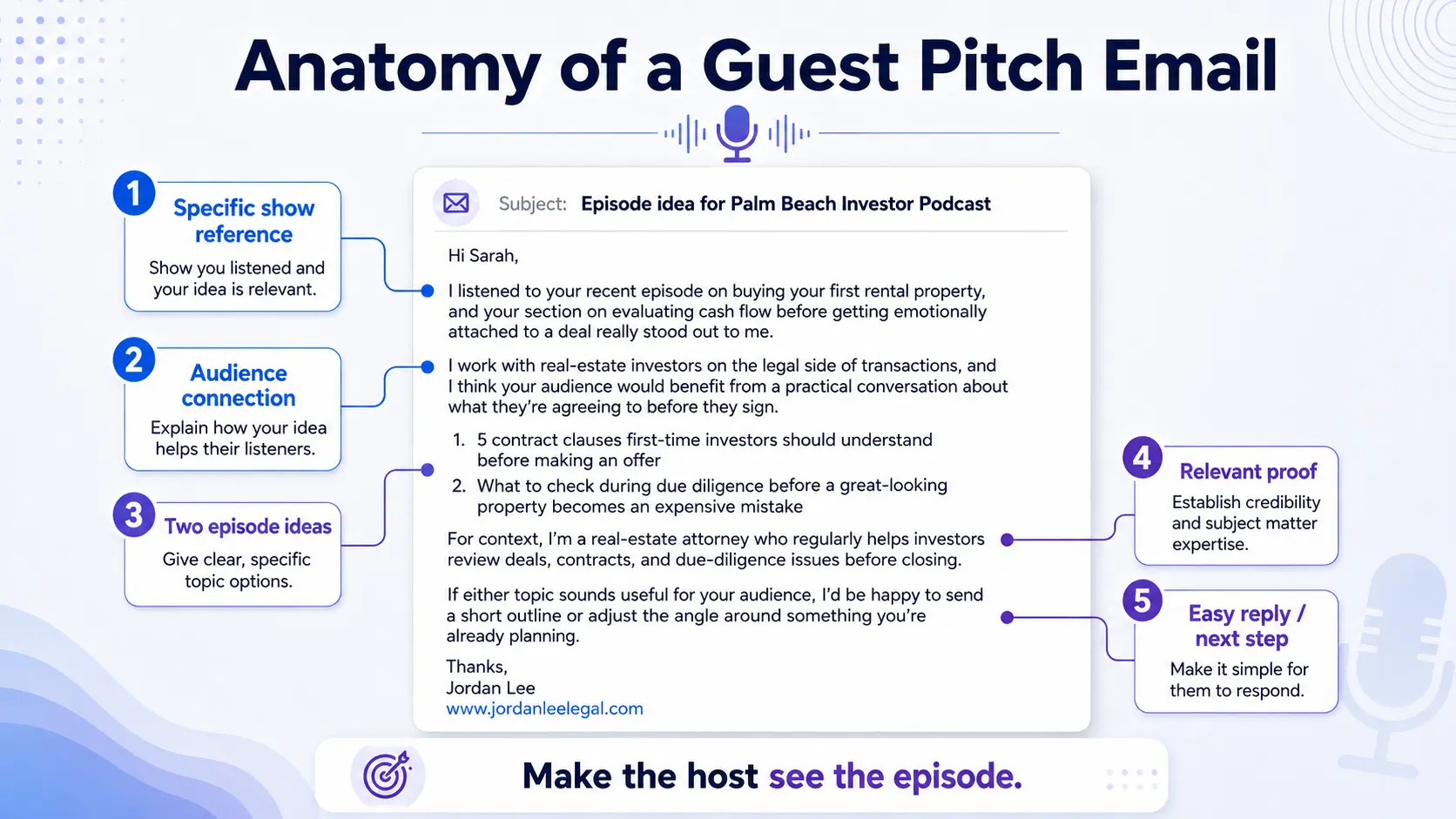
For example:
I listened to your recent episode about buying your first rental property. Your section on evaluating cash flow before getting emotionally attached to a deal caught my attention.
That tells the host why you’re contacting this particular show.
Avoid fake personalization.
Changing:
Hi Podcast Host
to:
Hi Jennifer
doesn’t suddenly make a mass email personal.
2. Establish the Audience Connection
Now explain why your expertise connects with the listeners.
Keep it short.
For example:
I work with property investors on the legal side of transactions, and there’s one area I see newer buyers consistently underestimate: what they’re agreeing to before they sign.
Notice what’s missing.
There isn’t a six-paragraph autobiography.
The purpose of this sentence is simply to connect:
your expertise → their audience → a useful problem
3. Offer One or Two Specific Episode Angles
Specificity makes a pitch easier to evaluate.
Compare these two pitches:
Weak:
I’d love to come on your show and talk about real estate law.
Better:
Two topics that may fit your audience:
- Five contract clauses first-time investors should understand before making an offer.
- What to check during due diligence before a seemingly great property becomes an expensive mistake.
The second version gives the host something they can imagine turning into an episode title.
That’s what you want.
You aren’t asking them to invent the interview for you.
4. Give the Host Enough Proof
Once the topic sounds useful, the host needs some reason to believe you’re qualified to teach it.
This is where your bio finally becomes useful.
Use the proof that supports the particular pitch.
Depending on your situation, that could be:
- relevant professional experience;
- specialized expertise;
- a book or body of published work;
- research;
- a case study you’re permitted to discuss;
- previous interviews;
- your own podcast or YouTube channel;
- a useful speaking sample.
Don’t dump every credential you’ve accumulated since high school.
Give them enough to answer:
Why this person for this topic?
5. Make the Next Step Easy
Finish with a simple ask.
You don’t need a complicated booking workflow in the first email.
Something like this works:
If either topic sounds useful for your audience, I’d be happy to send over a short outline or find another angle that fits the show.
Then give them whatever removes reasonable uncertainty.
That might include a link to:
- your website;
- a speaker or media page;
- your podcast;
- a previous interview;
- a short video showing how you communicate.
If you’re recording remotely, you can also briefly mention that you have a reliable recording setup.
That’s enough.
You don’t need to list the model number of every microphone, interface, camera, light, boom arm, and acoustic panel you own. The host is trying to book an interview, not inventory your studio.
Podcast Guest Pitch Email Template
Here’s a simple version you can adapt.
Subject: Episode idea for [Podcast Name]: [specific topic]
Hi [Host Name],
I listened to your recent episode with [guest/topic], and your discussion about [specific idea] caught my attention.
I work with [type of person/audience] on [relevant problem or area of expertise], and I think I could contribute a useful conversation around one of these topics:
- [Specific episode idea #1] — [one-sentence explanation of what listeners would learn]
- [Specific episode idea #2] — [one-sentence explanation of what listeners would learn]
For context, I’m [one or two lines of relevant proof].
If either topic feels like a fit for your audience, I’d be happy to send a short outline or adjust the angle around something you’re already planning.
You can see more of my work here: [link]
Thanks,
[Name]
That’s it.
Don’t bury the useful idea under 900 words of biography.
What Not to Put in Your Podcast Guest Pitch
Several things can make an otherwise reasonable pitch feel like work.
Avoid:
A Generic Life Story
The host shouldn’t have to dig through your career history to figure out what you could talk about.
A Topic That’s Way Too Broad
“Leadership.”
“Marketing.”
“Entrepreneurship.”
“Health.”
Those are categories, not episode ideas.
Give the host a problem, question, distinction, process, mistake, or outcome they can actually build a conversation around.
An Obvious Sales Pitch
A guest interview is not a 35-minute infomercial with a podcast intro attached.
The stronger approach is to make the conversation itself useful.
If the host gives you an opportunity to mention your resource, company, show, or offer, the connection becomes much more natural because you’ve already delivered something valuable.
Ten Different Topic Ideas
Two strong angles are easier to evaluate than a giant menu.
More choices don’t always make a decision easier.
Fake Familiarity
Don’t tell a host you’ve been a “huge fan for years” if you discovered the show yesterday.
You can simply say why a particular episode or subject made you think there might be a fit.
That’s believable because it’s true.
Should You Follow Up on a Podcast Guest Pitch?
Yes, one concise follow-up is reasonable when you haven’t received a response.
Don’t send:
Just bumping this to the top of your inbox.
Add something useful instead.
For example:
Hi Sarah — following up on the note below. I had one additional angle that may fit your recent series on first-time investors: “The three due-diligence questions to answer before you waive a contingency.” If that’s useful, I’m happy to send a quick outline.
Then move on if there’s still no response.
No response doesn’t automatically mean the pitch was bad.
The host may be booked, the timing may be wrong, the topic may already be scheduled, or the show simply may not be a fit.
Getting Booked Is Only Half the Job
There is another mistake I see with guest appearances.
People spend all their energy getting booked and almost none preparing to deliver a genuinely useful interview.
Getting onto the show creates the opportunity.
What you say once the microphone turns on determines what you do with it.
Before recording, know:
- the audience you’re speaking to;
- the central problem you’re there to help with;
- two or three useful teaching points;
- a couple of relevant examples;
- the stories or proof you can discuss;
- the one next step you’d like an interested listener to take if the host gives you the opportunity.
You should still listen to the host and have a real conversation. This isn’t about memorizing your 17 approved talking points and waiting impatiently to deploy them.
Preparation gives you useful material to draw from without turning the interview into a speech.
If you’re interested in the other side of that conversation, my guide to preparing podcast interviews without letting ChatGPT flatten every guest into the same interview explains the host’s perspective.
Think Beyond “Did My Downloads Go Up?”
If you’re pitching podcast appearances because you have your own show or business, decide what you actually want the activity to accomplish.
Maybe you want:
- qualified people to discover your podcast;
- more people to join your email audience;
- greater awareness around a particular area of expertise;
- new professional relationships;
- traffic to a useful resource;
- conversations with prospective customers;
- invitations to other relevant podcasts.
Then create a reasonable way to observe those outcomes.
A dedicated URL, campaign link, signup source question, or simple “How did you hear about us?” field can give you far better information than staring at your podcast download chart the morning after the episode publishes.
Guest podcasting is a distribution tactic.
It works best when the audience, message, authority, destination, and measurement plan connect.
Otherwise, you can spend months collecting guest appearances without being able to answer the most important question:
What were those appearances supposed to accomplish?
A Better Podcast Guest Pitch Starts With the Listener
The strongest guest pitches aren’t really about selling yourself to the host.
They’re about helping the host recognize a useful episode.
Research the show.
Understand the audience.
Pitch a specific conversation.
Give enough evidence to establish why you’re qualified.
Make the next step easy.
And when you get booked, show up prepared to make the host glad they said yes.
Want to Be a Better Podcast Guest Once You Get Booked?
The World-Class Guest Blueprint: How to Sound Sharp, Deliver Modular Value, and Drop Frictionless Backend Links is available inside the Podcasting Pro Tips Free Vault. It is designed to help you prepare what you’re going to say once you’re actually behind the microphone.
Frequently Asked Questions
How long should a podcast guest pitch be?
Keep it long enough to establish show fit, present the episode idea, provide relevant proof, and make the next step clear. If the host has to scroll through your entire biography before discovering what you’re proposing, the pitch is probably doing too much.
Should I pitch one podcast topic or several?
One or two well-developed topics are usually enough. Each should be specific enough that the host can imagine the resulting episode and understand why it would matter to the audience.
Should I include my podcast in my guest pitch?
Yes, when it provides useful proof of your expertise or communication ability. Include it as supporting evidence rather than making promotion of your own show the central reason the host should book you.