If your podcast takes forever to edit, the editor may not be the problem.
A rough edit is often the bill arriving for decisions that were never made before recording.
The episode ran long because nobody decided what it needed to accomplish. The opening drags because the hook wasn’t planned. There aren’t any good clips because the conversation never developed a complete idea. The call to action feels bolted on because nobody decided where the listener should go next.
Those may show up as editing problems.
They’re usually producer problems.
And that doesn’t mean every podcast needs to hire a professional producer.
It means every serious podcast needs someone to perform the producer function.
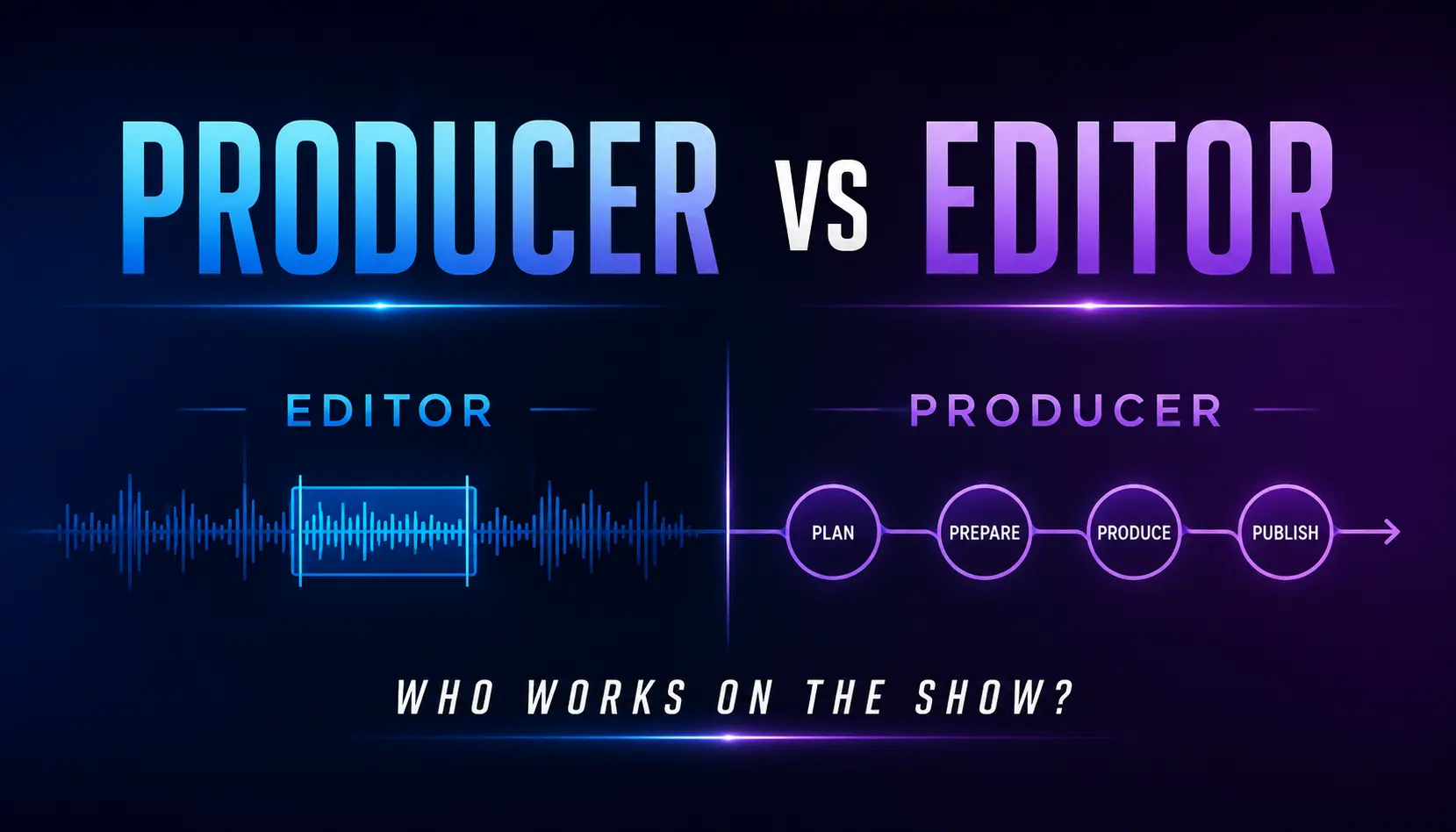
Podcast Producer vs. Editor: The Short Answer
A podcast editor primarily works with material that has already been recorded. A podcast producer looks across the larger process and helps make the decisions that determine what gets recorded, how the episode works, how production is handled, and what happens after the recording is finished.
There can absolutely be overlap.
A producer may edit. An editor may offer production guidance. A host may perform both jobs. A larger company might divide the responsibilities among several people.
The important distinction isn’t the job title.
It’s the decision being made.
Editing asks: How do we make this recording work?
Producing asks: What should we be making in the first place, and how will we make it consistently?
That’s a much bigger job.
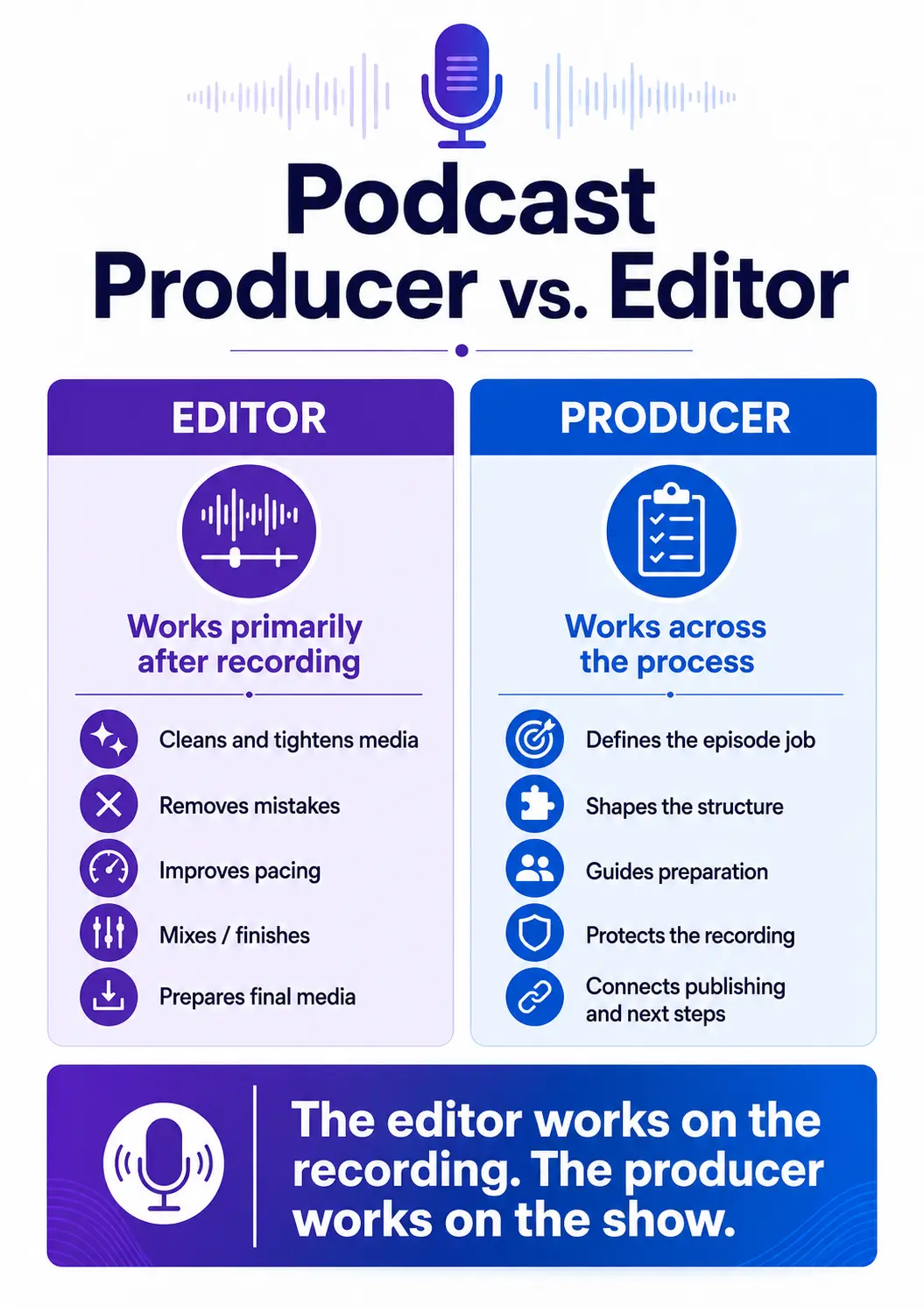
An Editor Works on the Recording. A Producer Works on the Show.
Think about what happens when you hand an editor a 50-minute recording.
By that point, dozens of important decisions have already happened.
The topic was selected.
The episode had—or didn’t have—a purpose.
The host prepared—or didn’t.
The guest was chosen.
The questions were planned.
The opening was recorded.
The conversation took whatever path it took.
The CTA was either built into the episode or remembered 14 seconds before the host hit Stop.
The editor inherits all of that.
A talented editor can improve pacing, remove distractions, clean up technical problems, tighten sections and make a recording substantially better.
But editing has limits.
You can’t always edit your way out of a missing idea.
That’s why good podcast production starts before the timeline ever opens.
If pre-production is one of the weak links in your show, my guide to podcast pre-production and episode planning goes deeper into that part of the process.
What Does a Podcast Producer Actually Do?
The exact role varies by show, but the producer function normally connects decisions across four areas: before recording, during production, after recording and across the show as a whole.
Before Recording
This is where a surprising amount of the real production work happens.
A producer may help answer questions like:
- What is this episode supposed to accomplish?
- Who is it for?
- What is the main promise?
- Why should someone care about this topic now?
- What’s the best structure?
- Does this guest actually fit the show?
- What questions will create the conversation we need?
- What should the listener understand or do by the end?
That does not mean writing every word.
In fact, good preparation often helps you rely less on a word-for-word script because you’ve already figured out where the episode is going.
During Recording
During the recording, the producer function shifts toward protecting the episode.
For an interview, that might mean recognizing when a guest is giving a great answer and letting the conversation develop instead of mechanically moving to the next question.
It can also mean noticing when the discussion is wandering, when an important point needs clarification, or when the listener will need more context.
On a solo episode, producing might be simpler. You’re paying attention to whether you’re following the intended idea instead of turning one bullet point into a 12-minute scenic route through your entire professional history.
The point isn’t rigid control.
The point is knowing what you’re trying to make.
After Recording
Post-production is more than removing mistakes.
Someone still needs to decide:
- What actually belongs in the final episode?
- Where is the pacing weak?
- Does the opening still work now that we’ve heard the entire recording?
- Are there unnecessary sections?
- What are the strongest self-contained teaching moments?
- Which clips are actually worth creating?
- What belongs in the show notes?
- What is the most relevant next step for the listener?
This is where editing and producing often overlap.
But again, the distinction is useful: the editor works on the media; the producer protects the purpose of the media.
Across Episodes
This is the part that gets overlooked.
A producer isn’t only thinking about Episode 27.
They’re looking at Episode 27 in the context of Episodes 26, 28 and the larger show.
Are you covering the same idea repeatedly?
Are the episodes supporting the position you want the show to own?
Is the production workload sustainable?
Are you constantly rebuilding the same files, prompts, checklists and publishing steps?
Is there a reason behind the content you’re creating after each episode?
That is where podcast production stops being a collection of individual tasks and starts becoming a system.
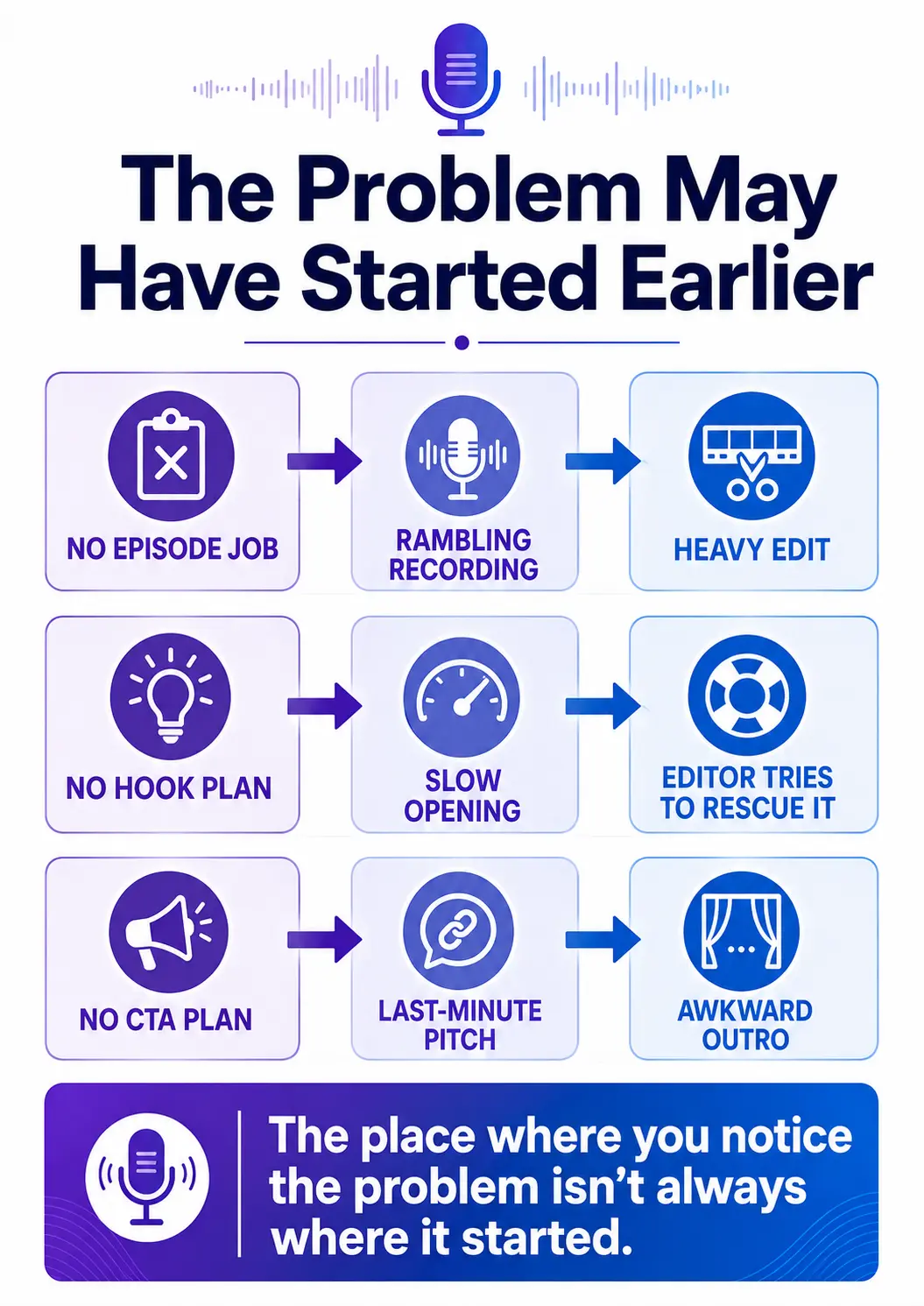
Many Editing Problems Start Before the Edit
I’ve spent years working in recording and podcast production, and one pattern comes up again and again:
The place where you notice the problem isn’t always the place where the problem started.
Here’s what that can look like.
| What You Notice | What May Have Happened Earlier | Producer Decision |
|---|---|---|
| The episode rambles | No clear episode job or structure | Define the promise and episode map |
| The opening feels slow | No hook was planned | Decide why the listener should care |
| The edit takes forever | Recording wandered or repeated itself | Improve preparation and recording control |
| There are no strong clips | Ideas were never developed into complete moments | Plan and recognize reusable value blocks |
| The CTA sounds awkward | The listener’s next step wasn’t chosen before recording | Decide the conversion path |
| Publishing is chaotic | Every episode uses a different process | Establish a repeatable workflow |
| The content feels disconnected | Episodes are being chosen one at a time | Connect episodes to the larger show strategy |
This is why hiring a faster editor doesn’t automatically fix an inefficient podcast.
Sometimes the editor is doing exactly what you hired them to do.
You’re just sending them a production problem.
The same idea applies to retention. Before adding another jump cut or zoom to a weak video, it’s worth figuring out whether the real problem is the structure of the episode itself. I break that distinction down further in this guide to video podcast retention, hooks and useful pattern interrupts.
Do You Actually Need to Hire a Podcast Producer?
Not necessarily.
The right answer depends on the size of the show, its complexity, your skills, your available time and what the podcast is expected to accomplish.
A professional producer can make a lot of sense when:
- the show involves multiple people or departments;
- the host needs help shaping episodes;
- interviews require substantial research and preparation;
- production has become difficult to manage;
- the show has important business or organizational objectives;
- nobody currently owns the complete workflow;
- the cost of inconsistent production is greater than the cost of experienced help.
But plenty of podcasters can produce their own shows.
A solo creator may be the host and producer.
A small company might have a marketing manager performing the producer role while an outside editor handles post-production.
A larger show could have a producer, editor, video team, booking support and marketing staff.
There isn’t one correct org chart.
The important question is:
Who owns the producer decisions?
If the answer is “nobody,” that’s the problem.
You Can Be Your Own Producer—But You Still Need a Process
Self-producing doesn’t mean keeping the entire show in your head.
That’s where a lot of podcasts become harder to operate than they need to be.
One week the episode outline is in a Google Doc.
The next week it’s in a ChatGPT conversation.
Guest notes are in an email.
The CTA is copied from Episode 14.
The clips are whatever seemed interesting while somebody scrubbed through the timeline.
The show notes get written from scratch.
Then everyone celebrates because the episode got published and gets to do the whole thing again next Tuesday.
That’s not really a workflow.
It’s a recurring scavenger hunt.
A producer function becomes much more useful when the major decisions follow a repeatable sequence:
PURPOSE → EPISODE PLAN → RECORDING → FINISH → PUBLISH → REPURPOSE → DIRECT → MEASURE → IMPROVE
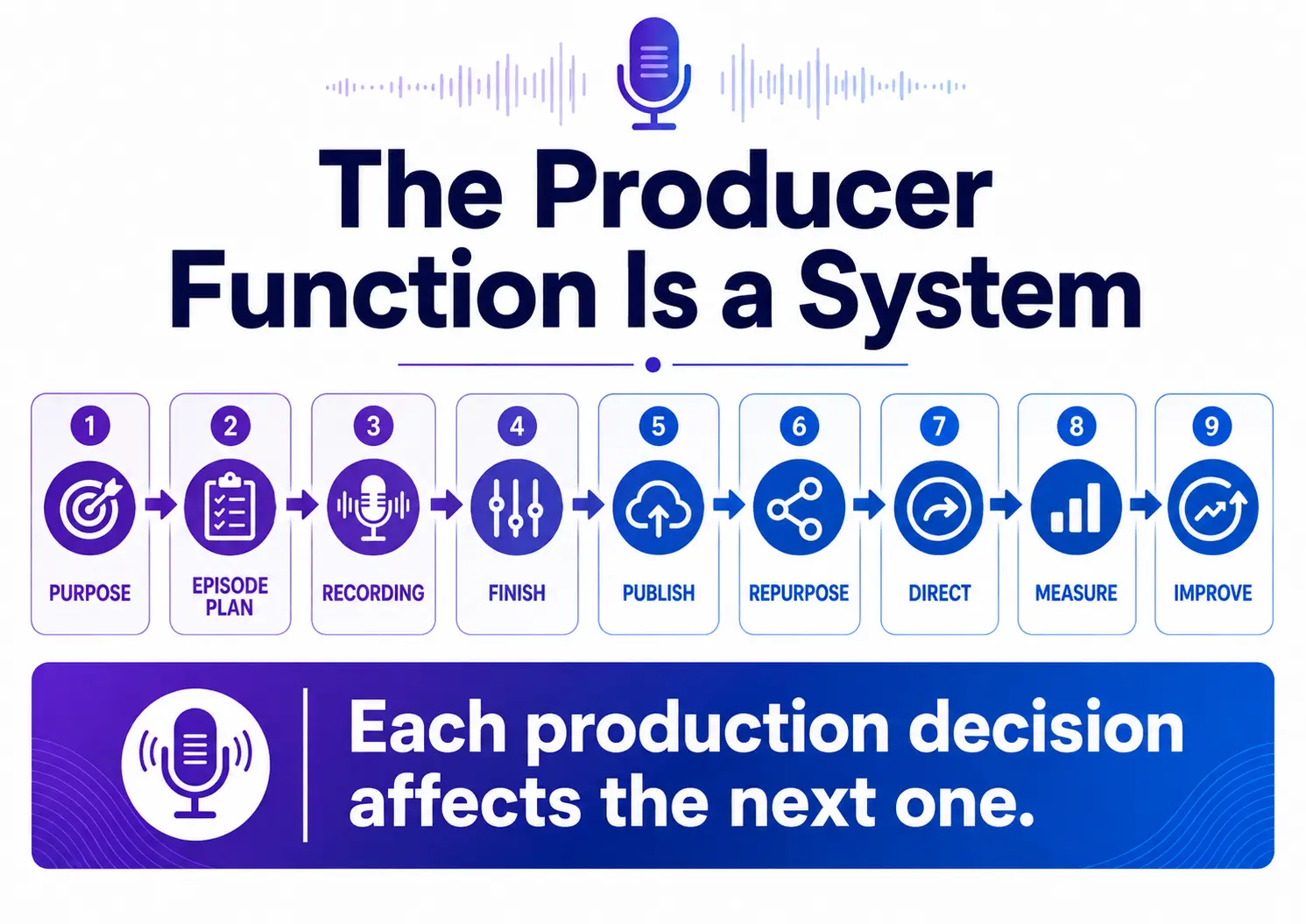
Each stage affects the next.
A poorly defined episode creates more work in recording.
A messy recording creates more work in editing.
An episode without clear value moments creates weaker repurposed content.
A CTA chosen at the last second creates a disconnected listener path.
A show that publishes without measurement gives you very little evidence about what to improve.
That’s also why I prefer to think about podcast workflow as a connected production system rather than a pile of automation tricks.
Automation can help, but first you need to know what the workflow is supposed to do. My automated podcast workflow blueprint covers that operational side in more detail.
Where Podcast Production OS Fits
This producer-function problem is one of the reasons I created the Podcast Production OS.
PPOS isn’t a human producer sitting in a control room, and it doesn’t record or edit your podcast for you.
It’s a structured production environment designed to help the person producing the show apply the same approved strategy and production logic from episode to episode.
The bigger system works in two parts.
The Podcast Business System helps you define the business behind the show: why it exists, who it serves, how it’s positioned, what authority it should build, what the content should support, where listeners should go next, and how the podcast’s value will be measured.
The Podcast Production OS takes that established show strategy and helps apply it to ongoing production work: episode development, hooks, outlines, solo scripts, interview arcs, calls to action and the content and publishing work that follows a completed recording.
That distinction matters.
A generic AI conversation can help you write an outline.
But if you have to re-explain the audience, positioning, offer, voice, CTA and purpose of the show every time you start an episode, you’re still rebuilding the producer context over and over.
The point of a production system is to stop starting from zero.
Your CTA Is a Producer Decision Too
One small example is the end of the episode.
A lot of hosts finish teaching and suddenly realize:
“Oh, right. I should probably tell them to do something.”
So they add the same subscribe pitch, booking link or product mention they always use.
A producer should be thinking about that earlier.
What did this particular episode help the listener understand?
What is the most useful next action based on that problem?
Does that next step actually fit the person who just listened?
A good CTA isn’t something you glue onto the end.
It’s part of the episode’s job.
If that’s a weak point in your current show, read my guide to building a podcast outro and call-to-action strategy.
The Producer Function Is Bigger Than the Job Title
You may need a professional producer.
You may need a better editor.
You may need clearer roles inside your team.
Or you may simply need to become more deliberate about producing your own show.
But don’t confuse those decisions.
An editor can make a good recording better.
A producer helps create the conditions for a better recording to exist in the first place.
And when the producer decisions are connected through a repeatable system, you’re no longer rebuilding the show every time you sit down to record.
You’re producing from decisions you’ve already made.
Want a System Behind the Producer Decisions?
The Podcast Business System + Podcast Production OS is designed to connect the strategy behind your show with the episode and production work that follows.
The Podcast Business System helps you define the show’s business architecture. Podcast Production OS then helps carry those approved decisions into episode development, recording preparation, calls to action, publishing and repurposing.
If your podcast currently depends on scattered prompts, documents, checklists and whatever you remember from last week, this is the system built to bring those pieces together.
Explore the Podcast Business System + Podcast Production OS
Frequently Asked Questions
What is the difference between a podcast producer and an editor?
A podcast editor primarily works on recorded media: tightening the recording, correcting problems and preparing the finished audio or video. A producer has a broader role that can include episode planning, structure, recording decisions, workflow, editorial judgment and coordination before and after the recording.
Do I need to hire a podcast producer?
No. A host, team member or outside professional can perform the producer function. What matters is that someone owns the decisions connecting episode planning, recording, post-production, publishing and the larger purpose of the show.
Can Podcast Production OS replace a human podcast producer?
No. Podcast Production OS is a structured production system, not a done-for-you producer, recording service or editing service. It helps the person operating the podcast apply the show’s established strategy more consistently across episode development and related production work.