If you are already publishing a podcast and considering another camera, a new microphone, or a more elaborate editing workflow, start by naming the result you want. Better equipment can fix a recording problem. It can make your show easier to produce or more effective in a format you have chosen. It cannot, by itself, decide who the show is for or what it should accomplish.
That distinction matters most when the reason for upgrading is, “Our podcast is not doing what we hoped it would do.” You may have a production problem, a business strategy problem, or both. The purchase makes sense only after you separate them.
A real camera question can uncover a different problem
I recently spoke with two podcasters who were more than 30 episodes into their show. They recorded with an iPhone and wanted to move toward three cameras. That was a legitimate production conversation: their host and producer worked from different locations, and a conventional multicamera setup could have added switching, separate recordings, file transfers, and management that their current arrangement was not built to handle.
We discussed a possible three-iPhone workflow using Riverside as one way to pursue more camera angles without asking the host to run a live control room. It was a recommendation, not an implemented result.
Then the questions changed. They also wanted to know how the podcast might support a business and what it should accomplish. Three cameras might improve their presentation, but they could not answer those questions. We discussed possible directions, including an owned audience and ways a show might support existing activities. Those were possibilities, not results.
The useful lesson is simple: a production upgrade solves a production problem. If you also have a business problem, give that problem its own diagnosis.
When better production is worth paying for
Production quality matters when it affects the listener experience or your ability to make the show reliably. A purchase may be justified if it helps you address a specific constraint, such as:
- Speech that is hard to understand because of noise, distance, or a poor recording setup.
- Video that genuinely limits a planned visual format or useful clips.
- A recording workflow that regularly loses time to preventable setup, syncing, or transfers.
- A format that requires another input, camera angle, or dependable monitoring method.
- A process that your team cannot sustain at the planned publishing rhythm.
Sometimes the fix is gear. Sometimes it is placement, room treatment, a simpler workflow, training, or a change in who does the work. If you are choosing a setup, the podcast equipment guide walks through recording formats and the equipment each requires. This article deals with the decision before the shopping list.
What an equipment purchase cannot decide
Suppose your audio is clear, episodes go out on schedule, and your video is usable. You still might be unsure why the right person would listen, what the show should become known for, or what a listener should do afterward. A cleaner edit will not choose your positioning. Another camera will not create an offer or a way to evaluate whether the show helps your business.
This is what I mean when I say your podcast should have a job. Its job is the useful outcome you intend the show to support. That could be customer education, qualified awareness, authority in a defined subject, owned-audience growth, inquiries, support for a product or service, an event or community, or reusable content for a larger publishing effort. It does not mean every episode must sell something.
Once you define that job, you can make connected decisions. Who needs the show? Why should they choose it? What subjects can you credibly teach? Which next step fits the listener? What production can you keep doing? If you are still shaping the show itself, define your podcast concept before adding more production complexity.
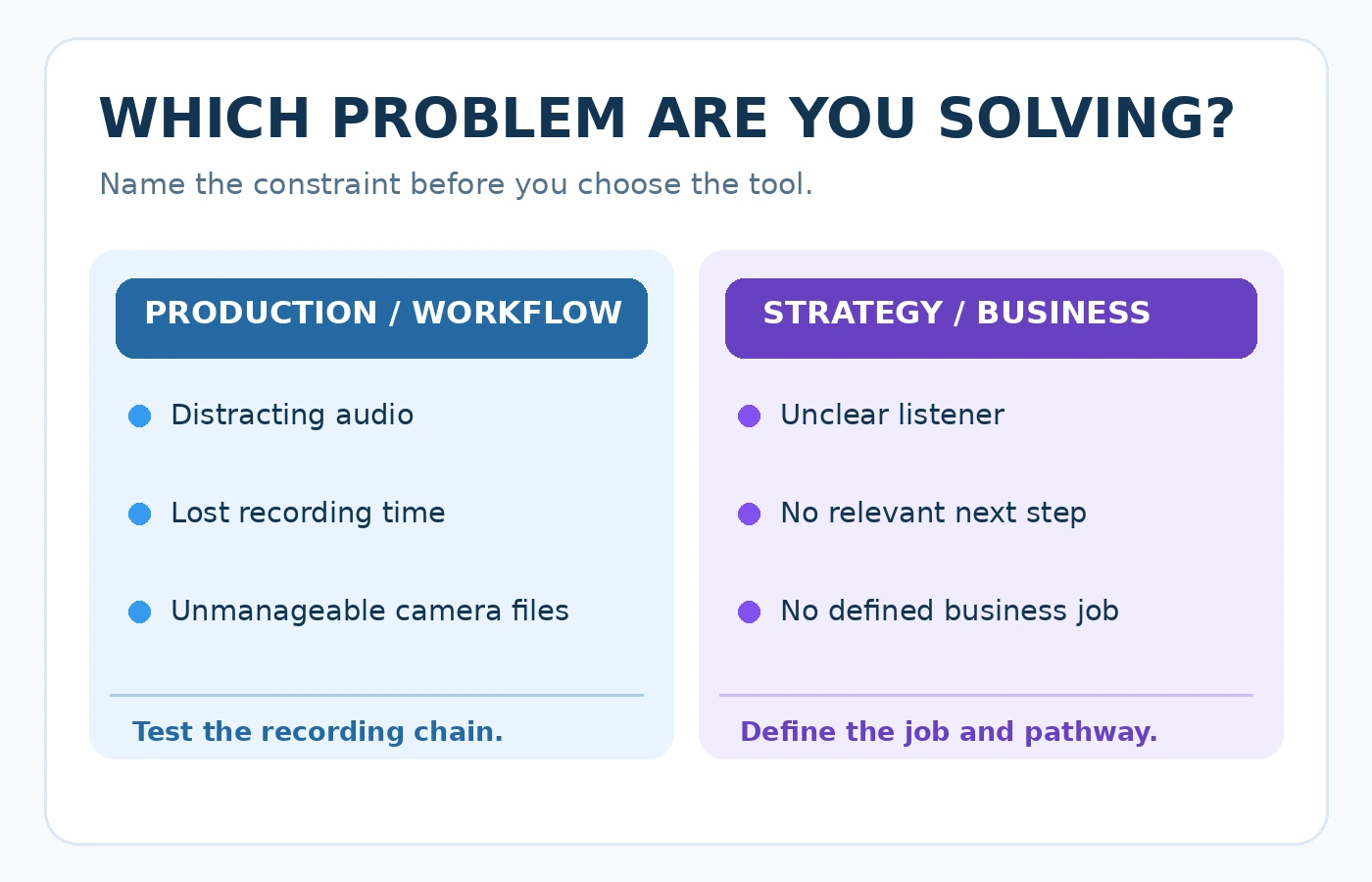
Production problem or podcast strategy problem?
Use the symptom to find the layer that needs attention. More than one row can apply to your show.
| What you are noticing | First question to ask | Likely first response |
|---|---|---|
| The voice sounds distant or distracting | Where is the sound being lost: room, placement, recording, or edit? | Test the recording chain and technique; buy only for the remaining constraint. |
| Multicamera recordings create messy files | Who records, syncs, transfers, edits, and checks each angle? | Design a workflow the actual team can operate. |
| Episodes publish, but the right people do not seem to find them | Is the listener, promise, topic choice, or distribution path clear? | Revisit positioning and discovery before assuming the camera is the cause. |
| Listeners engage, but nobody takes the intended next step | Is there a relevant offer or resource and a clear path to it? | Improve the listener pathway and measure the action. |
| You see downloads or views but cannot describe business value | What job did you assign the show, and what evidence would support it? | Define the outcome and measurement method. |
This is a diagnostic, not a rule that every low number has one cause. A show can need better sound and clearer positioning. Treat each issue separately so you do not ask one purchase to fix both.
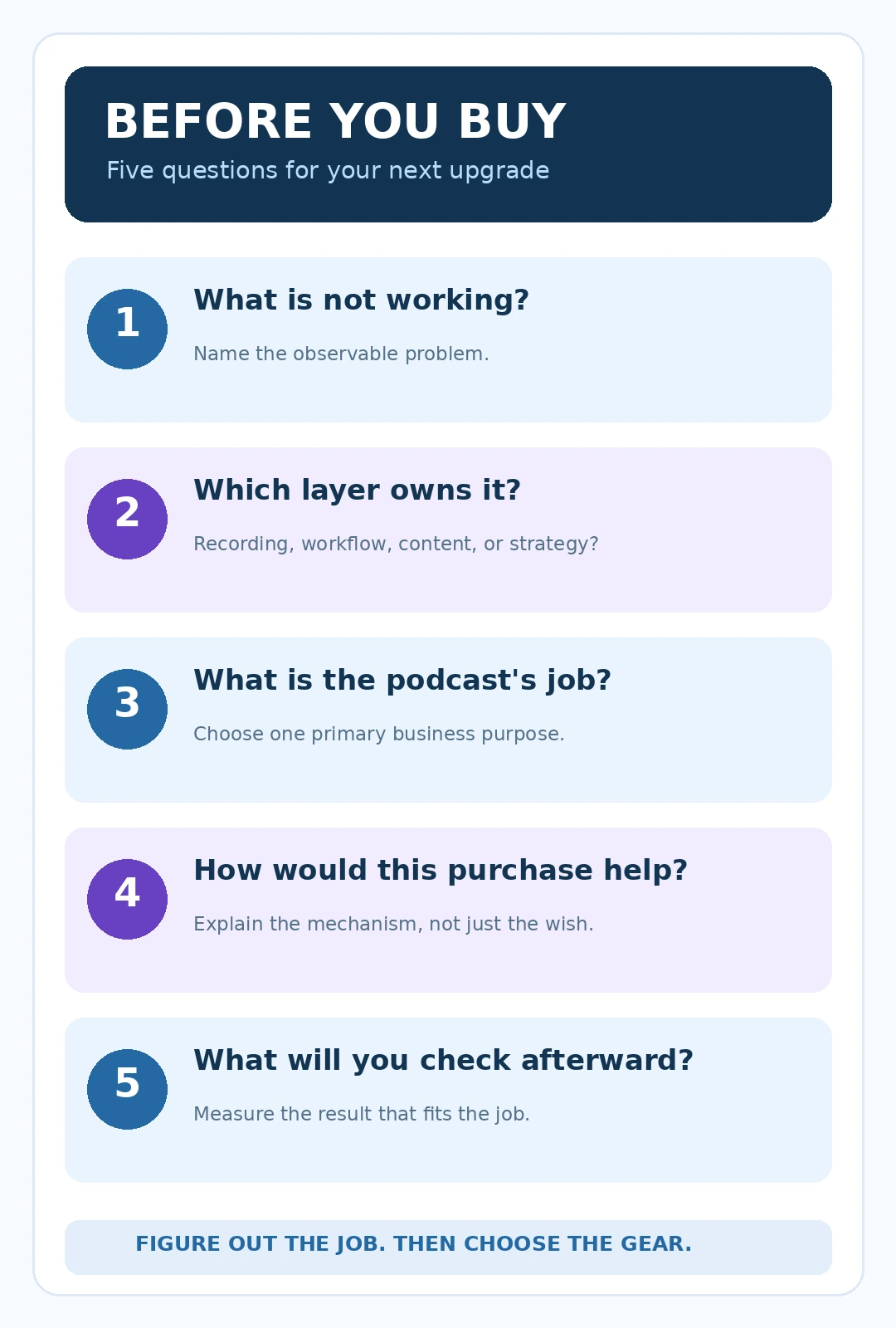
Run this five-question test before you buy
Write down short answers before opening another gear tab.
- What specifically is not working? Name the observable problem: distracting audio, lost recording time, weak qualified inquiries, or unclear listener action. “The show needs to look more professional” may be a useful concern, but make it concrete.
- Which layer owns the problem? Is it recording quality, workflow, content, positioning, audience movement, offer fit, or measurement? Identify the layer before choosing the tool.
- What job should the podcast perform? State one primary job for now. For example: “Help prospective clients understand our approach and move qualified people toward an inquiry.”
- How would this purchase help that job? Specify the mechanism. A second camera might make demonstrations clearer or provide better footage for a planned video channel. It might also add editing hours without improving what a prospective client learns.
- What will you check afterward? For a workflow upgrade, track time, failure points, or output consistency. For a business goal, track an action that fits the job, such as relevant signups or inquiries, while recording what you can and cannot attribute to the podcast.
Consider a show whose job is to educate prospective clients. If poor sound causes people to abandon the explanation, improving the recording may directly support that job. If the sound is fine but episodes never answer the clients’ actual questions or offer a relevant next step, gear is lower on the list.
Let the metric follow the job
Downloads, subscribers, and views can tell you about reach and distribution. They do not automatically prove that the show is accomplishing its business purpose. If the job is owned-audience growth, a relevant signup matters. If it is generating qualified inquiries, the quality and source of those inquiries matter. If it supports an event or service, you may need to look at both direct actions and credible assisted influence.
Start with a small set of measures you can actually collect. Do not claim a sale came from the podcast solely because the buyer once listened. For a deeper measurement model, read Podcast ROI Beyond CPM: How to Measure the Business Value of Your Show.
When the answer really is “buy the camera”
Buy the better camera, microphone, light, or software when you can name the production constraint, explain how the upgrade supports the show’s job, assign ownership for the added work, and judge whether the result was worth the time and cost. You do not need to delay a justified fix while you perfect a business plan.
If your recording already works and the question is how the show fits your larger business, start with the job, listener, content, next step, and evidence. Then choose the production that supports those decisions.
If those pieces are disconnected, the Complete Podcast Business System helps you build the strategy behind the podcast and turn it into a repeatable production process. Figure out the job first. Then build the production that helps it do that job.