LISTEN TO THE EPISODE
Recording a solo podcast gets much harder when you think you need to sit down and comfortably fill 30 or 45 minutes by yourself.
You don’t.
A better way to build your solo-hosting ability is to treat recording like practice. Start with one short, clean rep. Then gradually increase the amount of structure, explanation, and depth you’re asking yourself to handle.
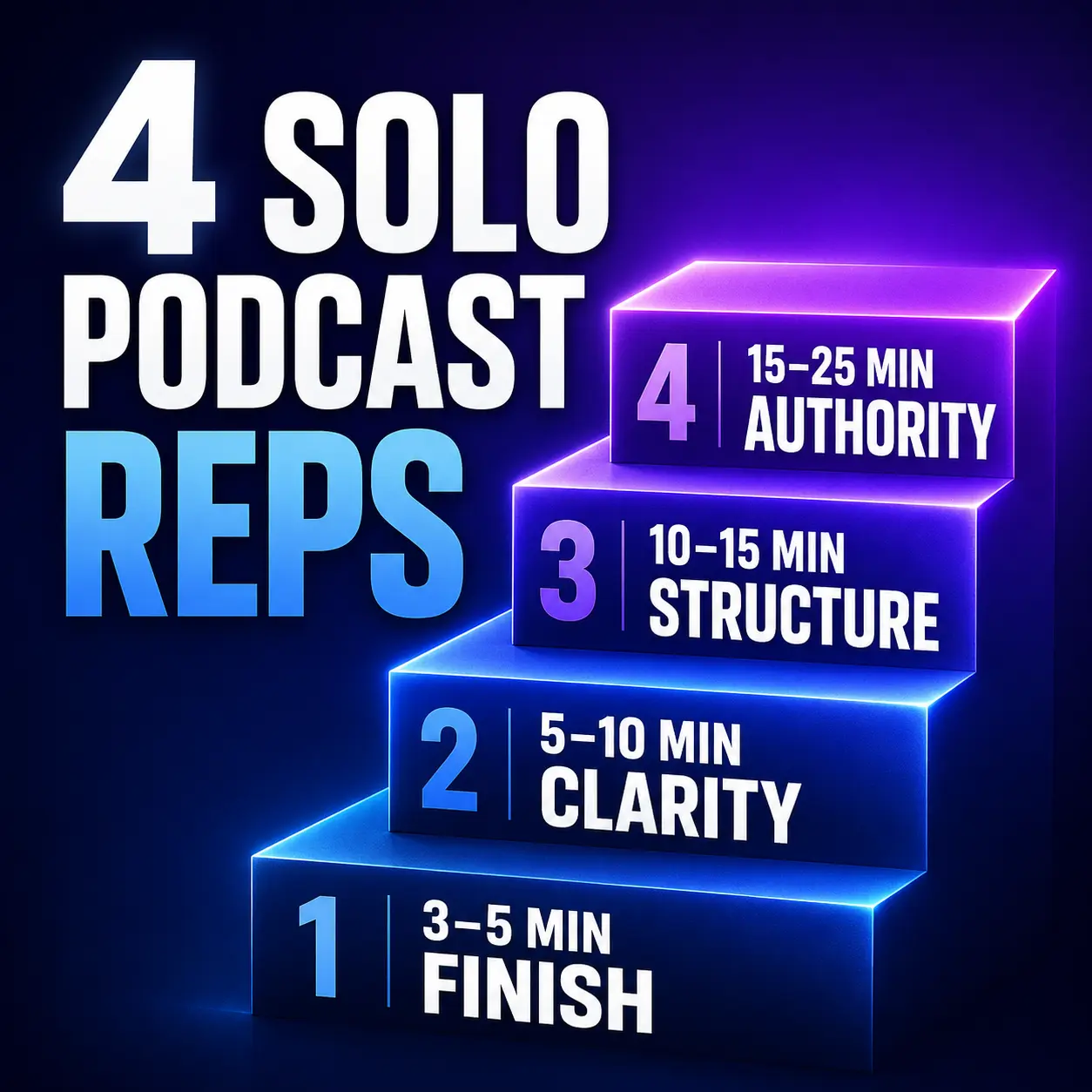
In this episode, I break solo podcasting into four practice levels—from a 3–5 minute idea to a 15–25 minute authority episode—so you can work on the specific speaking skill you need next.
WHAT YOU’LL LEARN
- Why your first solo-recording goal should be finishing, not perfection
- How to use a 3–5 minute episode to practice completing one clear idea
- When to move into a 5–10 minute teaching episode
- How a 10–15 minute framework episode develops structure
- When a longer 15–25 minute solo episode actually needs the additional depth
- How speaking maps can help you sound prepared without reading a full script
CHAPTERS
00:00 — Start Here: Solo Episodes
01:26 — Level 1: The 3–5 Minute Idea
03:22 — Level 2: The 5–10 Minute Teaching Episode
05:10 — Level 3: The 10–15 Minute Framework
07:35 — Level 4: The 15–25 Minute Authority Episode
09:28 — Recap: Build Your Solo Episode Skills
10:26 — Use Solo Episodes to Find Your Voice
GO DEEPER
Episode length shouldn’t be an arbitrary number. The better question is what the episode needs enough time to accomplish.
Read: How Long Should a Solo Podcast Episode Be? Match the Length to the Job →
Stop Holding the Whole Episode in Your Head
If you know your subject but start rambling, freezing, or sounding stiff as soon as the microphone turns on, you probably don’t need a longer script.
You need a better speaking map.
The Topic Flow Drill: How to Eliminate Script Reliance and Speak with Natural Authority helps you organize your main point, supporting ideas, example, recap, and CTA so you can practice speaking through the episode instead of memorizing it.
It’s available free inside the Podcasting Pro Tips Vault.
RESOURCES MENTIONED
- The Topic Flow Drill: How to Eliminate Script Reliance and Speak with Natural Authority
- Why Start With Solo Podcast Episodes?
- Podcast Hook Arc
Your podcast should have a job.
Go beyond publishing episodes. The Podcast Business System + Production OS gives you the frameworks and workflow to connect your strategy, content, production, growth, conversion, and measurement.
EXPLORE THE PODCAST BUSINESS SYSTEM →The 4 Solo Podcast Reps That Build Your On-Mic Confidence
Start Here: Build Your Solo Podcast Skills
Short solo podcast episodes are useful because they remove pressure.
You don’t need to fill 45 minutes. You don’t need to cover every part of a topic. You don’t need to sound like you’re giving a speech, and you definitely don’t need to make 20 different points.
You need to make one useful point.
That’s much easier to practice.
When you’re starting a podcast, I recommend getting some experience recording solo episodes. You need to get your podcast legs.
Being on camera, speaking into a microphone, organizing your thoughts, and carrying an episode by yourself are all skills. Like any other skill, they get easier with practice.
I’ve experienced the same thing from the other side as a podcast guest. The first few times I went on other podcasts, I didn’t think I was great. But I survived. Then I did another one, and another one, and every time it got easier.
That’s how you should think about solo podcasting.
Your first goal shouldn’t be, “I need to record the perfect solo podcast episode.”
Your first goal should be to complete one clean solo rep.
Think about it like doing reps in the gym. A clean solo rep means you choose one point, speak through it clearly, and finish the recording without constantly restarting from the beginning.
You don’t have to start with the hardest version.
You can build this skill in levels.
For me, those levels look like this:
- 3–5 minutes: Practice finishing.
- 5–10 minutes: Practice clarity.
- 10–15 minutes: Practice structure.
- 15–25 minutes: Practice authority and depth.
Let’s go through each one.
Level 1: The 3–5 Minute Solo Podcast Idea Rep
The first level is a 3–5 minute idea rep.
This is a low-pressure solo podcast format. You’re not trying to produce a huge authority episode or explain everything you know about a subject.
You’re practicing speaking clearly about one small idea.
That idea might:
- Answer one question.
- Explain one mistake.
- Share one quick lesson.
- Give one useful tip.
- Offer one practical reminder.
That’s enough.
A short 3–5 minute solo podcast episode is useful because it helps you become comfortable speaking without a guest while keeping the production simple.
It can also become useful content beyond the podcast itself. A short teaching segment could become a YouTube video, a short-form clip, an email idea, a social post, or the starting point for a longer piece of content.
But the main goal here is practice.
You’re building the ability to choose a topic and speak about it naturally without needing every sentence written in front of you.
Practice Speaking Without Holding the Whole Episode in Your Head
One reason people freeze when recording solo podcasts is that they’re trying to hold too much information in their heads at once.
They’re thinking:
What am I going to say next?
Did I already explain that?
Am I talking too long?
Did I forget something?
Should I restart?
That’s a lot to manage while you’re also trying to sound natural on a microphone.
A speaking map can make this much easier.
Instead of scripting every sentence, give yourself a few points that tell you where you’re going.
You can practice this almost anywhere. Walk the dog and talk through one point. Practice in the car. Practice in the shower.
Maybe don’t start delivering a full podcast monologue on a crowded bus unless you’re comfortable with people wondering what’s happening.
The point is to practice speaking about one idea without reading.
Over time, you get better at talking for several minutes about a specific topic while staying focused.
A Simple Structure for a 3–5 Minute Solo Episode
Here’s a simple speaking structure:
Hook the problem → Make the point → Give an example → End with the takeaway
That’s it.
For example:
If you freeze when recording solo, the problem probably isn’t that you don’t know enough. The problem may be that you’re trying to hold the entire episode in your head. Use a speaking map instead of a full script.
That’s a complete little teaching idea.
You identified a problem, explained the point, gave the listener a solution, and landed the takeaway.
You don’t need another 25 minutes just because you’re recording a podcast.
If the idea is complete in four minutes, you can stop.
Level 2: The 5–10 Minute Solo Teaching Episode
Once you can comfortably complete a short idea rep, move to level two: the 5–10 minute teaching episode.
The 3–5 minute episode is centered around one small point.
The 5–10 minute solo podcast gives you more room to actually teach the idea without turning it into a large episode.
Ten minutes is plenty of time to explain one useful concept.
You can:
- Introduce the problem.
- Explain the main idea.
- Teach a simple framework.
- Give an example.
- Leave the listener with a next step.
This is a useful format for business podcasts, educational podcasts, coaching podcasts, and other authority-building shows because you can answer a real audience question without overproducing the episode.
What Works Well in a 5–10 Minute Podcast Episode?
Use this length when you want to:
- Teach one clear lesson.
- Answer a common audience question.
- Explain a simple framework.
- Break down a mistake.
- Share a practical process.
- Solve one specific problem.
Here’s a simple structure:
Hook the listener → Name the problem → Teach the main idea → Give an example → Tell the listener what to do next
If you can spend roughly two minutes on each part, you already have a useful 10-minute episode.
You don’t need a giant script.
You need enough structure to know where you’re going.
That’s the main skill you’re practicing at level two: clarity.
Can you take something you understand and explain it in a simple way that another person can follow?
That’s a valuable podcasting skill.
Level 3: The 10–15 Minute Framework Episode
Level three is the 10–15 minute framework episode.
This format makes sense when you’re teaching something that needs more context.
Maybe you’re explaining:
- A process.
- A system.
- A method.
- A checklist.
- A framework.
- A way to solve a problem.
- A specific point of view.
Now you’re doing more than sharing a quick tip.
You’re showing the listener how something works.
That’s one reason framework episodes can be strong authority builders. They don’t just show that you know the subject. They show people how you think about the subject.
Over time, those episodes can also create a useful library of ideas, methods, and intellectual property around your podcast.
Teach One Method, Not Everything You Know
A framework episode is not an excuse to dump your entire brain into the microphone.
Keep it focused.
If you’re teaching a checklist, walk through the checklist.
If you’re explaining a method, explain the method.
If you’re showing how you solve one particular problem, stay with that problem.
You can always make another episode.
For example, this episode is solving a specific problem: How do you get better at recording solo podcast episodes?
I’m not trying to explain every part of solo podcasting.
I’m giving you a progression:
Start with a 3–5 minute idea.
Then move to a 5–10 minute teaching episode.
Then practice a 10–15 minute framework episode.
Eventually, work into a 15–25 minute authority episode when the topic deserves more depth.
That’s the framework.
A Structure for a 10–15 Minute Framework Episode
You could structure this type of episode like this:
- Open with the problem.
- Explain why the usual approach isn’t working.
- Introduce the framework or method.
- Walk through the major steps.
- Give an example.
- Recap the framework.
- Point the listener toward the next step.
The goal at this level is structure.
Can you guide somebody from the beginning of an idea to the end without losing the thread?
That’s different from simply being able to talk for 15 minutes.
Use a Speaking Map Instead of a Full Podcast Script
This is also where a tool like the Topic Flow Drill can help.
The idea is to give yourself a speaking map rather than writing every sentence.
For example, your map might contain:
- Your main point.
- Three supporting points.
- A story or example.
- A recap.
- Your call to action.
Now you have somewhere to go.
You can look at one point and practice talking naturally about it instead of trying to memorize a paragraph.
That’s an important distinction.
Structure is not the same thing as scripting.
A script determines most or all of your wording in advance.
A speaking map determines where you’re going.
For a lot of solo hosts, that middle ground is where the recording starts to feel much more natural.
Level 4: The 15–25 Minute Solo Authority Episode
The fourth level is the 15–25 minute authority episode.
A longer solo podcast works best when the topic actually needs more depth.
You may need additional time because you’re teaching a deeper framework, explaining a case study, walking through a complete process, giving several examples, or sharing a stronger point of view.
The additional length should come from useful depth.
Not just more talking.
That’s the difference.
Don’t Make an Episode Long Just Because You Can
I’ve seen solo podcast episodes go 45 minutes or an hour when the core idea probably could have been explained much more clearly in 15 or 20 minutes.
I’m not saying a 60-minute solo episode can never work.
If you have a strong following, the subject deserves the time, and you’re giving the listener enough value and movement to stay with you, great.
But longer isn’t automatically better.
Sometimes you’re just rambling.
I’ve watched this happen with podcasts I’ve worked around, and I’ve done it myself. You get going, you keep talking, you find another side point, and suddenly something that could have been a focused 15-minute episode is much longer.
That’s where editing and structure matter.
I’ve also seen audience attention begin to drop as episodes get longer. The last figure I remember seeing put average attention somewhere around 37 minutes, and I’ve seen discussions that put meaningful drop-off even earlier, around 20 minutes.
The exact number isn’t the main point here.
The practical point is that you have to earn the additional time.
If you can deliver a useful, focused 15–25 minute solo episode packed with real teaching, examples, and useful takeaways, that’s a strong format.
What Belongs in a 15–25 Minute Authority Episode?
This length works well when you want to:
- Teach a deeper framework.
- Share a developed point of view.
- Break down a case study.
- Walk through a complete process.
- Explain a complex problem.
- Use multiple stories or examples.
- Give the listener more context and interpretation.
You still need structure.
In fact, the longer the episode gets, the more important structure becomes.
Without it, a 25-minute solo episode can quickly become one long block of talking.
A stronger authority episode has movement. You introduce the problem, develop the idea, move through sections, use examples, reset the listener when necessary, and eventually land the point.
The goal at this level is authority.
Not authority because you talked longer.
Authority because you gave the listener a deeper understanding of the problem and showed them how you think.
The Four Solo Podcast Practice Levels
Here’s the progression again.
Level 1: 3–5 Minutes — Practice Finishing
Your goal is to complete a short solo recording without constantly restarting.
Choose one useful point.
Explain it.
Finish.
Level 2: 5–10 Minutes — Practice Clarity
Your goal is to explain one useful idea in a simple way.
Give the listener enough information to understand the point without turning it into a giant episode.
Level 3: 10–15 Minutes — Practice Structure
Your goal is to guide the listener through a process, method, checklist, or framework.
Learn how to organize multiple connected ideas without losing the main point.
Level 4: 15–25 Minutes — Practice Authority
Your goal is to go deeper when the topic deserves it.
Use stronger interpretation, examples, stories, processes, and point of view to help the listener understand something at a deeper level.
So the progression is:
Finish → Clarity → Structure → Authority
That’s a much better way to think about improving as a solo podcast host than simply asking, “How long should my podcast episode be?”
Solo Podcast Episodes Help You Find Your Voice
There’s another reason I like solo episodes for new and developing podcast hosts.
They let you test your show.
You can practice:
- Your opening line.
- Your episode promise.
- Your host introduction.
- Your episode introduction.
- Your transitions.
- Your segment structure.
- Your self-sponsored messages.
- Your outro.
- Your call to action.
- Your sign-off.
You get to hear what sounds natural and what sounds stiff.
You start noticing where you ramble.
You notice which transitions feel awkward.
You figure out which phrases actually sound like you.
You can experiment with a call to action and hear whether it feels natural before it becomes part of your normal episode format.
That’s how you develop a podcast voice.
It’s not something you figure out entirely on paper before recording your first episode.
You develop it by recording.
Stop Waiting to Feel Completely Comfortable
If solo podcasting feels awkward at first, that’s normal.
You’re learning how to carry an episode without another person in the room.
You’re learning microphone technique.
You’re learning pacing.
You’re learning how long you can stay on one idea.
You’re learning to recover when you stumble instead of restarting the entire recording.
You’re learning to look at a few points and speak naturally rather than reading paragraphs.
Those are all reps.
So don’t start with the hardest possible version.
Start with the version you can finish.
Record the three-minute idea.
Then record another one.
Move into a short teaching episode.
Practice a framework.
Eventually, when you have something that genuinely needs more depth, record the longer authority episode.
That’s how you get your podcast legs.
And once you can carry a solo episode confidently, you’re not depending on a guest to make the show work. You can answer your audience’s questions, teach your ideas, build authority, and create useful episodes in your own voice.
Get the Topic Flow Drill
If the biggest problem you’re having with solo podcasting is getting away from a word-for-word script without rambling, use the Topic Flow Drill: How to Eliminate Script Reliance and Speak with Natural Authority.
It gives you a simple speaking structure so you can organize the episode, know where you’re going, and practice speaking through your ideas naturally.
You can get the Topic Flow Drill free inside the Podcasting Pro Tips Vault at:
PodcastingProTips.com/vault
