Your podcast episode title has a simple job: help the right person understand what the episode is about and give them a reason to choose it.
That sounds obvious. But a lot of podcast titles spend their best words on things a new listener doesn’t care about yet:
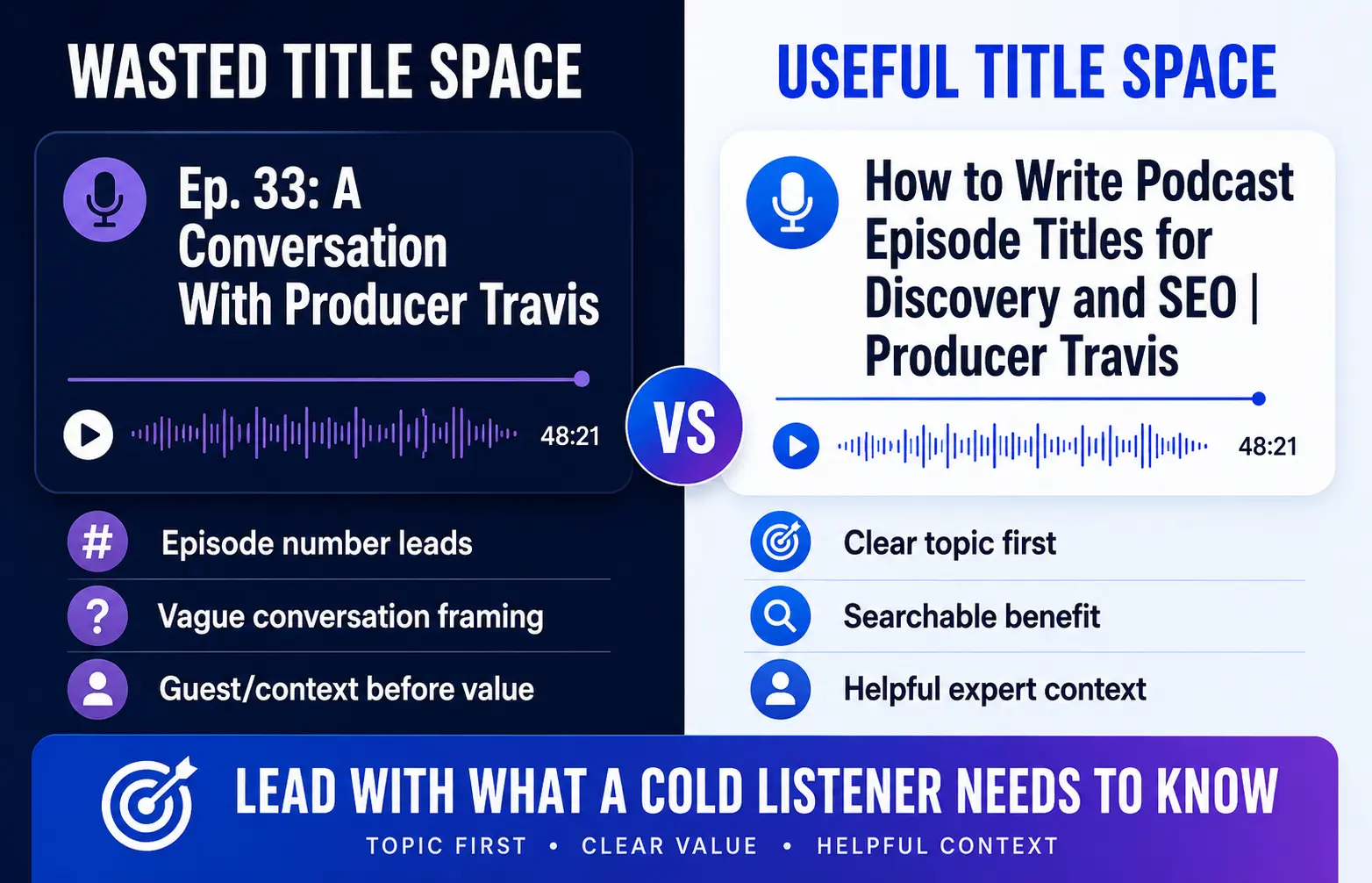
Episode 42: A Great Conversation With John Smith
The title tells me the episode number. It tells me somebody named John is involved.
It doesn’t tell me why I should listen.
A stronger podcast episode title normally leads with the problem, question, topic, promise, or useful angle of the episode.
For example:
Podcast Guest Prep: How to Get Better Answers Before You Record | John Smith
Now I know what the episode is about before I know the guest.
That’s the basic principle behind podcast episode title SEO. You’re not trying to trick an algorithm. You’re making the subject of the episode obvious to people and easier for discovery systems to understand.
Google’s guidance for web page titles follows the same general logic: titles should be clear, concise, unique, and accurately describe the content. Apple similarly recommends brief, focused episode titles and advises using the proper metadata fields for episode numbers rather than stuffing the number into the title.
The Podcast Episode Title Formula
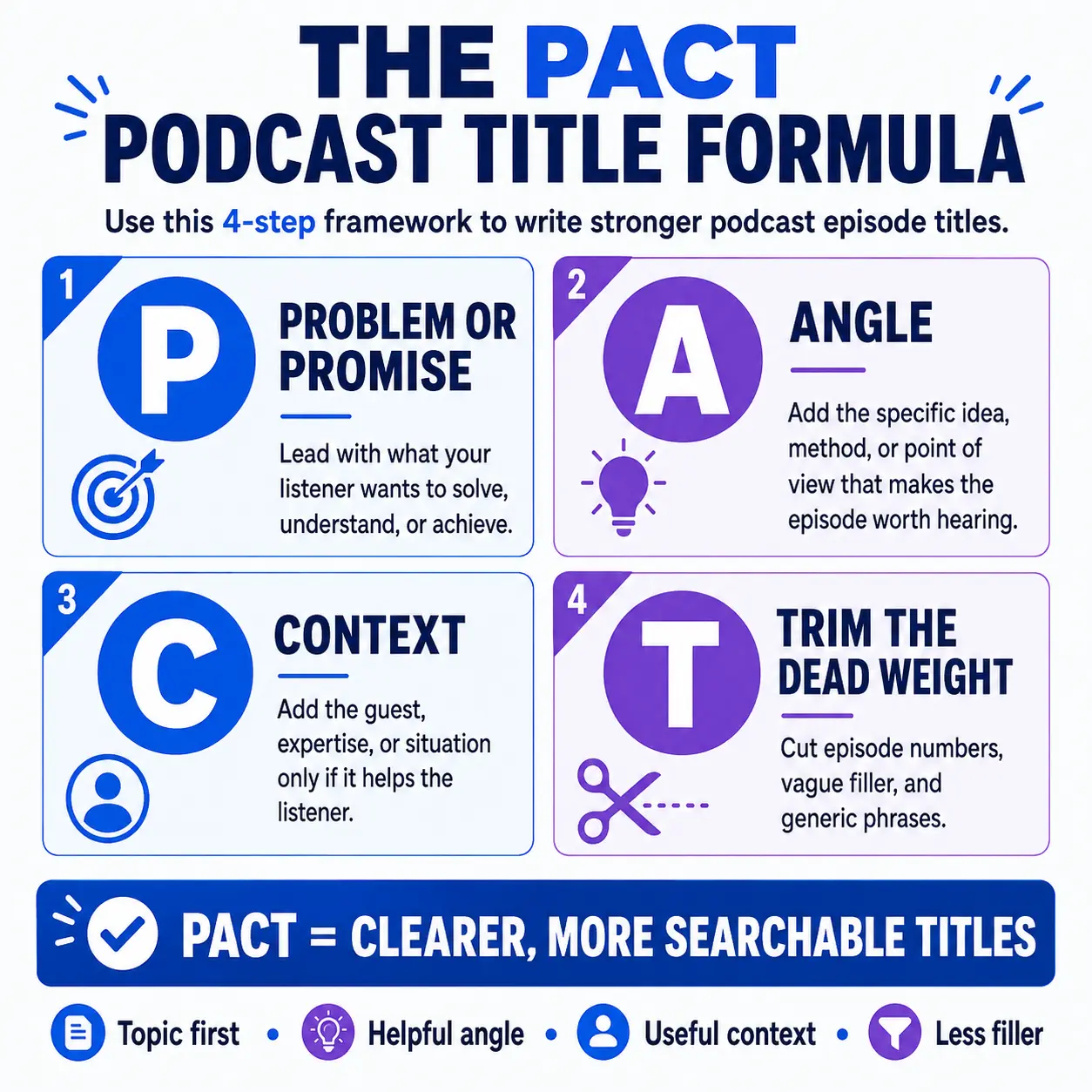
A useful starting formula is:
Searchable Problem or Promise + Specific Angle + Guest or Context if Useful
You won’t need every part every time.
The key is the order.
1. Lead With the Topic, Problem, or Promise
Put the part a new listener is most likely to recognize near the beginning.
Instead of:
Episode 31: Talking About Podcast Audio With Mike
Try:
Podcast Audio Levels: How Loud Should Your Podcast Be? | Mike
Instead of:
Episode 18: My Thoughts on Podcast Guests
Try:
How to Prepare a Podcast Guest Before You Record
Instead of:
Episode 74: An Interview With Sarah Brown
Try:
Why Your Podcast Content Strategy Stalls After 12 Months | Sarah Brown
You don’t have to force an exact keyword into the first three words of every title.
You do want the title to communicate its subject quickly.
That’s a much better standard.
Stop Making the Episode Number the Headline
Episode numbers can be useful for your internal organization, loyal listeners, serialized content, or particular show formats.
They usually don’t deserve the most valuable position in a standalone educational episode title.
Apple specifically recommends using its episode and season metadata fields instead of putting those numbers into the episode title.
That means this:
Episode 56: How to Improve Podcast Retention
can normally become:
How to Improve Podcast Retention Without Shortening Every Episode
The episode number hasn’t magically become illegal.
It just doesn’t need to be the first thing a cold listener sees.
Your Guest’s Name Doesn’t Automatically Deserve First Position
Interview podcasts run into the same problem.
Hosts often assume the guest’s name should lead because the guest is important to the episode.
But ask a different question:
Is that name important to the person deciding whether to listen?
If the guest already has strong recognition with your intended audience, absolutely use the name prominently.
If not, lead with why the conversation matters.
Weak:
John Smith on Building a Better Podcast
Stronger:
How to Turn Podcast Expertise Into Authority | John Smith
Or:
Why Most Podcast Advice Never Builds Authority | John Smith
The guest still gets credit.
The topic gets the first job.
This is especially important when your podcast is supposed to build your own authority rather than making every episode dependent on somebody else’s name.
Five Useful Podcast Episode Title Patterns
You don’t need one rigid title formula for every episode. Different episodes have different jobs.
Here are five patterns worth keeping in your production toolkit.
How-To Title
How to [Desired Outcome] Without [Common Problem]
Examples:
- How to Record Solo Podcast Episodes Without Reading a Script
- How to Improve Podcast Retention Without Overediting
- How to Prepare a Podcast Guest Without Writing 40 Questions
This works well when someone already understands what they want to accomplish.
Mistake Title
[Topic] Mistakes That [Consequence]
Examples:
- Podcast Intro Mistakes That Lose Attention Before the Episode Starts
- Podcast Show Notes Mistakes That Make Your Page Harder to Use
- Podcast Guest Prep Mistakes That Create Boring Interviews
Use this when the episode diagnoses something the listener may already be doing.
Question Title
[Question]? [Useful Angle or Answer]
Examples:
- How Long Should a Podcast Episode Be? What Actually Matters
- 4K vs. 1080p for Video Podcasts: Which Should You Record?
- What Does a Podcast Producer Actually Do?
Question titles work particularly well when the episode answers something people naturally ask.
Contrarian or Correction Title
Why [Common Tactic] Doesn’t Fix [Real Problem]
Examples:
- Why More Podcast Clips Won’t Fix a Weak Content Strategy
- Why Better Equipment Won’t Fix a Poorly Planned Podcast
- Why More Downloads Don’t Automatically Mean More Business Value
The important part is that the episode has to earn the claim.
Don’t manufacture controversy because the title looks good.
Guest Interview Title
[Problem, Promise, or Insight] | [Guest Name]
Examples:
- How to Build Authority Without Sounding Self-Promotional | Jane Smith
- What First-Time Podcast Sponsors Actually Look For | Mark Jones
- Why Experts Struggle With Solo Episodes | Sarah Brown
The guest adds context instead of consuming the entire title.
Write the Title Before You Record
One of the most useful title exercises happens before you turn on the microphone.
Try writing a working title during pre-production.
You don’t have to publish that exact version.
The exercise forces you to answer a more important question:
What is this episode actually about?
If you can’t write a reasonably clear working title, there’s a good chance the episode itself is still too broad.
Maybe you’re trying to teach five different ideas.
Maybe the interview doesn’t have a defined angle.
Maybe you know the guest but haven’t figured out why your audience should care.
Maybe the episode has a topic but no useful promise.
That’s why title writing belongs closer to podcast pre-production than most hosts realize.
A title is packaging, but good packaging starts with a clear product.
Use the Title and Show Notes Together
The episode title doesn’t need to carry every related term or explain the entire episode.
That’s what your episode page and show notes are for.
If your title is:
How to Improve Podcast Retention Without Shortening Every Episode
your show notes can naturally explain related ideas such as:
- first-minute retention;
- episode structure;
- midpoint resets;
- listener re-entry;
- pacing;
- pattern interrupts.
You don’t need:
How to Improve Podcast Retention, Audience Retention, Listener Retention, Podcast Engagement and Podcast Completion Rates
That’s not optimization.
That’s a grocery list.
Google explicitly recommends using words people would use to find your content in prominent locations while still creating helpful, people-first pages.
Your title establishes the main subject.
Your description, headings, show notes, transcript, internal links, and supporting content give that subject context.
Use Specific Chapter Titles for the Subtopics
A long episode may cover several useful questions that don’t belong in the main title.
That’s where chapters can help.
Instead of:
04:15 — More About Podcast Guests
write something useful:
04:15 — How Much Podcast Guest Research Is Enough?
Instead of:
12:10 — Audio Discussion
try:
12:10 — What LUFS Level Should a Spoken-Word Podcast Target?
Apple currently supports chapters supplied through episode descriptions, RSS chapter tags, and supported file metadata.
For a deeper breakdown, see how to use podcast chapters and timestamps.
The important distinction is that a chapter title is not a second main episode title. It’s navigation and additional context around a specific section.
Your Podcast App Title and YouTube Title Don’t Have to Be Identical
The underlying subject should stay consistent.
The packaging can change.
An audio podcast title may need to communicate the subject clearly inside an episode list.
A YouTube video has a title and a thumbnail working together, so you have another layer of packaging available.
For example, your audio episode might be:
Podcast Guest Prep: How to Get Better Answers Before Recording
Your YouTube title might become:
Your Podcast Guest Isn’t the Problem. Your Prep Is.
with thumbnail text:
DON’T WING THIS
Same episode.
Same promise.
Different discovery environment.
If you’re publishing video versions of your episodes, see the separate guide to YouTube podcast SEO, titles, and thumbnails.
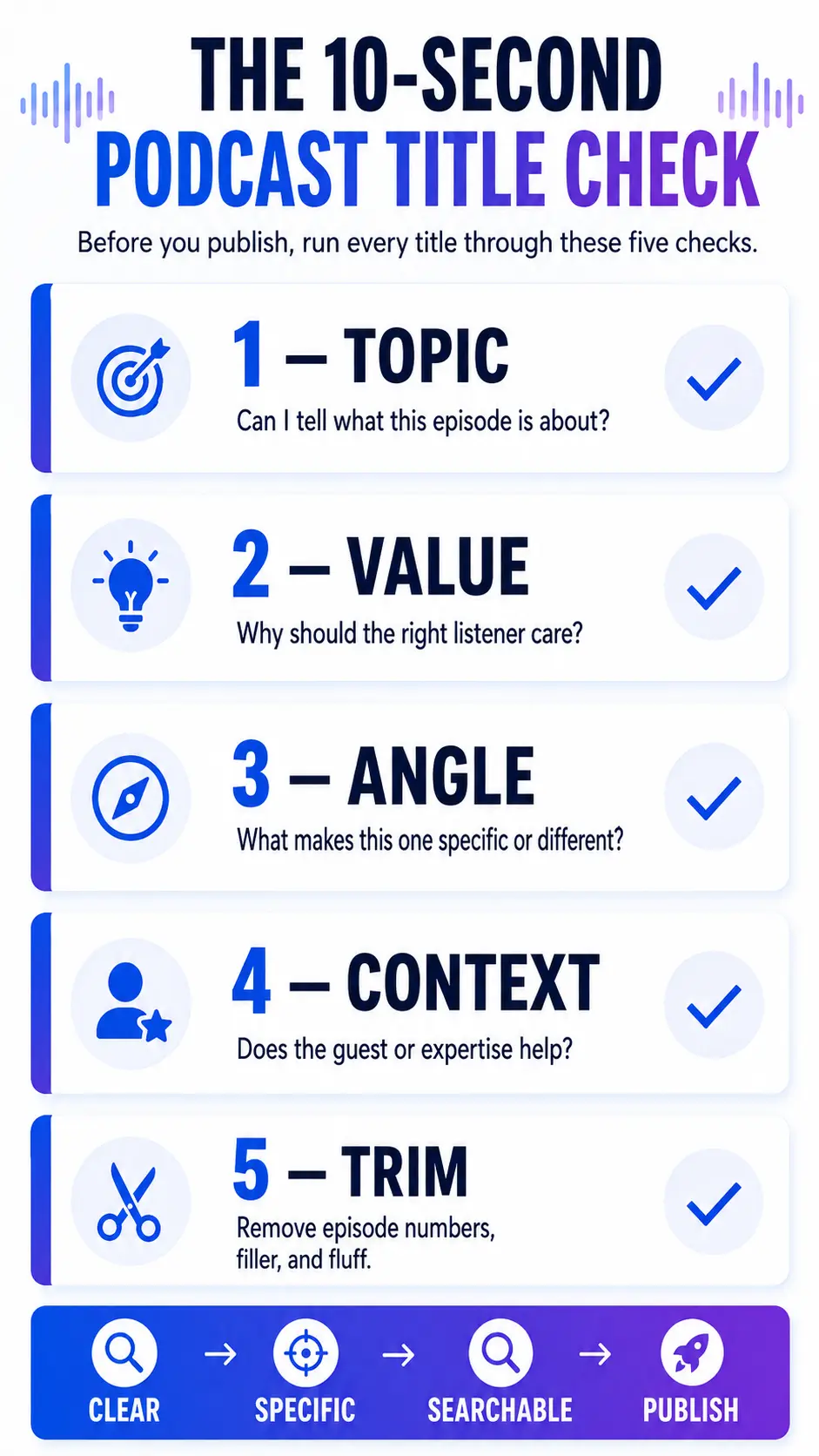
The 10-Second Podcast Title Test
Before you publish an episode, look at the title by itself and ask:
- Can I tell what the episode is about?
- Can the right person tell why they should care?
- Are the most useful words near the beginning?
- Does the title accurately represent what the episode delivers?
- Could I remove the episode number or generic filler without losing anything?
- Does the guest’s name actually add value to the title?
If the title passes those six questions, you’re probably in much better shape than if you spent twenty minutes trying to calculate the perfect keyword density.
Don’t Ask SEO to Rescue an Unclear Episode
Sometimes the title isn’t the real problem.
You keep rewriting it because the episode itself has no clear promise.
That’s an upstream problem.
Before recording, you should know:
- who the episode is for;
- what problem or question it addresses;
- what the listener should understand afterward;
- what specific angle makes this episode useful;
- what action should come next.
Once those decisions are clear, title writing gets a lot easier.
That’s also why strong episode planning and good SEO aren’t separate activities.
The episode creates the value.
The title makes that value easier to recognize.
Build the Rest of the Show Notes Around the Same Promise
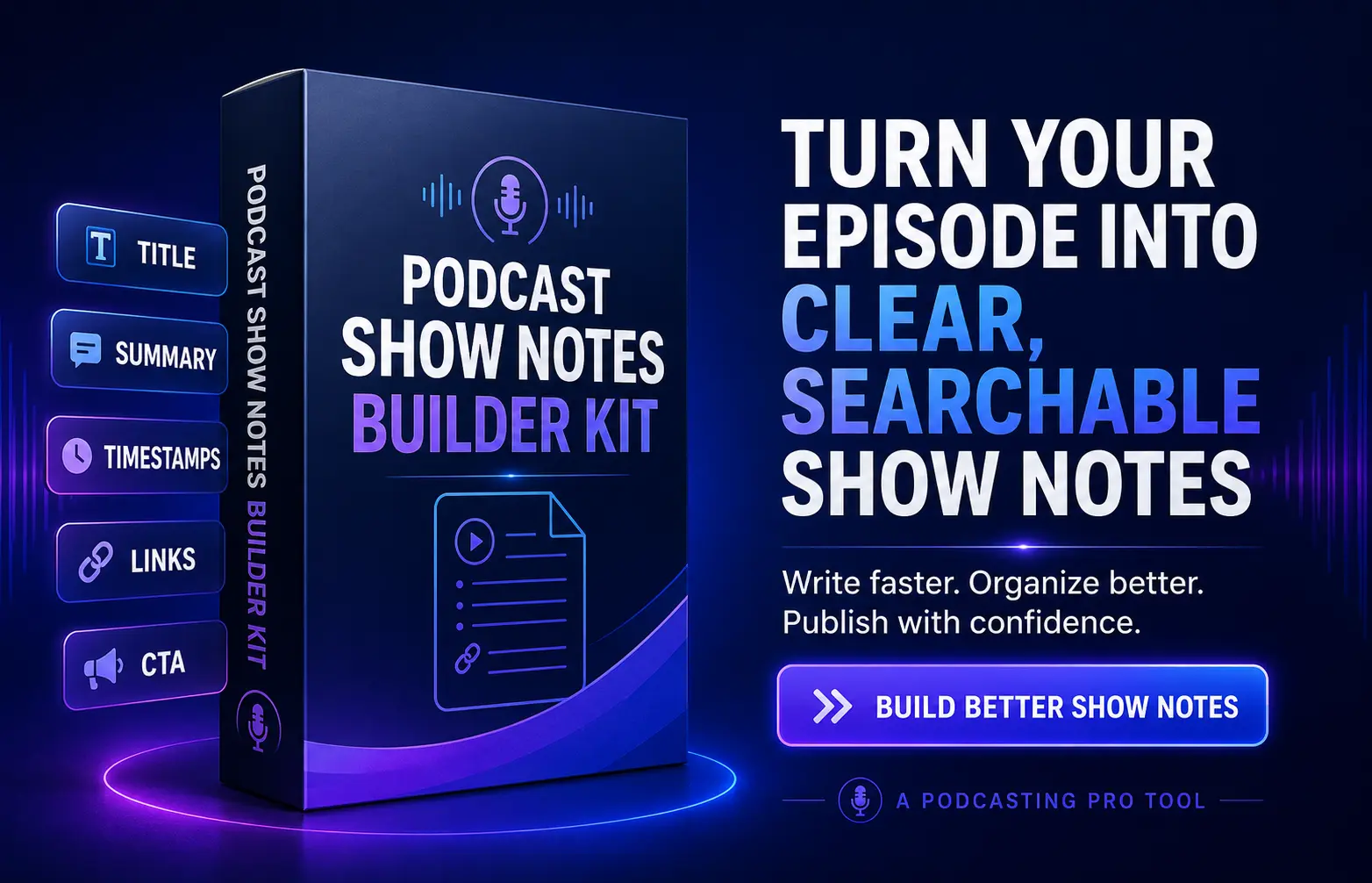
If you want a repeatable workflow for turning the episode into a clear title, front-loaded summary, useful timestamps, organized links, and one primary CTA, use the Podcast Show Notes Builder Kit.
It includes the SEO episode title workflow, show notes structures, timestamp planning, Q&A blocks, link cleanup, and a 10-minute builder so you’re not reinventing the publishing process after every recording.
Frequently Asked Questions
Should podcast episode titles include episode numbers?
Usually not in the main title unless the number has a useful editorial purpose. Apple recommends putting episode and season numbers into their dedicated metadata fields rather than the episode title.
Should I put my podcast guest’s name first?
Only when the guest’s name creates meaningful recognition for your intended audience. Otherwise, lead with the problem, promise, question, or useful insight and place the guest name later.
How long should a podcast episode title be?
There isn’t one universal character count that works across every app and device. Aim for a title that is brief enough to scan but specific enough to explain the episode. Front-loading the most useful information is more practical than chasing a magic number.
Should my podcast and YouTube titles be the same?
Not necessarily. Keep the underlying topic and promise consistent, but adapt the packaging to the discovery environment. YouTube gives the title and thumbnail complementary jobs, while an audio podcast listing relies much more heavily on the title itself.